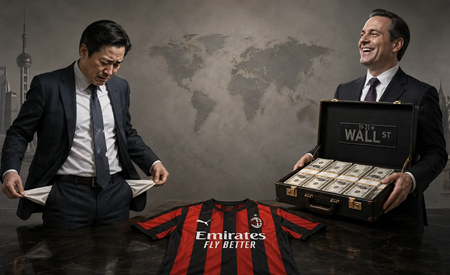
Football clubs trade at absurd multiples, private equity funds keep paying billions, even though the numbers don't add up. Here's what doesn't appear on the balance sheet.
Please the full article at this link
Anyone who knows me knows that although I was born in New York and am a big baseball fan (and a fan of other American sports that most Europeans can't understand how anyone watches with enthusiasm), I have a weakness that has nothing to do with any of that.
I'm a huge AC Milan fan. The one with the red and black shirt.
When I was young my parents moved to Milan and I grew up there. Like any kid who grows up in a city with a football club, I ended up supporting the local team (well, I could have ended up an Inter fan too, but thankfully I was spared that misfortune).
What most people don't know is that I became a Milan fan during one of the club's saddest moments. The club had just been relegated to Serie B after a scandal, then came back up, then went down again, this time on sporting merit alone.
Then in the mid-eighties, Silvio Berlusconi arrived. He hired Arrigo Sacchi as manager and quickly built one of the most extraordinary sides ever seen in European football. The Dutch trident was Gullit, Van Basten, and Rijkaard. Around them, some outstanding Italians ( where have all the talented Italian footballers gone?) like Baresi, Maldini, Ancelotti, and Donadoni. We won the European Cup in 1989 and 1990 playing wonderful football.
Unfortunately those days ended long ago, and Milan rarely even qualifies for the Champions League nowadays.
I mention all of this becauseMilan is, without having planned it that way, the perfect example of what has happened to European football in recent years.
For three decades, Silvio Berlusconi was the club's owner. Milan was his favorite toy, his visibility platform, his personal project. Football in that era was basically that: wealthy men with large egos and clubs as personal vanity projects for those who could afford them.
After Berlusconi came a Chinese owner, Li Yonghong, who arrived in 2017 with grand promises and without the money to keep them. What followed was a slow-motion disaster, and then private equity showed up.
Elliott Management(a US private equity fund with $80 billion under management) entered Milan involuntarily in 2017. Elliott had lent Li Yonghong €300 million at 11.5% interest, with the club's shares as collateral. In 2018, Li failed to pay the interest and Elliott enforced the guarantee. It ended up owning Milan without having sought it at all.
For four years, Elliott managed the club with typical private equity criteria. It raised capital,reduced the wages-to-revenue ratio from 108% to 64%, brought financial talent into management, and applied operational discipline. The club won a league title during Elliott's four years in charge, though it was certainly no golden era on the pitch. With the club cleaned up, Elliott sold Milan toRedBird Capital Partners, another US private equity fund, for€1.2 billion.
Elliott's return was 1.9x invested capital, with an estimated IRR of around 12% annualized.Good, but not extraordinary by PE standards.
RedBird has more ambitious targets. Its stated goal is a2.5x return, meaning it would need to sell the club for around €3 billion (given how things are going, good luck with that…).
Part of the thesis is to build value in the player asset base: buying young talent at reasonable prices, developing it over two or three seasons, and selling it at a significant profit. It's essentiallyprivate equity applied to people. Identify undervalued assets, develop them, and realize the investment. So far the club has managed several years of net profit using this formula, though on the sporting side it's been a non-event. Last season they finished 8th in the league, this year 5th, and it's not as though the Italian league is particularly competitive these days.
Milan is not an isolated case.European football has shifted from being the favorite hobby of billionaires like Berlusconi, Russian oligarchs, or Middle Eastern emirs, to becoming a fully-fledged asset classwhere private equity funds with billions under management invest with structured theses, and where some clubs trade on stock exchanges with annual reports and presentations to institutional investors.
It's an enormous change. To understand whether it makes financial sense, it's worth looking at the numbers coldly.
The numbers of listed clubs
I compiled the numbers for five European football clubs listed on stock exchanges, with enough history to identify a trend: Manchester United (NYSE), Borussia Dortmund (Frankfurt), Juventus (Euronext Milan), Ajax (Euronext Amsterdam), and Celtic (London AIM). Ten years of revenues, EBITDA, and net profit for each.

The summary is not flattering.
Of the five,only Celtic closed the 2025 financial year with positive net profit (€39.5 million). Manchester United lost €38.5 million. Juventus lost €58 million. Ajax lost €37 million. Borussia Dortmund broke even.
EBITDA is the metric that treats them most kindly, but of course EBITDA doesn't account for investment spending (player acquisitions and stadium investments worth hundreds of millions per year). Manchester generated €216 million in 2025, Dortmund €112 million, Juventus €85 million, and Celtic €33 million. Ajax was the only club with negative EBITDA (−€16.9 million).
What is most striking, given these dismal figures, are the market multiples.Manchester United trades at 5x EV/revenue, more than double what any comparable industrial company would fetch.Juventus trades at 2.4x despite nine consecutive years of losses. Celtic trades at 28x EV/EBITDA.The exception within the group is Borussia Dortmund, which trades at just 0.68x EV/revenue.
Beyond these five, there are other listed clubs in Europe: Roma and Lazio in Milan, Sporting CP, Benfica, and Porto on Euronext Lisbon, and Galatasaray, Fenerbahçe, Trabzonspor, and Beşiktaş on the Istanbul Stock Exchange. I haven't analyzed them with the same rigor, but in general they trade at unreasonable multiples given that most are loss-making in most years.

Beyond Milan, private equity has been betting heavily on European football for years, with different models, different theses, and very different outcomes.
The story of Inter Milan, curiously, closely mirrors the Milan case. The Chinese group Suning Holdings bought 70% of the club in 2016 at a valuation of roughly €400 million. In 2021, with Suning facing financial difficulties in its retail business in China, the group took a loan of€395 million fromOaktree Capital Managementusing its stake in Inter as collateral, at an interest rate of 12%. In May 2024, Suning was unable to repay the principal plus accrued interest and Oaktree enforced the guarantee, becoming majority owner without having sought it. A déjà vu of what happened with Milan.
Oaktree is a fund specializing in alternative credit withmore than $190 billion under management. It is not a classic private equity fund, and it didn't enter Inter to stay. It entered to recover its investment with a return. The club is not yet for sale, because the fund wants to first complete the new stadium (jointly with AC Milan) to maximize the exit price. Its target is to sell forno less than €2 billion.
Clearlake Capitalbought 61.5% of Chelsea in 2022 alongside Todd Boehly for£2.5 billion. In the 2024-25 financial year, Chelsea reportedlosses of £256 million. The club's net liabilities exceed £1.38 billion, and in accounting terms the club is technically insolvent, sustained solely by the explicit support of the parent entity. The strategy was to accumulate a large number of young players on the assumption they would appreciate in value, a thesis the market has so far not validated.
Silver Lakeinvested $500 million in 2019 in City Football Group, the holding company that owns Manchester City and twelve other clubs across four continents, valuing CFG at$4.8 billion post-money. Silver Lake has since increased its stake to approximately 17%. PE funds typically seek exits after around five years, so we may not be far from seeing a sale.
Arctos Partnerstook a minority stake in Atalanta (the club from the Italian city of Bergamo) in 2022, alongside the consortium led by Stephen Pagliuca, which acquired 47% of the club. In 2024, Atalanta won the Europa League, which has significantly increased the value of the asset.
Arctos has also recently entered PSG, acquiring a12.5% stake. PSG was 100% owned by QSI (Qatar Sports Investments), and this is the first time the Qatari fund has opened its capital to an outside investor.
Apollo Global Management, with$908 billion under management, announced in November 2025 the acquisition of 55% of Atlético de Madrid at a valuation of€2.5 billion, becoming the majority shareholder. The transaction closed in the first quarter of 2026 with an additional capital injection of €100 million. Miguel Ángel Gil and Enrique Cerezo continue as CEO and president respectively.
The implied multiples in this deal are illustrative of everything this article is about. The club generated €425 million in revenue in its reference year, implyingan EV/revenue multiple of approximately 5.8x and an EV/EBITDA of between 20 and 22x. The club's net financial debt was around €509 million. In other words,Apollo paid more than 5x revenue for a club carrying net debt equivalent to 120% of its revenues.
Part of Apollo's plan includes the development of a Sports City adjacent to the Metropolitano stadium, which once again puts the real estate value surrounding the ground on the table. Apollo has also launcheda permanent capital vehicle of €5 billion dedicated to European sport.
The most curious case of all is Wrexham. Ryan Reynolds and Rob McElhenney bought the club in February 2021 for approximately£2 millionwhen it was playing in the fifth tier of English football. In December 2025, Apollo Sports Capital invested at a valuation of between£350 and £470 million. From £2 million to £350 million in four years.
There is also the route of buying commercial rights to leagues rather than clubs.CVC Capital Partnershas invested in the rights of LaLiga (€2.1 billion in 2021) and Ligue 1 (€1.5 billion in 2022). That's not the focus of this article, but it's worth noting that private equity's attraction to football extends well beyond buying teams

When we atBondo Advisorsanalyze an acquisition for a private equity fund, we think about concrete things.
Does the business have solid and growing EBITDA? Does the debt structure allow leveraged financing, with the business's own cash flow gradually paying down the loan over time? Is there room for operational improvement and a sale in a few years at an equal or better multiple than the entry price? Are there synergies with any of the fund's existing holdings that would justify paying a premium above standalone value?
Clubs generate little or no free cash flow, which means it's impossible to use leveraged debt in the classic sense, because the business simply doesn't generate enough cash to service it. There is no market of comparable buyers that would allow an obvious multiple arbitrage. Operational improvement is possible but limited. In fact, a large part of financial results is tied to sporting performance, which everyone knows is deeply unpredictable.
If someone tries to value a football club using a conventional Discounted Cash Flow model, they will find thatalmost none of them justify what the market pays for them. Indeed, clubs would probably be better suited to special situations funds (those that buy companies in bankruptcy or with serious financial problems) than to traditional private equity. So what are buyers seeing that doesn't show up in the DCF?
The answer is thatfootball clubs are not just companies. They have value attributes that traditional financial models capture poorly. Let me take them in turn.
Churn and retention.In football, the LTV (the lifetime value of the customer, meaning the fan) is essentially their entire life. In almost any other business, the customer has options. If a software product raises its price, the customer evaluates alternatives. If a brand loses relevance, the consumer buys another. In football, the relationship is different. A Liverpool fan doesn't switch to Manchester City because City wins more Champions Leagues. An Atlético fan doesn't become a Real Madrid fan because Madrid wins more league titles. That loyalty is not rational in product terms; it is emotional, identity-based, inherited.The emotional churn rate of football clubs is close to zero.The customer doesn't just buy. They belong.
Transgenerational brand equity.There are very powerful brands in the world: Apple, Ferrari, Nike, Disney. But few have the ability to pass from parents to children with the intensity of a football club. Fandom is not acquired through advertising; it is lived within families, associated with childhood memories, tied to a city and a shared identity.A club can have bad seasons, terrible management, and mediocre results for years and still retain a completely loyal fan base(I still watch almost every Milan match on television after more than a decade of wretched seasons). Few businesses can perform so poorly for so long without losing demand in any meaningful way. It is brand equity that accumulates on its own, without significant marketing investment.
Pricing power in live content.Football remains one of the few content formats that cannot be time-shifted without losing all its meaning. This is hugely valuable in the age of streaming platforms, YouTube, and Reels. It is commented on live, bet on live, shared live, monetized live. That creates exceptional pricing power relative to broadcasters, streaming platforms, global brands, and sponsors.Simultaneous mass attention is an extraordinarily scarce asset in a fragmented digital entertainment world, and whoever holds it can charge for it on a recurring basis.
Structural scarcity and barriers to entry.You cannot create many AC Milans, Real Madrids, Barcelonas, or Manchester Uniteds. New clubs and new leagues can emerge. But assets with history, a city, a stadium, a global fan base, and cultural relevance are finite and extremely hard to replicate.This resembles the art market more than the traditional business market.There are not unlimited Picassos. When something is scarce, desired, and difficult to replicate, price is no longer determined solely by EBITDA.
Relational capital and access.Owning a recognized football club gives you access to other business people, politicians, celebrities, media, funds, and global brands. It makes you "the owner of," which is a social position that is hard to achieve by buying a more profitable industrial company. For an investor who has already made a great deal of money, financial return matters, but it is not the only variable.The relational capital generated by a football club doesn't appear on the balance sheet, but it is real and it has a price.
Platform optionality.A club can start as a local entity and hold the optionality of becoming a global platform. International broadcast rights, academies, merchandising, digital content, gaming, betting, documentaries, premium experiences, licensing. The team is the central asset, butmany layers of monetization can be built around it that simply didn't exist twenty years ago.The upside from that optionality is also poorly captured in a current EBITDA multiple.
Structural resilience to AI.There is a great deal of debate about what will happen when artificial intelligence and robotics take over a significant portion of the tasks humans perform today. More leisure time, transformed economies, human skills replaced across entire sectors. But who wants to watch a robot play football?
The chess case is instructive. Deep Blue beat Kasparov decades ago and computers have long played chess better than any human on the planet. Yet human chess tournaments continue to fill halls, generate audiences, and produce cultural heroes.
The logic in football is the same.What makes a match matter is not technical perfection. It is unpredictability, human error, the story behind each player, the rivalry between cities, the emotion of not knowing what will happen in the next ninety minutes.No algorithm can replicate that.
In a world with more leisure time and with machines doing many of the things humans do today,watching extraordinary people do extraordinary things could become even more valuable. Football could be one of the great beneficiaries of that world.
There are two additional value creation areas that are frequently underestimated.
Talent trading.RedBird has this firmly embedded in its investment thesis for Milan. A well-run club can buy or develop through its academy young talent at reasonable prices, develop it over two or three seasons, and sell it at a significant profit.The transfer balance can be as important as, or more important than, the operational margin of the business.Not all clubs do it well (it's certainly not easy), but those that do have a revenue stream that traditional valuation models don't capture correctly.
Adjacent real estate assets.Municipalities tend to be generous with football clubs when it comes to land and permits. Nobody wants their local team moving somewhere else. Around these spaces, some owners have developed hospitality, retail, dining, and enterta

cloud technology axon

Aurora Intelligent Nutrition has established itself as one of Europe's...