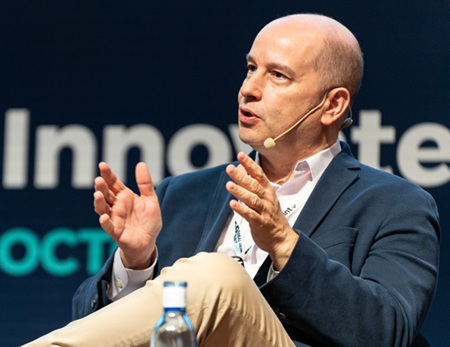
Agustín Vitórica, co-founder and Co-CEO of GAWA Capital, was recognized with the Ship2B Impact Award 2024 in the Impact Champion category for his key role in developing impact finance in Spain. For more than a decade, he has led a firm that has mobilized over €200 million toward projects that combine financial returns with social and environmental transformation.
But beyond the numbers, this award highlights his personal commitment to improving the lives of the most vulnerable, his innovative approach in launching the first blended finance vehicle in the country, and his contribution to strengthening the impact investment ecosystem.
In this interview, Fundación Ship2B speaks with him not only about his professional journey but also about the motivations, lessons, and values that have made him a true benchmark in the impact economy.
This award recognizes your career as one of the major drivers of impact finance in Spain. What does receiving this recognition mean to you personally?
I believe one of the fundamental characteristics of an impact investor is to work for the growth of the sector as a whole, beyond the interests of one’s own firm. Only through a collective effort can impact investment achieve the rigor, scale, and recognition it deserves. For this reason, being recognized as an Impact Champion fills me with immense joy and gratitude, as it means that, in some way, my efforts to promote and strengthen this ecosystem have borne fruit. Moreover, receiving this award from Ship2B is especially meaningful, as it is a pioneering organization that believed in impact from the beginning and has paved the way for many of us.
Your career shows a clear commitment to generating impact in vulnerable communities. Where does this social commitment come from? Was there a defining moment or experience?
I have always felt that vulnerable communities in developing countries face challenges that would be unimaginable even for disadvantaged populations here. My interest in providing our Latin American brothers and sisters with the same opportunities we enjoy has been present in my life since adolescence. However, the true turning point came after completing a stage at my previous job in a family office. It was then that the desire to give a deeper purpose to the investment skills I had acquired throughout my career ceased to be optional and became a vital necessity.
You say you are inspired by reconnecting with your roots in northern Spain. What role does that personal connection play in your vision of impact and purpose?
I grew up by the Cantabrian Sea, surrounded by the lush nature of Cantabria. Living in that environment, witnessing the beauty and untamable force of nature every day, makes you feel small and humble, reminding you that we are just a tiny part of a much greater project unfolding before us.
Impact investing came into my life as a true gift, the result of that greater project guiding our lives. Therefore, I do not see myself as a creator or founder of anything, but as an instrument serving the construction of something larger than myself. My experience is that this project aims at love, empathy, generosity, and focusing on improving the lives of people who have not had the same opportunities we have. Moreover, “letting go” in favor of that project brings peace and allows you to live with less obsession over control.
GAWA Capital has been key in developing the sector in Spain. What motivated you to found an investment firm with purpose when this concept was almost nonexistent in the country?
Before founding GAWA Capital, during my final stage in the family office, I observed how Dutch and Swiss impact funds were investing large sums in Latin America. This made me reflect on the role Spain should play in impact investing, given our deep ties with the peoples across the ocean. That conviction was shared by everyone who joined the project from its earliest steps. As I mentioned before, creating GAWA Capital was not really my doing—it was the result of the serendipity of meeting my partner Luca and the generosity of so many people who joined the project with nothing to gain but much to contribute, especially Eduardo Diez-Hochleitner, Antonio Garrigues Walker, Rafael Roldán, David Jiménez-Blanco, Santiago de Torres, Esther Giménez-Salinas, and Alfredo Soriano.
You have mobilized over €200 million toward impact investments. What lessons have you learned about balancing financial returns with social transformation?
We are now above €300 million and hope to reach over €400 million once our Kuali fund is fully raised. What I think is most important about that figure is that 80% comes from private investors.
To attract private investors, it is essential to offer competitive returns compared to non-impact funds. It is challenging to balance achieving those returns with generating high impact in vulnerable communities. This is especially true if the fund focuses on system-level changes affecting communities. In this approach, the benefit shifts from focusing solely on the fund’s shareholders to focusing on all system actors, with the community at the center, ensuring genuine system transformation. It is system change that allows impact to endure in the long term.
To make system-level change possible while delivering competitive financial returns, blended finance structures are necessary.
One of GAWA’s most innovative achievements has been launching the first blended finance vehicle in Spain. Why do you believe this model is key to scaling impact?
Blended finance aligns incentives and mobilizes private capital toward populations or regions where it would otherwise be difficult to invest. By including catalytic capital from public or philanthropic institutions, perceived risk is reduced, expected returns are increased, and a multiplier effect is generated.
In our case, blended finance funds demonstrated that this model is viable and can attract private investors at scale, directing their capital to complex contexts and channeling resources to small farmers and entrepreneurs who otherwise would not have accessed financing.
Perhaps the most important component of catalytic capital is technical assistance resources, which are grant-based. Technical assistance projects finance the transformation of system actors, involve them in the solution, facilitate adoption by communities, and give them a voice to verify whether the desired change is occurring. I am convinced that this model is essential to scale impact and close the financing gap faced by the most vulnerable communities.
Blended finance is further proof that grant resources can work alongside investment capital to reach more people and multiply impact.
What has surprised you the most—positively or negatively—during these years leading change from the financial sector?
What has surprised me most positively is the receptiveness of so many institutional and private investors, who have shown a genuine willingness to bet on impact. I perceive a profound cultural shift underway, where more and more capital seeks not only financial return but also a positive legacy.
On the less positive side, I believe the sector needs to free itself from non-catalytic public funding. Many impact funds are largely financed by non-catalytic public investors who take the role that should belong to private capital. As a result, they fail to mobilize almost any private capital, which is what we need to address humanity’s greatest challenges. Therefore, we need our funds to be primarily financed by private capital to build a consolidated and sustainable sector over time.
Beyond GAWA, you have also helped build Spain’s impact investment ecosystem. Where do you think we are, and what remains to consolidate it?
Spain has made extraordinary progress in a short time. We have gone from a country where impact investing was barely discussed to having multiple funds, platforms, foundations, and active networks in impact. However, three key aspects still need consolidation: greater mobilization of private capital to our funds, a clearer European regulatory framework defining and incentivizing these investments, and a true takeoff of impact investing toward foundations and other actors in the social economy. I believe the next decade will be decisive in making this leap, and we have a great opportunity to position Spain at the European forefront of impact.
If you could give advice to someone wanting to start a business or invest with impact, what would it be?
My advice would be to start with personal conviction. Impact is not just an investment strategy; it is a way of understanding the world and placing our capabilities at the service of something greater. For entrepreneurs, it is vital to surround themselves with a strong team that is ideally better than themselves, and allies who share that vision. For investors, the key is patience and understanding that system-focused impact investing takes time to generate lasting economic value for communities and competitive returns for investors.
Finally, what motivates you every day to keep pushing with purpose?
What motivates me most is knowing that behind every investment decision are real people whose lives can improve. When I think of farmers gaining access to financing and better inputs, families sending their children to school or increasing health spending due to higher incomes, or communities building resilience against climate change without having to abandon their homes, I find the energy to continue. I am also inspired by the commitment of my team and so many colleagues in the sector, who remind me that we are not alone: we are part of a global movement striving for a more just and sustainable future.

cloud technology axon

Aurora Intelligent Nutrition has established itself as one of Europe's...