The market has been consolidating for the past five years. Multiples have fallen, private equity has become more selective, and the list of what is considered valuable has changed completely.
There is one sector where M&A activity remains strong while its listed leaders are losing market share, cutting headcount, and facing margin compression. A sector in which large groups merge to gain scale, while the funds that entered four years ago are now looking for an exit. A sector where buyers are still buying — but no longer looking for the same things they once were.
That sector is advertising, media, and digital marketing agencies.
In Iberia alone, we have counted more than 170 majority transactions since 2021. Across Europe, dozens of deals continue to close every quarter. Activity has not stopped. What has changed is the logic behind each transaction: who is buying, at what price, and above all, what type of company they want to acquire
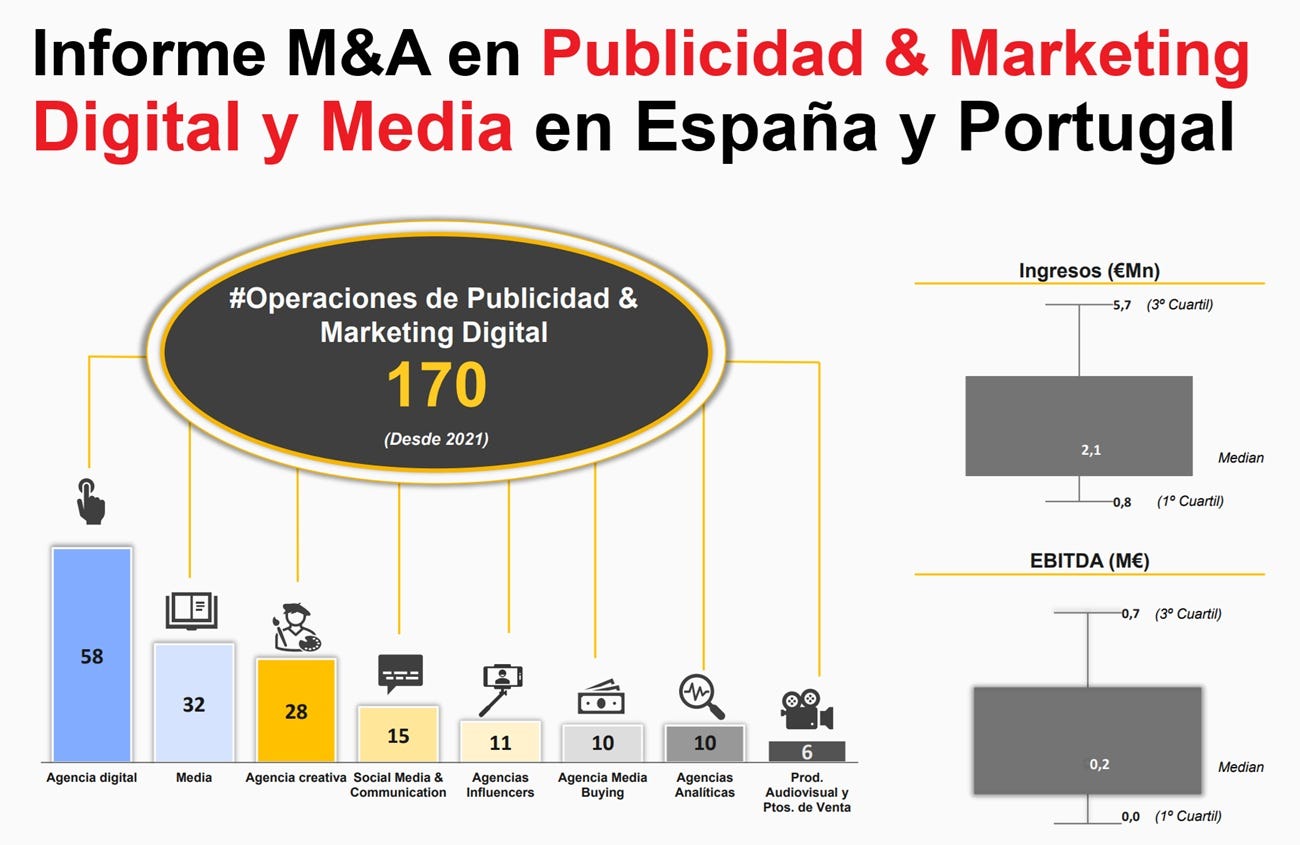
At Bondo Advisors we have just published a 31-page report on M&A in advertising, digital marketing, and media in Spain and Portugal. It includes the 170 transactions in Iberia since 2021, the most active buyers in the market, valuation multiples from recent deals, the evolution of 40 European listed companies in the sector, and a preview of transactions already completed in 2026.
You can download it here:Advertising, Marketing and Media Report
If you work in advertising, digital marketing, or media, I recommend reading it before continuing.
The peak of the European market was 2022. That year, 237 deals were completed and €11.684 billion in capital was deployed. It was the year when everything digital was highly valued, buyers competed for any agency with double-digit growth, and multiples reached historical highs.
Since then, normalization has been clear. In 2025, 169 transactions were completed in Europe. 54% were deals below €10 million. The median deal size, which reached €12.3 million in 2022, fell to €3.1 million in 2024. In 2025, it rebounded to €6.9 million, pointing to some recovery in the mid-market.
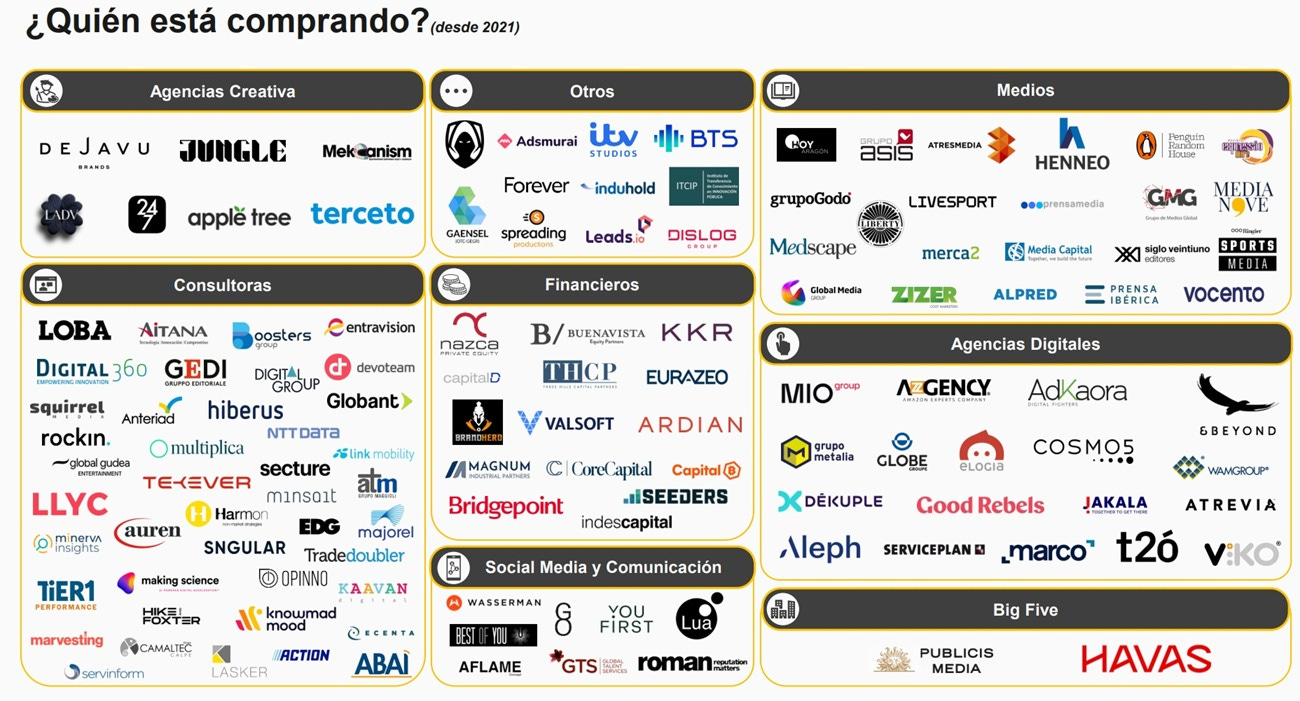
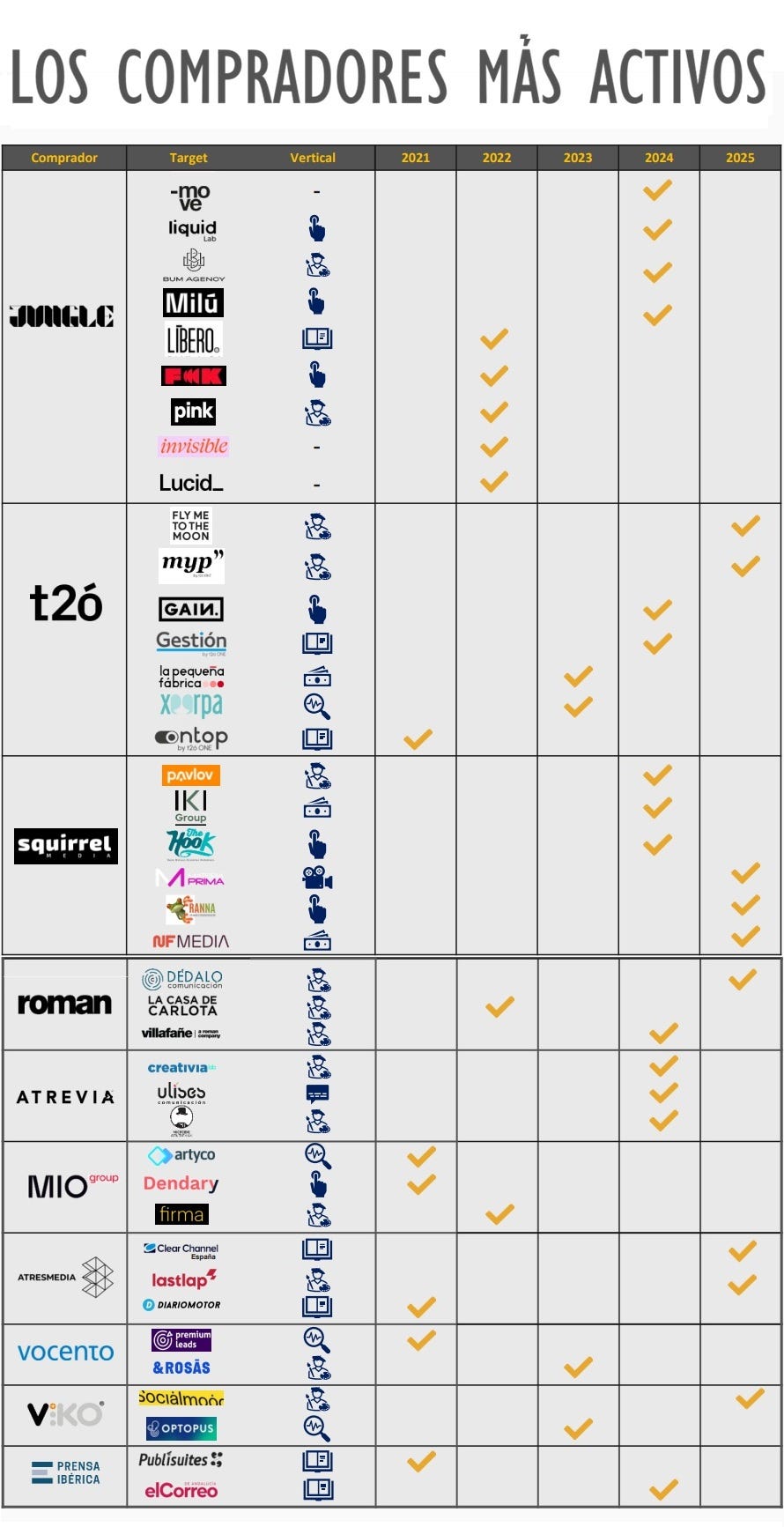
In Iberia, the pace has been more consistent. 170 majority transactions since 2021, led by digital, media, and creative agencies. Local buyers such as Vocento, Atresmedia, MIO Group, Jungle, Squirrel Media, and t2ó in the small and mid-sized segments; and international buyers such as Bridgepoint, Globant, and Eurazeo in larger transactions.
The market has not collapsed, but the 2021–2022 boom has definitely ended.
The best snapshot of the sector is not in press releases, but in the results of the major listed groups.
WPP is the most striking case. It closed 2025 with a 5.4% decline in like-for-like revenue, a 71% drop in profit, and thousands of jobs cut. The fourth quarter was worse than the third. For the first half of 2026, it is guiding for further declines. This is not a one-off setback.
Dentsu ended 2025 with just 0.5% growth. Havas performed better in 2025, with 3.1% organic growth, but this needs to be seen in context: it followed a very difficult prior year. A 3% rise off a low base is not exactly a sign of strength.
The exception is Publicis Groupe, which closed 2025 with 5.6% organic growth and an operating margin of 18.2%, along with €2 billion in free cash flow. In Q1 2026 it already reported 4.5% growth. The divergence with WPP is not random at all. Publicis has spent years investing in data, technology, and automation, and the market is drawing its own conclusions.
It is worth adding a scale-defining event for the current moment: the merger of Omnicom and Interpublic Group, completed in 2025, is the largest consolidation in the history of the agency sector. When major players combine to compete more effectively, it signals that something structural in the market has already changed.
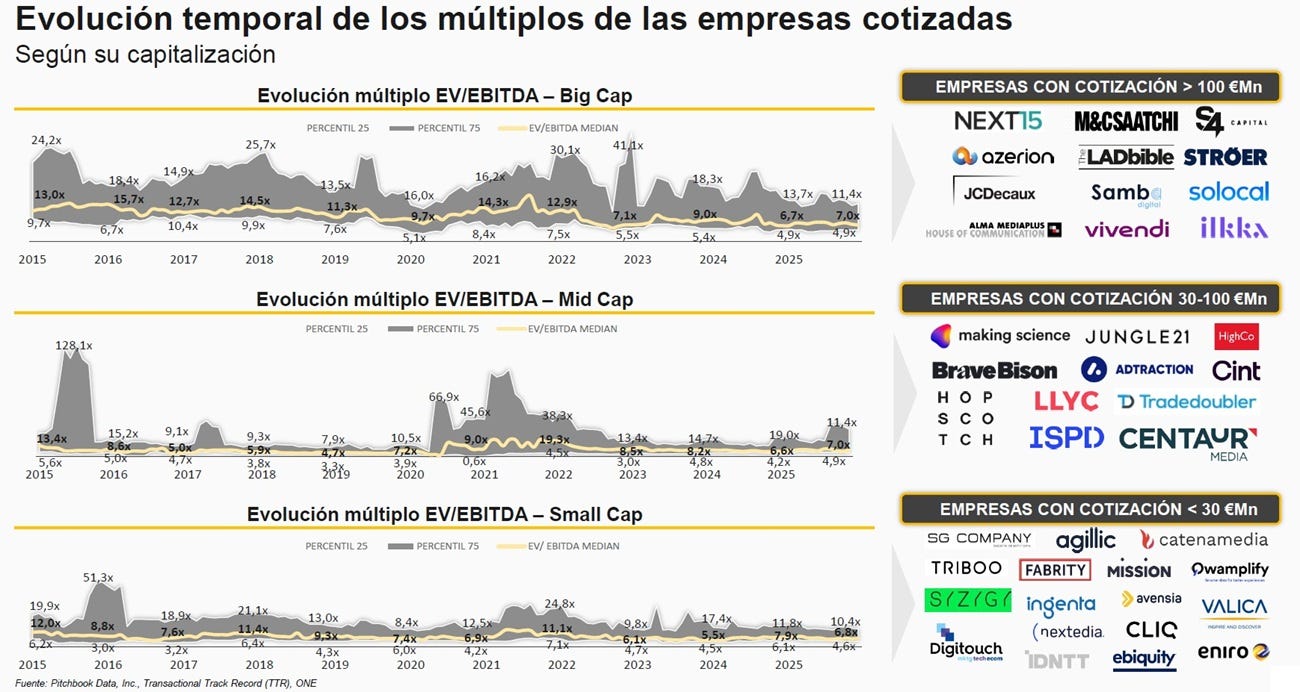
In valuation terms, our sample of 40 European listed companies in the sector is telling. Median EV/EBITDA has fallen from 12.8x in 2022 to 7.6x in 2025, back to pre-pandemic levels. The sector’s EBITDA margin has dropped to 6%, and 2025 revenue growth has been essentially flat at -0.1% YoY.
Most revealing is what has happened to the Big Five themselves. Historically, they traded at a clear premium to the rest of European peers, reflecting their global scale and recurring revenue strength. That premium has now completely disappeared. In 2025, the Big Five trade at 6.8x EV/EBITDA, while mid-sized European listed companies trade at 7.6x. The gap has almost fully vanished.
The listed market is no longer convinced that being large in this sector is necessarily an advantage.
There is a chapter of the local market that deserves its own note. In the years of euphoria, several groups in the sector chose to list on growth markets as a platform for consolidation. Mio Group went public on BME Growth in 2021, and Jungle did so on Euronext Growth in 2022. LLYC and Making Science had already followed that path since 2021 and 2020 respectively. Squirrel Media, a listed media and advertising group on BME, used that period to launch a very active acquisition strategy. ISPD, listed on Euronext Growth Paris and formerly operating under the name Antevenio (the company I co-founded and took public back in 2007), had taken that path even earlier.
The underlying idea in all cases was to raise capital, gain visibility, and from there go out and acquire. For a while, it seemed this could define how mid-sized groups in Spain were built.
In 2025, Mio Group and Jungle completed delisting processes and returned to private ownership. That said, delisting is not synonymous with stepping back. Jungle remains one of the most active buyers in the market.
Squirrel is arguably the most striking case of active consolidation from the stock market. More than ten acquisitions between 2022 and 2025, including IKI Group, NET TV, and Veralia, and in 2025 it doubled both revenue and profits.
LLYC and Making Science have opted to slow their acquisition pace and consolidate what they have already built. Redegal, incorporated into BME Growth in July 2025 after passing through the Scaleup segment, is the most recent entry into the listed segment of the sector.
Since 2022, the picture is clear: two companies have left the listed market, and only one has joined. Overall stock market performance has generally been modest. Only Squirrel and Jungle, albeit through different paths, maintain a clear acquisition appetite; the rest have slowed down and shifted focus toward consolidation.
Private equity has a significant presence in the Iberian sector, with several transactions already held for years and whose exits will be among the most interesting to watch in the coming period.
The most recent transaction in this cycle is the entry of Eurazeo, which took control of Exterior Plus in December 2025, replacing HIG Capital, which had been a shareholder since 2015. A decade-long investment that illustrates the real horizons such positions can have in the sector. Exterior Plus operates out-of-home advertising in Spain, a business with recurring revenues and a consolidated footprint, and has found in Eurazeo a top-tier buyer willing to back the asset in a period of some uncertainty.
Artá Capital holds a 25% stake in In Store Media since 2015 (already 11 years!), when it invested around €20 million, valuing the company at €125 million. In Store Media manages in-store advertising across more than 4,500 retail locations of chains such as El Corte Inglés, Walmart, and Carrefour, with presence in nine countries. A highly attractive asset in a niche that consistently draws buyer interest. How will it play out? It is reportedly back on the market after a first attempt in 2022.
Nazca Capital entered Soy Olivia Media Group in August 2022, one of Spain’s leading influencer marketing and talent representation agencies. Aurica Capital replaced Ardian in t2ó that same year, with an investment of around €17 million.
Aurica’s case is particularly interesting: rather than waiting for a passive exit, they have turned t2ó into an acquisition platform. The agency, rebranded as t2ó ONE, plans—according to its own statements—to invest between €25 and €50 million in new deals across Europe and the Americas. A consolidation model that turns the portfolio company itself into one of the most active buyers in the market.
What remains clear is that investor appetite in the sector has not disappeared. Bridgepoint acquired SAMY Alliance for €298 million in 2024, and Eurazeo has just entered Exterior Plus. Two recent, high-quality transactions from top-tier funds, demonstrating that when the asset is right, capital still moves.
The question that will be answered over the coming years is who will buy the remaining positions in portfolio companies: other private equity funds, or industrial and strategic buyers?
That said, there is now an inevitable question in every investment committee in the sector—one that was not part of the conversation three years ago: how much of this business will still be necessary when AI can do in hours what today requires a team weeks of work?
For a strategic buyer operating in the sector, the answer is part of daily operations. For a fund that needs to model a specific return over five years, it adds another variable to the equation.
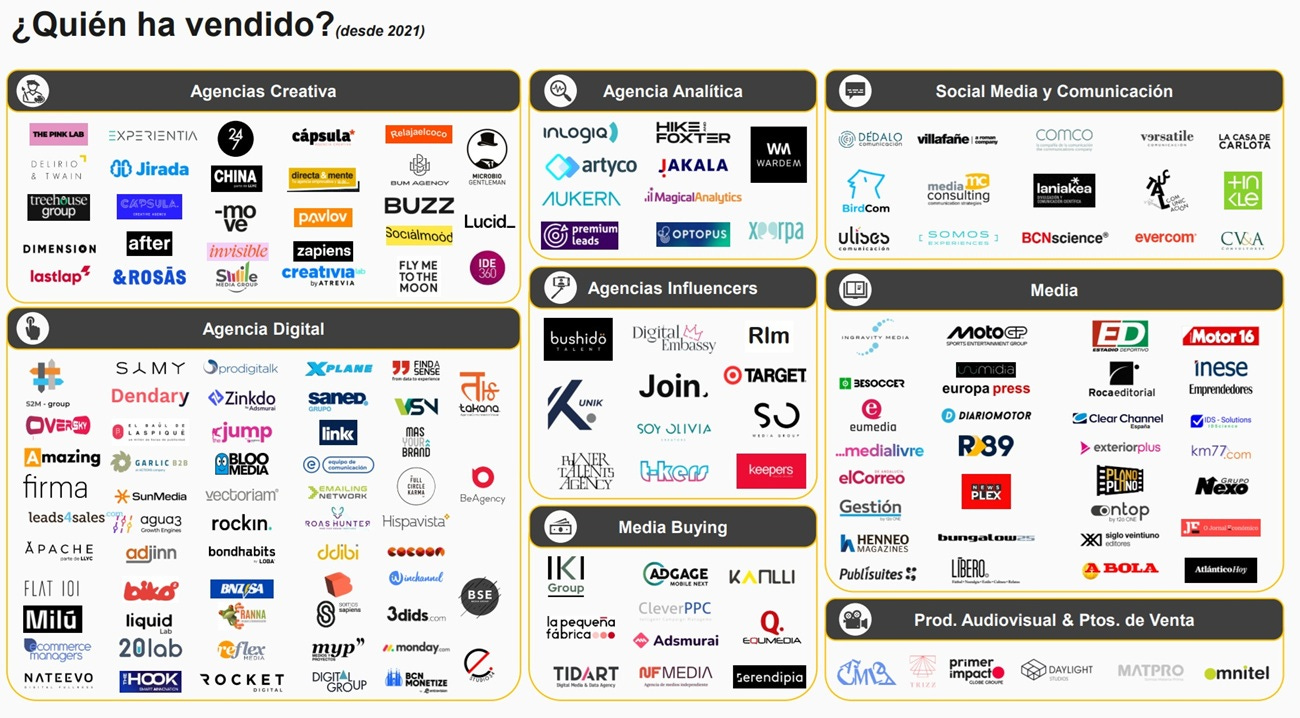
Until two or three years ago, the acquisition logic in agencies was fairly predictable. Any company with strong capabilities in digital media, performance, SEO, paid media, analytics, or e-commerce development was a natural candidate. Buyers wanted digital capabilities fast, and they paid for them.
That is still partly true: strong specialist boutiques (with some scale) remain attractive to industrial buyers. But among the most active acquirers in the market, a new obsession has emerged—one we at Bondo Advisors have been hearing for several months. They are looking to acquire what AI cannot easily replicate.
In practice, this translates into growing interest in specific verticals:
Events and physical activation. Everything that requires presence, real-world execution, and human coordination. AI does not organise a 500-person event or manage an in-store brand experience.
Point of sale and in-store execution. Work in large retail environments, direct trade relationships, and operational presence in stores. Models where the service is fundamentally physical.
Proprietary data and captive audiences. Companies that have access to data no one else has: owned databases, communities, identity-based audiences. This is more valuable than ever precisely because AI models depend on high-quality data, and generic data is no longer a competitive advantage.
PR, corporate communications, and public affairs. Institutional relations, access, reputation management. AI can draft a press release, but it cannot build trust with regulators or manage a reputational crisis with real judgment.
Crisis management. When things go wrong for an organisation, experience, judgment, and networks matter. Not an AI agent.
Audiovisual production with a distinctive identity. Not generic production, but creative capabilities with real audiences and loyalty.
Across all of this, one criterion is increasingly dominant in every acquisition process: recurring revenue. Buyers are paying premiums for monthly or annual fee-based models (ideally with multi-year contracts), and they are highly sceptical of purely project-based businesses. Predictability, in an uncertain environment like today’s, is extremely valuable.
Everything described in this article is backed by data we have compiled at Bondo Advisors over recent months. The report includes the full map of 170 Iberian transactions since 2021, detailing who sold, at what size, who bought, and at what multiples. It also covers the evolution of the European market year by year, recent transactions across Europe, and a full analysis of valuation multiples for 40 European listed companies in the sector, including the Big Five.
Download the report here:
https://bondoadvisors.com/informe-publicidad-marketing-digital-y-media/
https://bondoadvisors.com/
It’s 31 pages. Worth reading.
The sector is consolidating in a more rational way than three years ago.
For a founder thinking about selling their agency, the key point is this: the market is still active, but it no longer buys everything that grows or everything that is digital. Buyers now dig much deeper. They want to understand which parts of the business can withstand AI, whether revenues are predictable, and whether there is something that makes the company difficult to replace.
In 2022, many agencies received offers without even looking for them. In 2025, you need to be able to clearly explain why your company is one the market wants to buy.
That requires a deep understanding of the market—and also knowing who to call.
At Bondo Advisors, we have spent the last five years acting as a leading M&A advisor in advertising, digital marketing, and media in Spain. The 170 transactions in this report are not just statistics for us—we have been involved in many of them, on the side that matters most. If you are thinking about selling your agency, or buying one, it is a conversation worth having.
By Joshua Novick -Bondo Advisors

cloud technology axon

Addleshaw Goddard (AG), the London-headquartered international law fir...