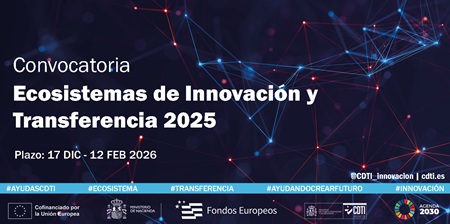
CDTI Innovación, the state innovation agency under the Ministry of Science, Innovation and Universities (MICIU), will open the application period for the 2025 Innovation and Transfer Ecosystems on December 17, 2025. This competitive grant call focuses on promoting more connected and efficient interregional innovation ecosystems and environments for knowledge transfer, dissemination, and valorization. This initiative aligns with the MICIU’s Complementary Knowledge Transfer Plan, designed to foster collaboration between territories and strengthen transfer capacities where they generate the greatest social and economic value. It responds to the challenge of creating solutions that reach the real economy, public services, health, energy, mobility, and territory, relying not on isolated actions but on a sustainable structure of organized cooperation—moving from a model of isolated projects to a collaborative ecosystem that multiplies impact.
Building Multilevel Governance for a Matrix Transfer Policy
To accelerate the conversion of knowledge into value, the 2025 Innovation and Transfer Ecosystems call focuses on supporting the development of the architecture and structure that enables transfer at scale and speed: shared diagnostics, work plans, technological and innovation roadmaps, common methodologies, training and dissemination actions, advice and preparation of R&D&I proposals, and the creation of networks and meeting points that connect capabilities and demand. The goal is to move from ad-hoc cooperation to organized cooperation, from transfer as the end of a project to transfer as a structural and continuous public policy. This transformation depends not merely on R&D funding but on fostering a less visible yet decisive foundation: a stable and competitive cooperation infrastructure, coherent across institutional levels and oriented toward territorial impact.
Five Socio-Technical Challenges for Purposeful Transfer
The call guides proposals toward five socio-technical challenges for real transformations that, in practice, orient transfer through public-public and public-private cooperative actions:
The call has been jointly designed by MICIU and CDTI Innovation, with the support of the Red IDI as a mechanism for strategic multi-level coordination between autonomous communities and the State Administration, also optimizing resource mobilization and access to European funding.
Who Can Participate: Balanced Consortia Focused on Real Cooperation
What Is Funded: Roadmaps, Knowledge Circulation, and Projects Ready to Take Off
Why It Matters: Territorial Cohesion, Transfer, Less Gap, and More Transformative Innovation
The public value of this call can be summarized as the idea that transfer is not decreed—it is organized. This organization requires public policies capable of aligning incentives, connecting actors, and sustaining cooperation over time. The call’s transformative axes are:
Overall, the 2025 Innovation and Transfer Ecosystems call reinforces a commitment to the country-wide message that innovation is not just a sum of projects but a policy of intelligent connection between knowledge, business, institutions, and territory.
The application period will remain open until February 12, 2026.
Link to the call publication:
https://www.cdti.es/sites/default/files/2025-12/ecosistemas_2025_conv.pdf
More information on the CDTI website:
https://www.cdti.es/ayudas/ecosistemas-de-innovacion-y-transferencia-2025
The Center for the Development of Industrial Technology (CDTI Innovation) is the innovation agency of the Ministry of Science, Innovation, and Universities.
More information:
Web: www.cdti.es
Linkedin: https://www.linkedin.com/company/29815
X: https://twitter.com/CDTI_innovacion
Youtube: https://www.youtube.com/user/CDTIoficial

cloud technology axon

Open Value Foundation has launched Catalytic Ventures, an impact inves...