“Should I raise a new round or sell the company?”
Sometimes the answer is very quick.
Because in some cases it’s obvious that the company cannot raise money from a venture capital fund (or a new round), and the only option on the table is to sell the business.
And other times the answer is more difficult.
Because, honestly, there are companies that cannot do either:
they are not investable for a Venture Capital fund and, at the same time, are very hard to sell at that moment.
In short: if your company isn’t in that group capable of accelerating exponentially, that’s fine. Venture capital is not your path, and there’s no need to waste time or energy forcing it.
Some companies aren’t ready to be acquired, even if they are very good businesses.
In those cases, some options eliminate themselves.
When both routes are actually viable, both objective and personal reasons come into play.
From a personal point of view, some founders simply run out of energy. They no longer want more rounds or investors pushing them to grow at full speed. They prefer to sell, close the cycle and move on.
Others dream of building the absolute leader in their sector and are willing to take on more risk, even if that delays the reward.
Before making the decision, it’s worth thinking about what comes next: raising a new round or selling the company lead to very different destinations — not only in numbers, but also in pace, autonomy and personal motivations.
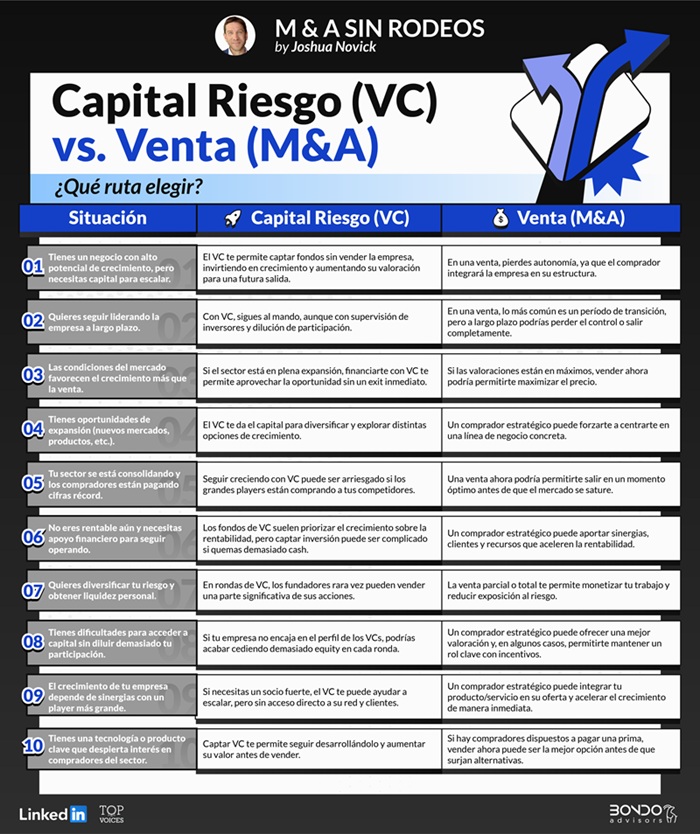
Here are the main factors I usually analyze with founders when we sit down to discuss whether it makes more sense to seek venture capital or consider a sale:
Need for capital to scale.
Venture Capital lets you raise funds without selling the company, invest in growth and increase valuation for a future exit.
A sale, on the other hand, reduces autonomy, as the buyer integrates the company into their structure.
Desire to continue leading the company.
With VC, you remain in charge, though under investor oversight and with dilution.
In a sale, there is usually a transition period, and in the long run you may lose control or leave entirely.
Market conditions.
If the sector is expanding, financing through VC allows you to capture the upside without selling.
If valuations are at their peak, selling now might maximize price.
Expansion opportunities.
Venture Capital provides capital to explore new products or markets.
A strategic buyer may push you to focus on a specific line.
Sector timing.
If major players are acquiring your competitors, continuing to grow with VC can be risky.
A sale might allow you to exit at the optimal moment before the market saturates.
Current profitability.
VCs prioritize growth over profits, but if you’re burning too much cash, raising capital becomes difficult.
A strategic buyer may bring synergies, customers and resources that accelerate profitability.
Founder liquidity and risk diversification.
In VC rounds, founders can rarely sell shares.
A full or partial sale allows you to monetize part of your equity and reduce exposure.
Equity dilution.
If your company doesn’t fit the VC profile, you may end up giving away too much equity each round.
A strategic buyer may offer a better valuation and, in some cases, keep you in a key role with incentives.
External synergies.
If you depend on a strong partner to scale, VC can help you grow, but without direct access to their network or customers.
A strategic buyer can integrate your product or service and accelerate growth immediately.
Key technology or product.
VC allows you to keep developing your technology and increase its value before selling.
If there are already buyers willing to pay a premium, selling now may be the best option.
Sometimes the decision between raising capital or selling isn’t really a choice, because circumstances remove one of the options.
Other times it is a choice — and then the answer depends both on the numbers and on the founder’s life moment.
What matters is understanding what you can do and what you want to do.
And from there, choose the path that brings you closer to what motivates you today.
By Joshua Novick, partner at Bondo Advisors
Source: https://www.joshuanovick.com/p/levantar-una-ronda-o-vender-la-empresa

cloud technology axon

Addleshaw Goddard (AG), the London-headquartered international law fir...