Interview with Álvaro Soler, CEO of PowerfulTree: "Thanks to CDTI Innovation and the European MRR funds, we have been able to establish ourselves as key players in the agrivoltaics sector."
PowerfulTree, a startup specializing in agrivoltaic solutions, has developed APV-Cable, a disruptive solution for large-scale crops, driven by CDTI Innovation and the European MRR funds.
In a context marked by two urgent challenges moving in parallel — the growing impact of climate change on agriculture and the need to accelerate the transition to a cleaner, more resilient energy model — PowerfulTree was born. As Álvaro Soler, CEO of the company, explains, the company’s mission is to:
"Protect agriculture from climate change and improve its profitability, while actively contributing to the energy transition through large-scale renewable energy deployment."
Unlike traditional approaches that often treat these challenges separately, the company proposes an integrative approach, placing crops and farmers at the center of technological design.
During its first years, PowerfulTree faced significant challenges. On one hand, the company had to confront entrenched technical, regulatory, and cultural norms in the energy and agricultural sectors. On the other, it needed to industrialize a complex technological solution designed to operate in real field conditions.
Soler states:
"Both factors have been critical in transforming an innovative vision into a viable and replicable solution."
PowerfulTree’s philosophy moves away from conservative approaches that merely aim to minimize the impact of new infrastructure on crops. According to Soler, the goal must be far more ambitious:
"It is not enough to avoid harming the crop; we must actively improve its conditions."
The company advocates a proactive model where agrivoltaic technology actively enhances production conditions.
PowerfulTree’s value proposition is built on three main pillars:
The result is a model of productive, regenerative, and intelligent agriculture, combining crop improvement and energy production in a single infrastructure.
At PowerfulTree, innovation is not a separate department but a transversal principle guiding daily operations. Soler emphasizes:
"Innovation is not a department; it is our daily way of working."
This approach is particularly evident in the integration of agriculture and renewable energy. Rather than adapting crops to pre-existing photovoltaic infrastructure, each project is designed from scratch as a combined agricultural and energy system. This involves structural and mechanical design, agronomic and microclimatic modeling, and energy optimization.
Field validation is crucial. Soler explains:
"At PowerfulTree, we apply iterative cycles of measurement, learning, and improvement, supported by advanced sensors and real crop data, allowing us to continuously adjust the system to agronomic and operational needs."
APV-Cable is one of PowerfulTree’s most ambitious developments and the core of its technological strategy. Designed as a disruptive solution for cereals and rotational crops, it addresses a key limitation of traditional agrivoltaics: incompatibility with large-scale mechanized farming.
APV-Cable relies on a cable-suspended structure that minimizes rigid elements on the ground and frees up usable space for machinery. Soler explains:
"Our goal is to allow farmers to continue working their rotations normally, using equipment and performing maneuvers fully compatible with the installation."
As the CEO summarizes:
"It represents a new generation of agrivoltaics, compatible with extensive crops, energy-efficient, and designed for real field conditions."
The system’s innovation relies on a lightweight, modular structural design, high agricultural compatibility, cost reduction focus, and intelligent protection against adverse weather. One distinguishing feature is the algorithm that dynamically adjusts cable tension based on wind direction and speed, protecting the structure and panels even against gusts up to 100 km/h.
Cost reduction and operational optimization are central to APV-Cable, especially in a sector where economic viability is crucial for large-scale adoption.
PowerfulTree tackled complex technical challenges related to structural behavior, cable installation and tensioning, and long-term operation and maintenance.
The solution was practical engineering, based on iterative development, careful component selection suited to rural environments, and real-world field validations. Soler notes:
"We are not just aiming for a solution that works; the goal is for it to operate reliably, efficiently, and profitably throughout its lifespan."
A distinctive feature of PowerfulTree’s approach is the “Plant Wellbeing” concept, inspired by the logic of animal welfare. Soler explains:
"It is not enough for the plant to survive; we must create optimal conditions for it to reach its full potential."
This concept goes beyond simple shading, focusing on intelligent microclimate management tailored to the crop’s physiological needs, reducing heat and light stress, preserving soil moisture, and decreasing evapotranspiration. The outcome is more stable production and, in many cases, improved fruit quality.
Plant wellbeing is monitored and adjusted via sensors and algorithms, reinforcing the idea that the plant is the central element of the agrivoltaic system.
APV-Cable’s potential goes beyond individual projects. PowerfulTree aims to adapt this technology to up to 70% of Spain’s crops, representing a structural shift in how agricultural and energy infrastructures are conceived.
Scaling plans include standardizing modules and processes, adapting to different crop types, building strategic partnerships with developers and farmers, and demonstrating agronomic and economic impact with real data. The goal is to enhance agricultural climate resilience and generate direct, recurring territorial value beyond mere land leasing.
APV-Cable has been supported by Neotec from CDTI Innovation, co-financed by the European MRR funds. Soler emphasizes:
"This support was a turning point, allowing us to transform an ambitious technological vision into a structured, industrial-ready development."
He adds:
"It enabled us to take R&D risks more deeply, attract highly qualified talent, accelerate field validations, and structure the project with milestones, metrics, and traceability, laying the groundwork for its future evolution."
In the coming years, PowerfulTree anticipates the agrivoltaics sector maturing, moving from experimental projects to consolidated industrial deployment. Soler notes:
"The sector will transition from pilot and exploratory projects to industrial-scale deployment and regulatory consolidation."
In this context, the company aims to play a reference role, providing engineering and expertise to make agrivoltaics genuinely agricultural, economically viable, and territorially coherent.
Short-term priorities focus on consolidating presence in Spain, though the challenges it addresses — extreme heat, drought, productivity loss — make its approach highly exportable.
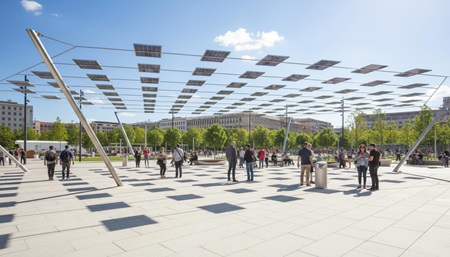
Meanwhile, the company is expanding with UrbiVoltaics, a line integrating photovoltaic solutions into urban and peri-urban environments. This approach transfers APV-Cable knowledge to structures that modulate shading and provide active cooling, helping mitigate urban heat islands. This evolution aligns with the company’s vision: scale with purpose, creating solutions that start in the field and also transform cities.
Image: Adapting PowerfulTree agrivoltaic technology for urban environments
The Centre for the Development of Industrial Technology (CDTI) is the innovation agency of Spain’s Ministry of Science, Innovation, and Universities, promoting technological innovation in business. CDTI’s mission is to help Spanish companies generate and transform scientific-technical knowledge into globally competitive, sustainable, and inclusive growth.
In 2024, under a new strategic plan, CDTI provided over €2.3 billion in support to Spanish companies and startups
Web: www.cdti.es
Linkedin: https://www.linkedin.com/company/29815
X: https://twitter.com/CDTI_innovacion
Youtube: https://www.youtube.com/user/CDTIoficial

cloud technology axon

Addleshaw Goddard (AG), the London-headquartered international law fir...