
Emerging use cases like Industry 4.0, drones, connected mobility, and more are fueling the demand for a new set of network application programming interfaces (APIs). Communication service providers (CSPs) need to act now to capture value — collaboration will be critical to prevent slow market take-up and a marginalized role for CSPs.
Traditional APIs have been built around core telecom services (e.g., voice, SMS, and video), allowing enterprises to access functionality like SMS-based one-time passcodes or over-the-top (OTT) messaging services. This ecosystem simplified the way enterprises sourced and used network connectivity. With the adoption of 4G and 5G networks, along with the virtualization of network functions exposing new areas of the network, next-generation APIs are now available.
These APIs enable more sophisticated use cases, including guaranteed quality of service, resource orchestration, and edge cloud computing. The use cases offer potential revenue for CSPs, which is important to monetizing their large network investments over the past several years. The network API market is expected to grow by a CAGR of 47% between 2023 and 2030 (from about US $1 billion to $13.5 billion), and communication APIs overall (including SMS, video, and voice) are expected to grow at an CAGR of 18% (to a total value of about $32 billion by 2030). It will be crucial for CSPs to react rapidly to reap the rewards of this growing market and deliver attractive ROIs on spent network CAPEX (see Figure 1).

Network APIs let external software applications interact with and use the capabilities of a CSP’s network. Network APIs operate across three layers:
(Layer 4 is a complete solution that sits outside the network API market considered in this Insight.)
Network APIs promise to let businesses access advanced network capabilities, such as ultra-low latency and precise location services (see Figure 2), which can enable various use cases in the industry.
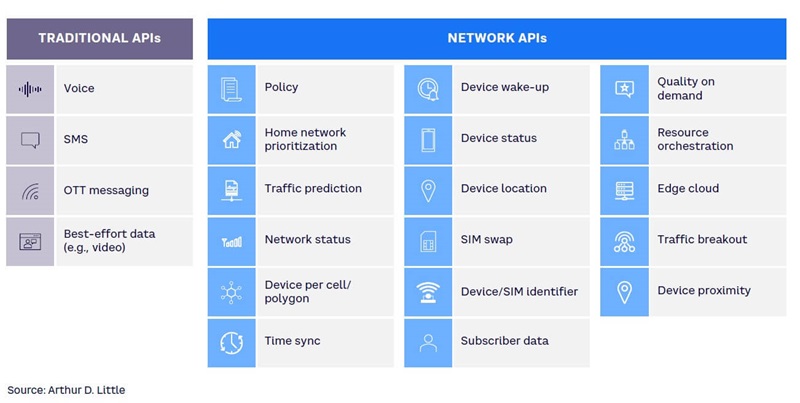
Example use cases include:
We believe CSPs that successfully engage with the network API market will generate revenues from four core customer groups purchasing API-driven connectivity:
Although the market potential for network APIs is large, some obstacles must be overcome to unlock its promised value. First, a common CSP approach toward APIs is critical to create a compelling alternative to hyperscaler and aggregator offerings (e.g., Twilio, Sinch, and Megaport) and accelerate overall take-up of high-quality network APIs. Second, industry-wide initiatives (e.g., CAMARA, Open Gateway, and TM Forum) already exist, although given the complexity of network APIs, an additional layer of cooperation in the form of a joint company is necessary to enable seamless API aggregation for developers to easily leverage their solutions.
CSPs will need to: (1) ensure their APIs are standardized across as many other CSPs as possible; (2) build a global network in their standardization efforts; and (3) provide a single, aggregated API to decrease integration costs and attract as many downstream users as possible.
Arthur D. Little has supported CSPs over the past 24 months in conceptualizing and implementing an industry-wide collaboration that will address the challenges mentioned above and help accelerate the network API market for CSPs worldwide. In September 2024, Ericsson and 12 leading CSPs[1] announced a joint company establishing a collaborative ecosystem for APIs (see Figure 3). A CSP collaboration done quickly and decisively gives a first-mover advantage and allows CSPs to have a future network API “category builder” role, as is the case with Open Gateway.
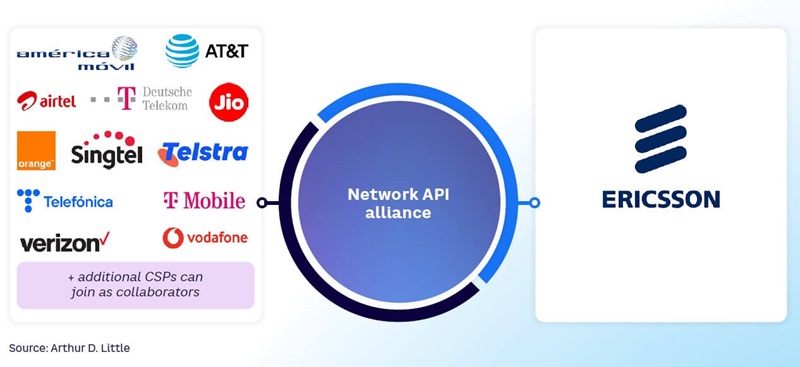
The goal is to develop and aggregate a standardized set of APIs based on CAMARA’s principles. These APIs will be available across multiple networks, making it easier for developers to build new services on top of them. These APIs and the use cases they enable offer significant revenue-generating potential for participating CSPs. A joint company of this nature facilitates API standardization, making APIs accessible to a broad audience of developers and customers to use in their applications. The global coverage of aggregated APIs will encourage the development of use cases that require extensive reach to be commercially viable for developers, unlocking revenue potential.
Network APIs represent a powerful opportunity for CSPs to monetize their networks and become central to the digital economy. CSPs, whether members of the company or not, have a clear “right to win” in this market given their:
It’s clear that CSPs need to respond to the rise of network APIs to thrive in the changing telecom market. We recommend the following:
We would like to acknowledge all those whocontributed to this Insight, especially Bela Virag, Maximilian Scherr, and Pierre Peladeau.
By Christoph Uferer, Dr. Karim Taga, Hariprasad Pichai, Makram Chehayeb, Milos Marjanovic
Note
[1]The full joint company comprises Ericsson, América Móvil, AT&T, Bharti Airtel, Deutsche Telekom, Jio, Orange, Singtel, Telstra, Telefónica, T-Mobile, Verizon, and Vodafone.

cloud technology axon

Impulse plans to develop between 15 and 20 internationally focused pro...