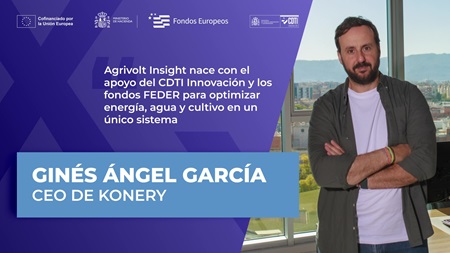
Interview with Ginés Ángel García, CEO of Konery: “The Agrivolt Insight project was born with the support of CDTI Innovación and FEDER funds to optimize energy, water, and crops within a single system”
The company Konery, backed by the support of CDTI and co-financed by European European Regional Development Fund, is committed to transforming the agricultural production model through the smart integration of advanced technologies such as IoT, AI, and digital twins. Its goal is to turn the greenhouse into a connected, efficient, and autonomous system capable of simultaneously optimizing the use of resources such as water, energy, and nutrients, while maximizing agricultural production and renewable energy generation in the same space.
In a global context marked by pressure on natural resources, energy volatility, and the urgent need to transform production models, innovation is emerging as an essential driver of change. From this conviction, Konery was born—a company that has made improving the energy model its core mission and is now taking a step further with the development of Agrivolt Insight, a project that connects agriculture, renewable energy, and advanced technology within a single system.
At the helm of the company is its founder and CEO, Ginés Ángel García, who created Konery with a clear objective: “to change the energy model of companies.” To achieve this, the company has structured its activity into four main areas—energy markets, energy efficiency, renewable energy, and energy management and storage—in order to become a comprehensive strategic partner for its clients.
Konery currently has a team of more than 70 people, nine of whom are dedicated to R&D activities. The company operates exclusively in the Spanish market, although it has a clear international expansion outlook, and works with leading companies in industrial and agri-food sectors. Its value proposition is focused on turnkey solutions for photovoltaic self-consumption, energy efficiency, and increasingly, the emerging market of Energy Savings Certificates (CAE), where it acts as a delegated entity.
Where agriculture and energy meet
The Agrivolt Insight project represents one of the company’s most advanced developments to date. Its starting point is an increasingly evident reality: the need to rethink the relationship between agricultural production and energy generation.
“Agrivoltaics in greenhouses introduces a multi-objective intersection: maintaining competitive agronomic yields while generating energy within the same system,” explains García. However, this duality introduces significant complexity, as both processes share a limited resource: solar radiation.
From an agricultural perspective, the project addresses structural challenges such as water scarcity and the need to optimize inputs. “Currently there is suboptimal use of water and fertilizers due to the lack of integration and real-time dynamic adjustment,” he notes. This is compounded by factors such as rising temperatures and recurring droughts, which require more resilient solutions.
At the same time, the energy dimension presents its own challenges. “The goal is to move toward a greenhouse that operates as an energy island, capable of functioning independently from the conventional power grid,” says the CEO. This involves integrating renewable generation, storage, and intelligent management in a highly technological environment.
A “digital brain” for the greenhouse
One of the key differentiators of Agrivolt Insight is the integration of technologies such as Internet of Things (IoT) sensors, artificial intelligence (AI), and digital twins. Together, these tools form what García describes as a “digital brain” for the greenhouse.
“The system follows a logical flow: sensing, communications, cloud processing, AI analysis, and decision-making translated into actions in the physical system,” he explains. Sensors act as the system’s “senses,” collecting data on temperature, humidity, CO₂ levels, radiation, soil conditions, and other key parameters.
This data is transmitted via IoT technologies to a cloud platform, where it is stored and processed. This is where the digital twin comes into play—a virtual replica of the greenhouse that allows simulation of scenarios and anticipation of decisions. “The digital twin not only helps design the optimal installation but also test operational changes before applying them in the real world,” he says.
Artificial intelligence provides predictive and analytical capabilities. “AI models analyze historical and real-time data to forecast future needs, detect anomalies, and propose adjustments that optimize both agricultural production and energy generation,” he adds.
How to integrate complex systems
Despite the potential of these technologies, their integration is not without challenges. In fact, the main challenge of the project has been ensuring that all components work in a coordinated manner.
“The biggest challenge is not installing sensors or panels, but achieving full integration between the physical and digital worlds,” García acknowledges. This requires ensuring data quality, real-time synchronization, and system interoperability.
“If sensors are not properly calibrated, the AI learns incorrectly. If communications fail, decisions arrive too late. And if systems are not interoperable, inefficiencies arise,” he summarizes. On top of this, agronomic and energy variables must be optimized simultaneously, turning the project into a constant balancing exercise.
Collaboration with academia
To address this complexity, Konery has partnered with the Polytechnic University of Cartagena, specifically its Telematics Engineering Research Group.
“UPCT is a key technological partner, especially in areas such as communication optimization and the development of IoT- and AI-based solutions,” García highlights. This collaboration has helped reduce technological risks and advance knowledge transfer into real applications.
It has also opened the door to intellectual property protection and new innovation pathways. “We will jointly analyze the best way to protect the results, whether through patents or utility models,” he says.
Impact on efficiency, sustainability, and the 2030 Agenda
The potential of Agrivolt Insight goes beyond technological innovation. Its true value lies in its ability to transform resource management in agricultural systems.
“The combination of real-time data, simulation, and automation allows optimization of water, fertilizer, and energy use,” García states. Practically, this translates into cost reductions and improved sustainability.
On one hand, the system enables precise irrigation and fertilization, avoiding waste. On the other, integrating solar energy reduces dependence on external sources and contributes to decarbonization. This aligns the project with the 2030 Agenda and key goals such as SDG 7 (affordable and clean energy), SDG 9 (industry, innovation and infrastructure), SDG 12 (responsible consumption and production), and SDG 13 (climate action), promoting a more responsible, innovative, and resilient production model.
“What matters is not just incorporating renewables, but intelligently integrating energy and agronomy into a single decision-making layer,” he emphasizes. Thus, the greenhouse ceases to be a set of isolated systems and becomes an integrated optimized ecosystem.
Public support
Developing a project of this scale requires significant investment in technological and human resources. In this regard, public funding support has been decisive.
“Receiving this funding has been a key factor in carrying out the project. It is a necessary trigger to finance large-scale initiatives that would otherwise be difficult to undertake,” García says.
In particular, support from CDTI, co-financed by European FEDER funds, has accelerated the development of Agrivolt Insight and strengthened Konery’s commitment to R&D.
“This type of funding encourages companies to invest in research and development, generating a positive impact across the innovation ecosystem,” he adds. “It makes projects possible that inherently improve society—in our case, contributing to a more sustainable and efficient energy system.”
From pilot project to scalable platform
In the medium term, Konery aims to turn Agrivolt Insight into a replicable and scalable solution.
“The goal is to evolve from a pilot project into a platform adaptable to different types of greenhouses and crops,” García explains.
In the coming years, the company expects to move toward more autonomous systems with predictive and maintenance capabilities, as well as deeper integration with other energy infrastructures.
“We want the digital twin to be not just an analysis tool, but a real-time operational engine,” he says. This would enable anticipation of needs, resource optimization, and continuous improvement in decision-making.
Ultimately, Agrivolt Insight reflects a paradigm shift in production systems. Instead of fragmented models, it proposes an integrated vision based on data, technology, and sustainability.
“In five years, we want these types of solutions to be the foundation for designing, predicting, and managing greenhouses as integrated systems,” García concludes. “Because the future is not about optimizing each element separately, but about understanding how they interact and managing them together.”
CDTI Innovación
The Centre for the Development of Technology and Innovation (CDTI E.P.E.) is the innovation agency of the Spanish Ministry of Science, Innovation and Universities, aimed at promoting technological innovation in the business sector. Its mission is to ensure that the Spanish business ecosystem generates and transforms scientific and technical knowledge into globally competitive, sustainable, and inclusive growth. In 2025, under its 2024–2027 Strategic Plan, CDTI provided more than €2 billion in support to Spanish companies and startups
More info:
En Linkedin: https://www.linkedin.com/company/29815
En X: https://twitter.com/CDTI_innovacion
En Youtube: https://www.youtube.com/user/CDTIoficial

cloud technology axon

Addleshaw Goddard (AG), the London-headquartered international law fir...