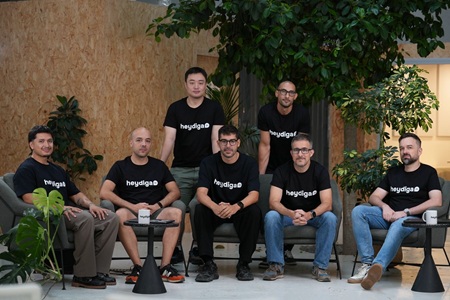
Less than a year after its launch, HeyDiga, the company founded by Zafra and Espeja, and backed by the founders of JobandTalent, has successfully consolidated its growth following its first months operating in production with clients across strategic sectors such as automotive, healthcare, beauty, and businesses with high operational complexity.
The company, which currently exceeds 100 clients, manages thousands of automated daily conversations and works with large corporate groups, including official dealerships of virtually all brands, multi-brand workshop networks, beauty groups, hospitality groups, hospital groups, and private clinic chains.
In December 2025, the company announced the closing of a €1 million funding round and benefits from the support and confidence of top-tier investors and partners, including venture capital firm Kfund and business angels Felipe Navio and Juan Urdiales (founders of JobandTalent), Borja Suárez and Alfonso Núñez (partners at EY), Alberto Velarde (founder of east crema), Carlos Fernández (COO of Docplanner), and Josep Navajo (founding partner of leading technology law firm Delvy).
“In some verticals, we are able to automate more than 60% of repetitive calls and reduce call handling time by 70%, which alleviates administrative burden and, most importantly, prevents the loss of opportunities outside business hours or during peak times,” said Espeja. “In certain cases, the return on investment has reached up to 27x.”
Specifically in the automotive sector, dealerships fail to answer 21% of incoming calls, and 85% of those customers do not call back—they go directly to competitors.
In Spain, 40% of commercial calls are not answered on the first attempt, and the average SME loses up to €15,000 per month due to missed calls. This is compounded by pressure from brands, which require customer responses within less than two hours and availability to offer workshop appointments within the following days—requirements that overstretched human teams struggle to meet.
Keeping customers informed about the status of their vehicle is one of the KPIs with the greatest impact on satisfaction, and the frustration of not being able to check it significantly lowers ratings: 40% of customers do not return to the dealership after the first service, and 45% switch brands when renewing. With HeyDiga, it has been possible to answer 100% of calls, offer real-time workshop appointments, proactively inform customers about their vehicle status, and meet brand standards without increasing headcount.
As a result of its rapid market adoption, HeyDiga has announced key partnerships in the automotive sector (including official dealerships and multi-brand chains), such as agreements with dealerships of brands including Triumph, Harley-Davidson, Toyota, SEAT, CUPRA, and Audi, among others.
According to Zafra, “they all share a very clear pattern: high conversational volume, overstretched teams, poorly structured processes, and revenue leakage. Our technology turns that conversational chaos into measurable processes—in other words, we transform calls into structured data and appointments into revenue.”
This technology enables each sector and client to tailor HeyDiga’s software to their specific needs and challenges. “We first conduct a Voice Intelligence audit to identify recurring topics, peak workload times, the main sources of friction, and missed opportunities. From there, we determine which processes should be automated first to maximize operational efficiency and incremental revenue,” explained Espeja. “Our value proposition is not just answering calls, but turning conversation into a data-driven financial asset.”
The company stands out as a pioneer in Spain in the use of this advanced technology, enabling businesses to manage calls, schedule appointments, and respond to inquiries through channels such as phone or WhatsApp, transforming customer interactions into valuable insights to optimize efficiency and drive business growth. “Our clients typically start with a specific use case, but quickly realize the impact is transversal: operations, sales, after-sales, internal support, incident management, and more,” concluded Zafra

cloud technology axon

Through its A&G Real Estate Sustainable Developments SICC S.A., A&G wi...