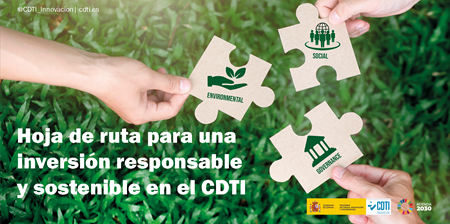
CDTI Innovación, the Spanish State Innovation Agency under the Ministry of Science, Innovation and Universities, has just launched its Roadmap for Responsible and Sustainable Investment. This initiative was already envisaged in the 2024–2027 Strategic Plan and responds to the global debate on which innovations are desirable, which generate net benefits, and which may produce unintended effects on social cohesion, rights, equality, or the environment.
As stated in the document itself, the Roadmap is a working plan to reorganize public action and ensure that technological development does not advance at the expense of social cohesion or citizens’ rights. It incorporates criteria such as gender equality, accessibility, privacy, and ethics into the evaluation and management of funded projects.
The Roadmap is based on a simple but demanding idea: innovation is not neutral. It can accelerate positive transitions (clean energy, health, productivity, or inclusion), but it can also amplify inequalities, introduce risks, or consolidate gaps if it is not properly guided and governed. It is no longer sufficient to assess only technological feasibility or scientific and technical excellence. Therefore, the Roadmap for Responsible and Sustainable Investment proposes consolidating a framework for responsible and sustainable innovation aligned with the Sustainable Development Goals (SDGs) and internationally recognized ethical principles.
Among its background elements, the Roadmap highlights the objective of adopting or developing a code for ethical financing, in line with the United Nations Principles for Responsible Investment (UNPRI), and establishing a mechanism for ethical oversight and advice through a Responsible Innovation Committee composed of external experts, available to both management and technical teams when needed.
This shift is not limited to the strategic level but is also connected to the evolving regulatory framework. The Roadmap recalls its alignment with EU and United Nations sustainability objectives and situates this orientation in continuity with the ongoing statutory reform, strengthening coherence between mission, governance, and public action.
One of the most notable elements is its overall integration framework, represented as a process that spans the entire cycle: mission-aligned governance – proposal evaluation – monitoring and data collection – processing and accountability. This includes a system of social, environmental, and governance impact metrics that will be reflected in CDTI’s annual report. The distributed governance scheme ensures that the approach is sustainable over time.
The Roadmap also incorporates a virtual experimentation space, CDTI-LAB, which will channel changes in project-related information flows.
The Roadmap is structured around four main pillars, with a specific architecture of instruments and processes.
The document positions the Science and Innovation Missions programme as one of the most suitable instruments for introducing responsible innovation principles, due to its explicit focus on social and environmental challenges rather than on technological verticals or specific industrial sectors. The Missions instrument, aimed at promoting business R&D that delivers innovative solutions to concrete challenges, is based on principles of co-design and participation and evaluates both technological quality and alignment with mission principles.
The Roadmap describes a call design that includes consultation with ministerial departments to identify medium- and long-term challenges, selection and refinement by CDTI teams, consultation and co-design with stakeholders, and final validation with ministries prior to preparation and launch.
The document specifies that the regulatory framework has increased the weight of social and environmental impact in project evaluation and that, to ensure a substantive assessment, a pilot is being developed using ex ante evaluation methodologies through an experiment with shadow evaluations in collaboration with the Innovation Growth Lab, of which CDTI Innovación has been a member since 2024. The results will help shape ex ante evaluation tools based on potential social and environmental impact, as well as define metrics and criteria for subsequent monitoring.
The approach seeks simple criteria focused on relative progress and easy identification, so as not to impose an additional burden on companies, especially SMEs.
The third pillar is based on the idea that responsible innovation cannot be built alone. The Roadmap proposes advancing partnerships and specifies actions such as collaboration agreements with the CSIC and the State Secretariat for Social Rights and Agenda 2030 to develop a centre of excellence in social innovation; support for an AECID call on innovation for development by participating in its evaluation; work within TAFTIE to develop common social impact indicators; strengthening relationships with platforms such as Fundación COTEC and the Nausika Forum; and exchanges with other public enterprises committed to sustainability.
In addition, a strategic mapping of responsible innovation initiatives is planned, as well as the presentation of CDTI’s framework in relevant forums and cooperation spaces with Spain’s Autonomous Communities.
The fourth pillar focuses on making impact visible and is probably the most transformative from a public perspective. The plan is to consolidate the sustainability report with the annual report, so that activity and impact are not separated. In 2025, CDTI will for the first time provide data linking funded projects to the most relevant SDGs, as well as examples of projects with positive social and environmental impact.
To achieve this, CDTI is developing a specific metrics dashboard, fed by standard sources such as the results monitoring survey and harmonized with ex ante and ex post evaluation criteria. The goal is to establish standardized and comparable metrics across time and sectors, citing frameworks such as IRIS as a reference, so that they are useful both for the stakeholder community and for citizens.
For the innovation ecosystem, this Roadmap means that CDTI will continue to support business R&D with technological ambition, but with a more comprehensive compass that systematically incorporates social and environmental impact in a structured, comparable, and reasonable way for companies. For citizens, the Roadmap represents a commitment to increasing the legitimacy of innovation policy by showing what actually changes in people’s lives when technology is funded.
Overall, this Roadmap presents CDTI Innovación from a new perspective on how to guide public funding toward innovation that is not only technologically advanced but also socially robust, ethically guided, and transparent—an innovation that generates growth and competitiveness while also protecting the planet, rights, and social cohesion that help shape the future.
CDTI Innovación
The Centre for the Development of Technology and Innovation (CDTI E.P.E.) is the innovation agency of the Ministry of Science, Innovation and Universities. Its mission is to promote technological innovation in the business sector and ensure that Spanish companies generate and transform scientific and technical knowledge into globally competitive, sustainable, and inclusive growth. In 2024, within the framework of a new strategic plan, CDTI provided more than €2.3 billion in support to Spanish companies and startups.
More information:
Web: www.cdti.es
En Linkedin: https://www.linkedin.com/company/29815
En X: https://twitter.com/CDTI_innovacion
En Youtube: https://www.youtube.com/user/CDTIoficial

cloud technology axon

Addleshaw Goddard (AG), the London-headquartered international law fir...