Interview with Ginés Martínez, CEO of Reciplast “CDTI Innovación and ERDF funds enable us to tackle sustainable waste management projects with a more ambitious vision”
When Reciplast was founded in the late 1970s, recycling plastic was an activity that the industrial world hardly took seriously. Today, with decades of experience and the support of CDTI Innovación and the European ERDF funds, the Murcia-based company is taking its most ambitious step yet: a new advanced extrusion line that will enable it to produce high-quality recycled plastic for the most demanding markets, demonstrating that waste, when properly processed, can become a valuable opportunity.
There are companies that are born before the world is ready to understand them. Reciplast is, in a way, one of them. When it began operations in 1978, talking about the circular economy or sustainable waste management was almost science fiction in the industrial world. “The idea emerged very naturally: to continue something that has always existed—the efficient use of resources and the reuse of materials—by bringing it into the industrial sphere,” explains Ginés Martínez, CEO of the company.
His parents identified both a need and an opportunity. Today, nearly five decades later, Martínez runs the family business together with his two brothers, “maintaining the values they passed on to us: commitment and hard work.”
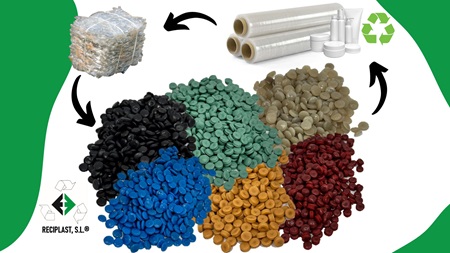
With a workforce of 25 employees and operations concentrated mainly in the Region of Murcia, the Valencian Community and Andalusia, Reciplast specializes in the collection, treatment and recovery of plastic waste, producing and marketing high-quality recycled LDPE, HDPE and PP pellets. All of this is carried out under RecyClass certification and in compliance with TED/646 regulations, ensuring traceability, material quality and adherence to circular economy criteria.
Its main customers operate in the agriculture and packaging sectors, including companies from the Armando Álvarez Group, Sistema Azud and Ródenas y Rivera. Its activity is currently entirely domestic, although Martínez does not rule out expansion into international markets “in the not-too-distant future.”
Nearly Half a Century of Recycling: What Has Changed
Few things illustrate Reciplast’s journey better than the evolution of society’s perception of recycling itself. “When the company began operating, recycling had very little social recognition and was often seen simply as a waste recovery activity, without the environmental and strategic importance it has today,” Martínez recalls.
What for years was an invisible or even undervalued activity is now an essential part of the solution to some of the planet’s most urgent environmental challenges. “For us, it is especially rewarding to see how something that was once barely appreciated is now considered fundamental,” he adds.
This journey has been accompanied by a sustained commitment to technology. In recent years, the company has incorporated highly energy-efficient equipment, installed photovoltaic panels to reduce its energy footprint, developed a water treatment system that allows 100% of the water resources used in production to be reused, and built a digital traceability tool that guarantees control and transparency throughout the value chain.
These advances reflect a clear philosophy: continuous improvement is not a slogan—it is a way of working.
A New Extruder That Changes the Rules of the Game
In this context of continuous evolution, Reciplast has now taken one of its most ambitious steps: implementing a new advanced extrusion line that will allow the company to make a qualitative leap in the quality of the recycled plastic it produces.
The project, supported by CDTI Innovation and co-financed by the European ERDF funds, responds to growing market demand that is becoming increasingly demanding.
“The demand for recycled plastic has been growing very clearly in recent years, driven both by regulation and by greater environmental awareness,” explains Martínez.
However, that growth comes with requirements that the company’s current production lines, although fully operational, cannot fully satisfy. “Today, it is no longer enough for a material simply to be recycled; customers require highly consistent quality, full traceability of the waste’s origin, and technical guarantees that allow the material to be processed with the same reliability as virgin plastic,” he notes.
This is especially important for entering high-value-added sectors such as food packaging and cosmetics, which require technologies for decontamination, homogenization and advanced process control beyond what current lines can provide.
The chosen solution is the Starlinger recoSTAR universal 125 VAC extruder, equipment that represents, in Martínez’s words, “a significant technological leap” compared to the company’s existing systems.
Its most important advantage is its enhanced degassing and decontamination capacity, thanks to advanced vacuum and filtration systems that more effectively remove moisture, odors, inks, volatile compounds and impurities present in post-consumer plastics.
“This is essential to obtaining high-quality recycled material suitable for more demanding applications,” he emphasizes.
The new line also offers greater process stability and homogeneity, as well as improved energy efficiency, resulting in a lower carbon footprint.
“Overall, this investment will allow us to move toward a more sustainable, efficient production model that is better prepared to meet the new technical and regulatory requirements of the recycled plastics market,” Martínez summarizes.
The Challenges of a World with Strained Supply Chains
No major industrial project reaches completion without difficulties, and this one is no exception.
The main obstacle Reciplast faces in implementing the new line is something beyond its direct control: manufacturing and delivery times for certain technological components.
Global supply chain disruptions affecting numerous industrial projects across Europe have introduced uncertainty into the delivery of some specific parts and equipment.
The company’s response has been pragmatic: constant coordination with the manufacturer, flexible planning and anticipation of possible delays.
“Our objective is to ensure that the line is commissioned with all the necessary technical and quality guarantees, always prioritizing reliability and the proper operation of the facility,” Martínez explains.
Making Possible What the Market Alone Would Not Do
A project of this nature—technologically ambitious, involving significant investment and a long-term return horizon—would be difficult to undertake without appropriate support.
At this point, the backing of CDTI Innovation and the European ERDF funds has been decisive.
“These types of investments require a major technological and financial effort, and this support allows us to accelerate the incorporation of more advanced technologies, improve our processes and approach projects with a more ambitious, long-term vision,” says Martínez.
Beyond its direct impact on Reciplast, the CEO highlights the positive effect this type of funding has on Spain’s industrial ecosystem as a whole.
“We believe it has a very positive impact on the innovation ecosystem, especially for industrial companies committed to innovation and sustainability. It not only helps modernize processes and improve competitiveness, but also promotes environmental impact reduction and the development of solutions that generate real benefits for society, such as better resource utilization and reduced dependence on virgin raw materials.”
Toward Higher Value-Added Sectors
The new line is not an end in itself but rather the tool that opens the door to Reciplast’s next stage of growth.
Once operational, the company aims to expand its presence in sectors where recycled plastic has not yet achieved the position it deserves, particularly food and cosmetics—two fields with very demanding technical and sanitary requirements where high-quality recycled pellets can play a major role.
“We want to continue positioning ourselves as a benchmark company in high-quality plastic recycling, combining innovation, sustainability and reliability, and demonstrating that recycled materials can meet the same demanding standards as virgin materials,” Martínez states.
Ultimately, this reflects the same conviction that led Ginés Martínez’s parents to found Reciplast decades ago: that waste is not a problem but an opportunity.
Only now, with the right technology, that opportunity has greater value, greater reach and a brighter future than ever before.
This project is also directly linked to several Sustainable Development Goals of the 2030 Agenda: SDG 12 (Responsible Consumption and Production), by replacing virgin raw materials with recycled ones; SDG 13 (Climate Action), by reducing the carbon footprint of the production process; SDG 9 (Industry, Innovation and Infrastructure), by incorporating cutting-edge technology into the recycling industry; and SDG 17 (Partnerships for the Goals), by fostering collaboration between private enterprise and Spanish and European public funding.
Nearly fifty years after a family from Murcia decided to give plastic a second life, Reciplast remains committed to that original vision.
Technology has changed, markets have changed and social awareness has changed.
What has not changed is the conviction that waste has value—and that, when properly managed, that value can be enormous.
CDTI Innovación
The Centre for the Development of Technology and Innovation (CDTI E.P.E.) is the innovation agency of Spain’s Ministry of Science, Innovation and Universities. Its objective is to promote technological innovation within the business sector.
CDTI’s mission is to ensure that Spain’s business community generates and transforms scientific and technical knowledge into globally competitive, sustainable and inclusive growth.
In 2025, within the framework of its 2024–2027 Strategic Plan, CDTI provided €2.423 billion in support to Spanish companies and startups.

cloud technology axon

Stolt Sea Farm’s Philstop project, co-financed by CDTI Innovación a...