Interview with Santiago de Guzmán, Technical Director of Brezo Energy: “Support from CDTI and FEDER funds has been a true accelerator for our floating offshore wind technology”
In the race to make floating offshore wind viable, Brezo Energy is advancing the certification of its CROWN FW® technology, a solution designed to reduce costs and accelerate the industrial deployment of this energy source. Supported by CDTI Innovación and co-financed by European FEDER funds, the project aims to position the Spanish company in a global market that is still taking shape, where technological innovation will be key to transforming the energy model.
In a context where the energy transition demands increasingly efficient, scalable solutions adapted to geographic particularities, floating offshore wind is emerging as one of the major technological bets for the coming decades. In this nascent field, the Spanish company Brezo Energy is working to establish itself as a relevant player through the development of its CROWN FW® technology, a concrete floating platform designed to transform the way offshore wind farms are deployed and operated.
Technological and industrial focus
Santiago de Guzmán, Technical Director, explains that the company was born with a clear technological and industrial vocation. “Brezo Energy originated from a patent developed within Seaplace, an engineering firm specializing in naval and offshore design. We are a spin-off created in 2021 with the objective of commercializing and further developing the CROWN FW® technology,” he notes. Since then, the company has built a highly specialized team—currently 18 professionals—where innovation is a transversal task. “Although we have a formal R&D structure, the entire team participates in development to some extent. We are a technology-based company, and our daily work revolves around research.”
Innovation to open markets
Developing solutions for floating offshore wind requires operating in a still-emerging field, where market rules are under construction. This is an industry that has yet to reach large-scale commercial deployment. “We are talking about an emerging global market, which in Spain is still under development. Our projects are international, mainly in Europe—France, the UK, Norway—and also in Asia,” De Guzmán explains.
Brezo Energy has focused its activity on advanced engineering and consulting services while continuing to refine its proprietary technology. The goal is clear: to consolidate a solution that is competitive both technically and economically, enabling the transition to industrial-scale production. “Our approach is oriented toward serial manufacturing. We need to execute projects to validate our estimates of performance, timing, and costs. If we succeed, we believe our product has great potential to achieve a significant market share.”
Design for industrialization
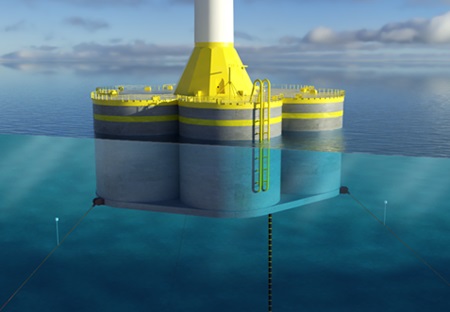
At the heart of this strategy is CROWN FW®, a floating platform that, according to De Guzmán, introduces a differentiated philosophy in the design of such infrastructures. “I would say our main innovations are simplicity and an obsession with industrialization. It is not easy to design a product that, while simple, addresses the major challenges of floating wind: reducing the cost of energy, improving production rates, and leveraging the existing supply chain,” he says.
Unlike other solutions, this technology follows a flexible construction model that allows fabrication both onshore and afloat, with reduced requirements for specialized infrastructure and faster production cycles. “Our platform is significantly cheaper than other developing solutions and allows local manufacturing, which could be key for large-scale deployment.”
Beyond economic advantages, floating offshore wind often represents a technological necessity. “In countries like Spain, where there is no wide continental shelf, the depth of the sea makes fixed structures unfeasible. Floating wind is not just an alternative; it is an enabling technology,” he emphasizes.
The challenge of validating new technology
A major challenge for the sector—and for solutions like CROWN FW®—is technological validation in an environment with no consolidated references. Brezo Energy has opted for an approach based on experimentation and certification.
“In technological development, the most efficient tools for advancing market penetration are certification and validation through testing,” De Guzmán explains. The difficulty lies in the fact that real-scale demonstration projects require very high investments. “We are talking tens of millions of euros, so certification becomes the most efficient way to reduce uncertainties and validate both methodology and costs.”
To date, the company has conducted five testing campaigns in various hydrodynamic channels, accumulating thousands of tests that have helped calibrate numerical models and improve platform performance under real wind, wave, and current conditions. “One of the biggest technological challenges is precisely obtaining models that accurately reproduce that dynamic behavior. Next year we will return to the testing channel to further refine our tools.”
Breaking industry inertia
Beyond technical challenges, De Guzmán points to a less visible but equally decisive barrier: resistance to change within the sector itself. “If I had to highlight a major challenge, it would be breaking the dogmas inherited from other industries. Changing the narrative is always difficult,” he acknowledges.
He notes a tendency to extrapolate solutions from onshore or fixed offshore wind to floating wind without considering that these are distinct technological leaps. “Convincing clients requires an effort that is often underestimated.”
Collaboration with other ecosystem actors is essential, particularly with turbine manufacturers, whose role is key in any wind farm. “Without this collaboration, it is impossible to advance in turbine-platform integration, and the market cannot prosper.” Brezo Energy has successfully formed alliances with some of the world’s leading manufacturers, significantly advancing the development of integrated solutions.
Certification: key for commercialization
The certification project for CROWN FW® technology, supported by CDTI Innovación and co-financed by European FEDER funds, represents a strategic milestone for the company. It allows not only technical validation but also reduces perceived risk among clients and investors.
“This project is fundamental to our technological development strategy. It will allow us to take the next step in certifying the technology and its industrialization process,” says De Guzmán, calling the support received decisive: “Receiving this aid from CDTI has been a boost for our technology. We can say it has been a real accelerator.”
In his own words, “the program has successfully fulfilled the purpose for which it was designed,” enabling the company to advance faster in a highly competitive and demanding environment.
A long-term bet
Despite progress, the development of floating offshore wind remains a long-term race. Forecasts indicate that the first large-scale commercial projects will not arrive until the next decade, with full deployment potentially extending to 2050.
“We are in a very early phase. If by then SMEs like ours have been able to implement viable solutions thanks to CDTI, FEDER funds, and other national and international agencies, we will have a real opportunity to position ourselves,” says De Guzmán.
He emphasizes the importance of maintaining institutional and financial support for the innovation ecosystem: “Meanwhile, we will continue to need all the support Europe and our funding bodies can consolidate.”
Future objectives
Looking ahead to the next five years, Brezo Energy aims to achieve one of its major goals: having fully certified technology that allows market entry. “This is a very important milestone because it opens the door to commercialization,” he states.
From there, the ambition is clear: to make CROWN FW® a benchmark in the floating wind sector. “We firmly believe our technology has everything needed to change the market. If we achieve agile and rapid penetration, it could become a standard both internationally and nationally.”
The path, he admits, is not without uncertainties—but it is full of opportunities for those, like Brezo Energy, who innovate from the ground up. In a market still under construction, the technological decisions made today will shape the energy future of tomorrow.
About CDTI Innovación
The Centre for the Development of Industrial Technology (CDTI) is the innovation agency of the Ministry of Science, Innovation and Universities, aiming to promote technological innovation in the business sector. Its mission is to help Spanish companies generate and transform scientific and technical knowledge into globally competitive, sustainable, and inclusive growth. In 2025, under the Strategic Plan 2024-2027, CDTI provided more than €2 billion in support to Spanish companies and startups.
More info:
Web: www.cdti.es
Linkedin: https://www.linkedin.com/company/29815
X: https://twitter.com/CDTI_innovacion
Youtube: https://www.youtube.com/user/CDTIoficial
Image: Concept image of CROWN FW® technology

cloud technology axon

Through its two funds, Criteria Bio Ventures and Criteria Venture Tech...