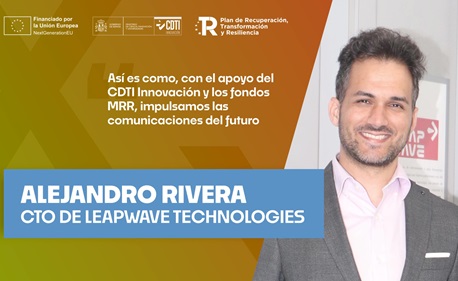
Interview with Alejandro Rivera, CTO of LeapWave Technologies: “This is how, with the support of CDTI Innovación and European MRR funds, we are driving the communications of the future”
The Madrid-based company LeapWave Technologies has developed an innovative interconnection technology based on dielectric waveguides that enables operation across ultra-wide frequency ranges. Support from CDTI Innovación has been key to accelerating this development, with future applications in 6G and 7G networks, advanced instrumentation, and high-performance electronic systems.
The advancement of digital technologies, from mobile networks to artificial intelligence, largely depends on the ability to process and transmit information at ever-higher speeds. However, this progress faces a key challenge: the physical limitations of current interconnections in high-frequency systems.
This is where LeapWave Technologies comes in, a spin-off from Universidad Carlos III de Madrid that has developed a disruptive technology based on low-loss, ultra-wideband dielectric waveguides. Its project, supported by CDTI Innovación and European Recovery and Resilience Facility (MRR) funds through NEOTEC, aims to eliminate one of the main bottlenecks slowing the evolution of communications and microelectronics.
From Research to Market: Identifying a Structural Problem
LeapWave Technologies was founded in 2022 as the result of years of research in the field of high-frequency communications. The founding team identified a critical limitation affecting the entire industry: the difficulty of interconnecting electronic devices when operating at very high frequencies.
As Alejandro Rivera, CTO of the company, explains, “A quick look through the catalogs of major microelectronic component suppliers is enough to reveal the current limitations: the highest-frequency components are offered without packaging.” This format, known as DIE, involves extremely small devices that are difficult to handle and integrate into real systems.
Beyond this example, the problem runs much deeper. Current packaging and interconnection solutions, mainly based on metallic connections, face significant limitations once certain frequencies are exceeded. “There are no efficient packaging or interconnection solutions capable of reasonably extending electrical technology to frequencies above a few tens of gigahertz (GHz),” he notes.
Meanwhile, electronic devices themselves are advancing much faster. Components already exist that can operate above 500 GHz, creating a disconnect between the technology’s potential and the real ability to integrate it into functional systems.
A “Bottleneck” Slowing Innovation
The project “Enabling the Communication Networks of the Future” focuses precisely on solving this gap. The origins of the solution can be traced back to the team’s previous work on the European TERAmeasure project, which addressed challenges related to measuring and testing high-frequency chips.
Building on that experience, the team identified a broader opportunity. “The proposed technological solution not only solved the immediate connection between measurement equipment and the chip: with just a few modifications, the same solution became a connector with an unprecedented frequency range,” explains the CTO.
The project’s goal has therefore been to eliminate the bottleneck represented by current interconnections by developing a technology capable of operating across a much broader frequency range, with lower losses and greater efficiency.
A Disruptive Technology: Ultra-Wideband Interconnections
LeapWave’s solution is based on dielectric waveguides that enable signal transmission with very low losses and across an exceptionally broad frequency range.
One of the most significant breakthroughs is overcoming a fundamental trade-off in communications engineering: the relationship between distance and bandwidth. In current technologies, increasing transmission distance means reducing the maximum frequency and, therefore, the data transfer speed.
In Rivera’s words, “At such high frequencies, any solution forces a trade-off between distance and bandwidth. We break that trade-off.” The results achieved are particularly significant: “We have demonstrated losses of just 0.15 dB per centimeter up to 500 GHz.”
This breakthrough has direct implications for electronic system design. It enables faster interconnection of devices without increasing packaging density, simplifying thermal management and improving reliability.
This aspect is especially relevant in the context of artificial intelligence and high-performance computing. “Breaking that trade-off between distance and speed will lead to more reliable systems, with particular impact on the hardware used to train AI models,” he points out.
Flexibility for Future Networks: Beyond 6G
One of the differentiating elements of the technology developed is its ability to operate continuously from direct current (DC) up to frequencies above 350 GHz, with the potential to exceed 500 GHz.
This capability offers significant flexibility for the development of future communications networks. Unlike current solutions, which require operation in fragmented bands, LeapWave’s proposal enables continuous spectrum coverage.
According to the CTO, “By covering everything from DC to at least 500 GHz, we offer a long-term evolution path that could support several generations using the same interconnection.” This opens the door to more sustainable and reusable infrastructures, both during development and deployment phases.
Furthermore, the technology could facilitate the evolution toward software-defined communication systems. “Our technology would allow that concept to be applied across the entire frequency range it covers,” Rivera states.
This represents an important step toward more adaptable and efficient networks.
Industrial Applications: From Testing to AI
Although the impact on future mobile networks is evident, the applications of this technology go far beyond that.
During the project’s development, LeapWave initiated contacts with test and measurement equipment manufacturers to expand the capabilities of their products. Another key area is microelectronics, particularly high-speed interconnections for computing systems. In this context, the technology could help improve the performance of data centers and AI-based applications.
“The use of this technology in high-performance computing electronics could be particularly interesting for improving data center capabilities and the applications running on them,” he notes. In a context where processing demand is growing exponentially, this type of advancement is strategic.
New Tools for Industry: Measurement Without Limits
The project has also enabled the development of new instrumentation solutions, such as probes for on-wafer testing and device characterization.
“Until now, the state of the art in the industry limited continuous measurement to frequencies around 220–250 GHz. Above that, the spectrum became segmented through the coexistence of different technologies and standards, each useful only for a limited frequency range,” says the CTO.
All of this not only improves technical capabilities but also helps reduce complexity and associated costs. “This is expected to catalyze technology development above 100 GHz, both in communications and microelectronics,” he adds.
Key to Adoption: Compatibility with the Existing Ecosystem
One of the main challenges for any disruptive technology is industry adoption. LeapWave addressed this issue from the outset by focusing on backward compatibility with existing solutions.
The reason is clear: “The investment companies have made in this type of equipment is considerable. A solution that requires discarding it will face additional resistance to adoption,” explains the CTO.
By enabling integration with current technologies, the company helps reduce one of the market’s main risks and facilitates the transition toward new solutions.
From Lab to Market: Transfer Strategy
LeapWave has adopted a B2B model aimed at instrumentation manufacturers and device developers. In the initial phase, the company developed its own production capabilities to manufacture its first products.
“We have built a diversified network of suppliers and providers and, wherever possible, geographically close ones,” says the CTO, highlighting the importance of supply-chain resilience.
In the medium term, the company is betting on a fabless model based on licensing intellectual property. This approach will allow the technology to scale into more complex sectors and broaden its impact.
The Role of CDTI Innovación: A Key Driver for Deep Tech Innovation
Developing technologies of this level of complexity involves high levels of risk, investment, and long timelines. In this context, public support is essential. Rivera summarizes it clearly: “The support from CDTI Innovación has been indispensable.”
In sectors such as hardware, where development cycles are longer, this type of funding makes a major difference. “Developing hardware requires significant investment and longer development times. For this reason, these types of grants considerably reduce time to market,” he adds.
Beyond financial support, the program also provided strategic value. “The work carried out during the preparation of the proposal allowed us to reflect on our business project, identify its weak points, and work on them.”
This support helps strengthen the innovative business ecosystem and reduce the competitive gap compared with other regions that have greater access to private funding.
In this regard, initiatives such as NEOTEC are essential for transforming scientific knowledge into technological solutions with real market impact.
Looking Ahead: Consolidation and Scaling
Following the completion of the project, LeapWave is now in a validation and growth phase. The company has already secured its first sales and, more importantly, success stories that support its technological proposition.
“The validation obtained is rigorous and thorough, matching the technological promise,” Rivera emphasizes.
The company is currently working with microelectronic component manufacturers to bring devices incorporating its technology to market, with applications in instrumentation, testing, and industrial sensing.
At the same time, development continues for integration into the microelectronics industry, with the aim of expanding its use in mobile communications and high-performance computing.
A Boost for Technological Innovation in Spain
The collaboration between CDTI Innovación and LeapWave Technologies exemplifies how support for innovation can accelerate the development of key technologies for the future.
By addressing one of the main bottlenecks in modern electronics, LeapWave is not only contributing to the advancement of communication networks but also opening new possibilities across multiple industrial sectors.
With the backing of CDTI, the company is taking firm steps toward transforming an innovation born in academia into a solution with real market impact, strengthening Spain’s role in the development of strategic technologies on a global scale.
CDTI Innovación
The Centre for the Development of Technology and Innovation (CDTI E.P.E.) is the innovation agency of Spain’s Ministry of Science, Innovation and Universities. Its mission is to promote technological innovation within the business sector. CDTI aims to ensure that the Spanish business ecosystem generates and transforms scientific and technical knowledge into globally competitive, sustainable, and inclusive growth. In 2025, within the framework of its 2024–2027 Strategic Plan, CDTI provided more than €2 billion in support to Spanish companies and startups
More info:
Web: www.cdti.es
Linkedin: https://www.linkedin.com/company/29815
X: https://x.com/CDTI_innovacion
Youtube: https://www.youtube.com/user/CDTIoficial

cloud technology axon

Addleshaw Goddard (AG), the London-headquartered international law fir...