CDTI interviews Manuel Avello, co-founder of Bcas: “Support from CDTI Innovación and FEDER funds has driven an alternative scoring model that promotes financial inclusion for students”
Bcas aims to transform post-compulsory education financing in Spain and Europe with KOSMOS 2.0, an alternative scoring system that measures students’ employability potential and promotes financial inclusion. The development of this project has been supported by CDTI Innovación and European FEDER funds, enabling Spanish companies to create proprietary solutions with economic and social impact.
Bcas was founded in 2021 with a mission as specific as it is ambitious: to remove the financial barriers that prevent thousands of students from accessing high-quality post-compulsory education. Its vision, explains Manuel Avello, co-founder of the company, stems from a simple yet compelling observation: “In Spain, post-compulsory education is not free, and many talented young people are excluded because they cannot pay for a course upfront. We saw that technology bootcamps offer very high employability, but students could not finance them and banks did not provide any solution for profiles without a credit history.”
Starting from this premise, Bcas set out to build a financial services platform designed specifically for education. The Income Share Agreement (ISA) model allows students to train without paying anything upfront, repaying only if they find a job and exceed a minimum salary threshold. “It’s a model that fully aligns incentives: if the student does not succeed, neither do we. And if they do well, they repay in proportion to their real income. It is financing linked to professional success, not to traditional credit risk,” Avello explains.
With a team of 25 employees—eight of whom are dedicated exclusively to R&D—the company operates under a B2B2C model: its direct clients are educational institutions, which channel and refer students who need financing. In Spain, Bcas collaborates with leading technical education providers, including La Escuela Internacional de Posgrado, Evolve and Ironhack. In Germany, its main partner is Tomorrow University, an institution focused on technology, innovation and sustainability. International expansion is still at an early stage, but the goal is to consolidate the model across the EU. “Our presence outside Spain is still in its early days, but Germany is growing very well and we are exploring Portugal and France,” he notes.
Over the years, Bcas has developed two distinctive technological capabilities: an alternative scoring system (Kosmos) that predicts future employability rather than past solvency, and an income-based repayment system that is activated only when the student exceeds a minimum salary. This focus on applied innovation has led the company to launch KOSMOS 2.0, a project supported by CDTI Innovación and co-financed by European FEDER funds, aimed at further developing a predictive evaluation engine for students without a financial track record. This institutional backing has been key to “bringing in specialised resources, training models with more and better data, and integrating new variables that have increased the system’s accuracy.”
The KOSMOS 2.0 project addresses a very specific need: developing a reliable method to assess students who lack a credit history but have real potential for future employability. According to Avello, this is one of the major gaps in the current financial system. “Traditional banking cannot assess these profiles because it is based on the past: credit history, job stability, debt levels, and so on. None of those variables exist for a young person starting their professional career. And that effectively excludes thousands of talented individuals.”
For Bcas, the key is not analysing past solvency, but future employability. KOSMOS 2.0 therefore aims to overcome three structural barriers: lack of access to financing due to the absence of financial data, unfairness arising from traditional criteria that penalise young people without work experience, and reliance on slow, manual and subjective processes that hinder accurate and scalable assessment.
The system combines educational, professional and soft-skill variables with information on labour demand in specific training sectors. The goal is to build a holistic model capable of predicting who is most likely to find a job after an intensive course or technical programme. “What sets us apart is that our scoring asks what a student can become, not what they have been until today. We measure potential, not the past,” the co-founder summarises.
This innovative approach—assessing potential rather than previous solvency—is precisely the kind of technological challenge that, according to Avello, could not have been addressed with internal resources alone without the support of CDTI and FEDER funds. “Without this support, it would have taken us twice as long and the project would have had less technical depth,” he emphasises.
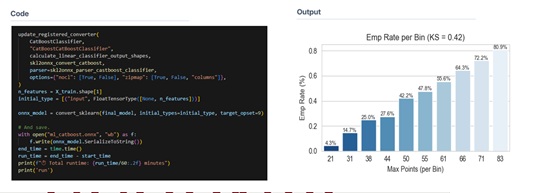
KOSMOS 2.0 involves testing advanced analysis and prediction technologies. The project uses machine learning models trained and managed with AWS SageMaker, applying regularisation and validation techniques to improve system accuracy. It also develops complex transformations of structured data drawn from employment records, educational background and soft-skills questionnaires, with the aim of generating predictive variables that traditional banking does not consider.
Another core pillar is dynamic decision workflows, which allow evaluation criteria to be adjusted in real time depending on the type of financing product, the specific training programme or the country. “We want a living system that learns and optimises itself, capable of adapting to each market or school without having to rebuild the entire model,” Avello explains.
In addition, the project includes validation of integrations with external sources, such as credit bureaus where applicable, to enrich the model and avoid false positives. In other countries, such integration will depend on the available infrastructure. “Each market has different systems, and one of our biggest challenges is adapting the model to these differences without losing technical consistency,” he adds.
This leap in technical complexity—which requires more data, more experimentation and more sophisticated models—has been possible, according to Avello, because European funding lowers entry barriers to building proprietary technology, especially in sectors where innovation is essential. “Thanks to this support, solutions like our alternative scoring reach the market sooner and benefit groups that would otherwise be excluded.”
The project’s main challenge is, paradoxically, its very raison d’être: predicting future employability using partial, heterogeneous and often incomplete information. Most students have short or non-existent work histories and come from very diverse educational backgrounds. “It is difficult to build a robust model when the traditional data used by the financial sector simply does not exist. That is why we need alternative variables and an infrastructure that allows us to assess them properly,” Avello explains.
Differences between countries add further complexity: data availability, regulatory frameworks and official systems are not homogeneous. However, the company has chosen to design a modular system capable of integrating with different sources or operating with alternative approximations when official data is not available.
The defining feature of Bcas’s scoring system is its focus on financial inclusion based on employability potential. Unlike traditional models that consider only credit variables, the company’s approach evaluates students from a comprehensive perspective. “Our scoring is aligned with the student’s success. We only charge if they find a job and exceed the monthly salary threshold of €1,416. That forces us to be very precise, because if we get it wrong, we earn nothing.”
This approach contrasts with what international consumer credit competitors offer. According to Avello, “none of them truly focus on the student’s potential. They either apply strictly financial criteria or assess risk very superficially. We go into detail: what the student studies, how much demand there is in that sector, what experience they have, what skills they demonstrate and their real probability of employment.”
Bcas’s growth is supported by a scalable system based on training centres as its main channel. After signing an agreement with a school, the institution regularly refers students who need financing, enabling organic growth with low commercial costs. “Each centre is a node. Once one starts working with us, it becomes a stable flow of students. It’s a model that scales very well,” Avello notes.
The expansion strategy focuses on Spain and Europe, with particular emphasis on high-employability sectors such as technology, cybersecurity, industrial vocational training and renewable energy. While Latin America is a market with potential, the current roadmap prioritises European countries where guarantees from the European Investment Fund exist, as is already the case in Germany. “We do not want to enter markets for which we are not yet operationally prepared. Europe is where we can replicate our model most safely,” he states.
The expected impact over the next five years is clear. On the social front, the company estimates that thousands of students will gain access to quality education thanks to the alternative scoring developed through this project. “This genuinely helps reduce inequality. Access to education will no longer depend on family income, but on talent and effort,” Avello argues.
From an economic perspective, Bcas aims to become Europe’s leading education finance provider. Improved scoring accuracy will be critical to expanding the number of partner institutions, reducing risk and entering verticals such as vocational training and regulated education. “If we accurately analyse future employability, we can finance more students with lower risk. That is the basis for sustainable scaling,” he explains.
At this point, Avello highlights the structural importance of public support: “Thanks to this funding, we can finance students that banks would not serve. This has real effects on social mobility, future productivity and the country’s competitiveness.”
The Centre for the Development of Technology and Innovation (CDTI E.P.E.) is the innovation agency of Spain’s Ministry of Science, Innovation and Universities. Its mission is to promote technological innovation within the business sector, enabling Spanish companies to generate and transform scientific and technical knowledge into globally competitive, sustainable and inclusive growth. In 2024, as part of a new strategic plan, CDTI provided more than €2.3 billion in support to Spanish companies and startups.
More information:
Web: www.cdti.es
Linkedin: https://www.linkedin.com/company/29815
X: https://twitter.com/CDTI_innovacion
Youtube: https://www.youtube.com/user/CDTIoficial
Photo: Software de Bcas' Software

cloud technology axon

Addleshaw Goddard (AG), the London-headquartered international law fir...