The startup Roseo Eólica Urbana is developing, with the support of CDTI Innovación and the European MRR funds, a business plan to bring its pioneering urban wind energy solutions to market. These solutions allow for the assessment, utilization, and management of building-generated wind as a clean, silent, and efficient energy resource.
Amid the ongoing energy transition, the search for new ways to generate clean, decentralized energy is more urgent than ever. If photovoltaic solar energy has conquered rooftops, urban wind energy is now emerging as a way to harness another inexhaustible resource: city winds.
In this context, Roseo Eólica Urbana has developed technology capable of converting urban wind into electricity efficiently and sustainably. The project began in 2017 at the Éibar School of Engineering, where years of research on renewable energy were conducted. As a result of this work, the company was founded in 2020 with the goal of bringing wind energy into urban environments and transforming it into a real source of clean, distributed generation.
The founding team identified an opportunity that had previously gone unnoticed: urban wind. As Ariana Martín, CEO and co-founder of the company, explains, “During our research phase, we identified an underutilized energy resource, mainly due to the technical and structural limitations of conventional wind turbines.”
Roseo’s mission is clear: to bring wind energy into cities and urban environments, promoting a distributed generation model that reduces dependence on the electrical grid and accelerates the transition to a more sustainable and decentralized system. “We want to transform the potential of urban wind into a real source of clean energy,” Martín summarizes.
To achieve this, the company set out to develop technologies that integrate wind energy into urban environments without altering building architecture or generating noise disturbances. The result is Rosbi and Anemoi, two complementary technological solutions that allow for the assessment, utilization, and management of urban wind as a viable energy resource.
Innovation to harness urban wind
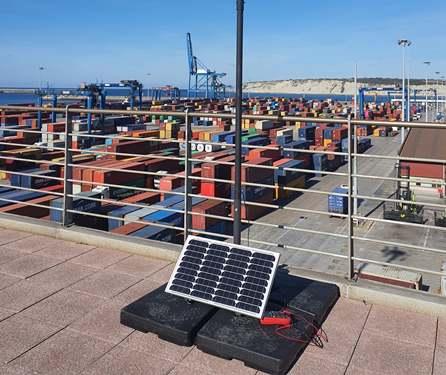
The company’s first development, Anemoi, is a technological tool that analyzes urban wind behavior while considering the topographical characteristics of each environment. Its operation is based on a proprietary calibration method that combines IoT sensors, statistical models, and microscale simulations to provide a precise assessment of the wind potential of each building or area.
“Anemoi adds value to each client’s energy strategy by offering a comprehensive and practical view of urban wind resources. Its integrated approach enables informed decision-making in areas where wind is a key factor,” Martín explains.
The company’s second pillar, Rosbi, is a modular wind turbine designed for direct integration on building rooftops. Its design does not require a mast, produces minimal noise or vibrations, and aesthetically adapts to the architecture.
“We have developed a concentrator system that increases incident wind speed by up to 270%, significantly improving energy efficiency,” highlights the CEO. Additionally, Rosbi can be hybridized with photovoltaic systems, allowing for combined generation curves and maximizing the use of renewable resources in buildings.
The synergy between the two developments is essential. “Anemoi determines the orientation, location, and areas of greatest wind potential on the rooftop, while Rosbi converts that knowledge into electrical generation. This way, we optimize each installation from the start and ensure maximum energy performance,” Martín notes.
Both solutions are 100% in-house developments by Roseo, resulting from R&D that combines engineering, data analysis, and industrial design. This has allowed the company to create a pioneering proposition that digitalizes urban wind assessment and materializes its utilization in an aesthetic, modular, and efficient manner.
From development to industrialization
The Neotec initiative from CDTI Innovación, co-financed with European Recovery and Resilience Mechanism (MRR) funds, has been a turning point for the company. With this support, Roseo is developing a strategic business plan that will allow it to move from technological development to industrialization and commercial expansion.
“Thanks to CDTI’s support through Neotec, we are consolidating a plan that enables us to transition from research to industrialization. The main objective is to advance the certification and industrialization of the Rosbi wind turbine, establishing a local, sustainable, and scalable manufacturing process that ensures its quality, reliability, and competitiveness,” explains the CEO.
The plan also includes the evolution of Anemoi into a SaaS (Software as a Service) model, allowing the technology to be offered as a digital, automated, and accessible service. “We aim to fully digitalize the analysis of urban wind resources to make it accessible, replicable, and global,” adds Martín.
Furthermore, the company is building a network of industrial and technological partners to drive growth and accelerate its expansion in Spain and other European markets. “This business plan lays the foundation for establishing Roseo as a benchmark in urban wind energy, combining technological innovation, sustainability, and economic development,” she highlights.
Neotec’s support has also had an organizational impact: “It has allowed us to professionalize the company structure, incorporate new talent, and consolidate a multidisciplinary team combining technical, management, and innovation profiles,” Martín states. According to the CEO, this support “has been decisive in moving from technical validation to commercial traction, increasing Roseo’s visibility and positioning within the innovation ecosystem.”
Clean energy with social and urban impact
Roseo’s commitment goes beyond technological innovation. Its approach seeks to generate a positive impact both environmentally and socially. “We want buildings to become protagonists in the energy transition without losing their identity or architectural value,” Martín affirms.
Rosbi utilizes underused urban spaces, such as rooftops, transforming them into active points of renewable generation without altering the landscape or generating significant noise or vibrations. “We demonstrate that sustainability and architecture can coexist elegantly, practically, and profitably,” she adds.
Each project also promotes the creation of qualified local employment and supports a proximity-based production model, reducing the carbon footprint associated with transportation. In this sense, Roseo’s technologies contribute directly to several Sustainable Development Goals (SDGs), especially SDG 7 (affordable and clean energy), SDG 11 (sustainable cities and communities), and SDG 13 (climate action).
Challenges and opportunities in urban wind energy
The urban wind energy market is still emerging, and Roseo faces the challenge of paving the way. “The main challenge is cultural: raising awareness that wind energy also has a place in cities,” explains Martín. “It is essential that, when forming an energy community or planning a generation model, small-scale wind energy is considered a viable and complementary alternative.”
Despite this, the opportunities are significant. Urban decarbonization policies and growing demand for self-consumption create a favorable scenario. “We believe urban wind will naturally complement photovoltaics, generating energy at different times of the day and helping achieve nearly zero-energy or even self-sufficient buildings,” the CEO points out.
Looking ahead: towards self-sufficient cities
For the coming years, Roseo’s vision is optimistic: “We aim to be a European benchmark in urban wind energy, with Rosbi installed on public and private buildings in various countries,” says the co-founder. The company also expects Anemoi to become a global digital platform for analyzing and monitoring urban wind resources.
Roseo’s goal is clear: “To demonstrate that urban wind is a real, valuable, and transformative resource capable of driving smarter, self-sufficient, and sustainable cities,” concludes Martín.
CDTI Innovación
The Centre for the Development of Industrial Technology and Innovation (CDTI E.P.E.) is the innovation agency of the Spanish Ministry of Science, Innovation, and Universities, aimed at promoting technological innovation in the business sector. Its mission is to ensure that Spanish companies generate and transform scientific and technical knowledge into globally competitive, sustainable, and inclusive growth. In 2024, under a new strategic plan, CDTI provided over €2.3 billion in support to Spanish companies and startups.
More information:
Web: www.cdti.es
Linkedin: https://www.linkedin.com/company/29815
X: https://twitter.com/CDTI_innovacion
Youtube: https://www.youtube.com/user/CDTIoficial

cloud technology axon

Addleshaw Goddard (AG), the London-headquartered international law fir...