The common mistake of thinking that more EBITDA always means a higher valuation
“Last year we reached a record EBITDA of one million, and I think it’s time to sell the company. How much do you think my business could be worth? I’ve read that companies in my sector usually sell for 7 or 8 times EBITDA…”
“Off the top of my head, it’s hard to say. What were your sales that year?”
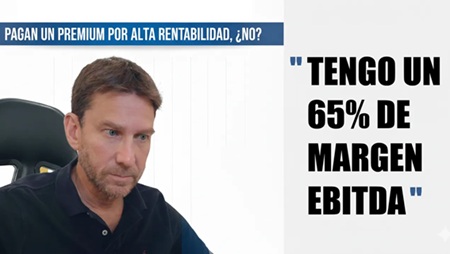
“Just over one and a half million euros. We have a 65% EBITDA margin. We’re super profitable—I think any buyer will be blown away by our profitability. Buyers pay a premium for high profitability, right? Joshua, do you think we could be valued at 8 million?”
“Let me look into it, but I don’t even know whether there’s a buyer for a company like yours…”
A classic mistake in M&A is thinking that the more profitable your company is, the higher the multiple a buyer will pay. The reality is that if your margins are too high compared to what is “normal” in your sector, buyers are more likely to adjust the multiple downward rather than pay a premium.
Why?
Because in M&A transactions, the buyer is not buying your company’s past, but its future: a professionalized business, independent from the founder (or founders), with sustainable margins.
If profitability appears unsustainable, the buyer will discount that risk.
In the specific case of the company in the opening dialogue, the main issue is the combination of an unusually high EBITDA margin and very low sales.
If sales are only €1.5 million and EBITDA is €1 million, total cost of sales and operating expenses amount to just €500,000. As a starting point, it is reasonable to assume this is a company with very few employees—probably between 5 and 7 people—and no management team. In other words, it is almost entirely dependent on the founder.
The high profitability is likely a direct consequence of the company being a micro-business in terms of revenue, offering a service or serving a type of client willing to pay premium prices. The big unknown is whether this model is truly scalable.
Beyond the difficulty of finding a buyer for a company with such low revenues and such a limited structure—which is already not easy—it is also unlikely that the entrepreneur will be willing to sell the company at the price that a potential buyer, if one appears, would be willing to pay.
The buyer will likely not want to acquire a company that is so dependent on a single founder. They will adjust the numbers by assuming the addition of a management and control team, with higher costs and a lower normalized EBITDA.
In addition, they will prudently apply sales and operating costs more in line with the market in their forward projections, which will significantly change the business’s profitability—resulting in yet another EBITDA adjustment.
After these adjustments, the company would likely end up with an EBITDA margin more in line with the sector, albeit at the higher end of the range—for example, around 35% in this specific case. From there, the buyer will also adjust the offer to reflect the risk of acquiring such a small company, and it is not uncommon for the final proposal to be, say, 3 times last year’s EBITDA—an amount that the entrepreneur will clearly find insufficient.
“For that price, I’d rather wait three years and generate the same profit you’re offering to pay me.”
This is a fairly common fallacy. EBITDA is not the same as the dividend one can actually take home. Taxes, working capital needs, and other factors mean that, in practice, it may take five or six years to extract as dividends an amount equivalent to 3 times EBITDA.
But even setting that aside, the reality is that many times the offer received by a very small company—once adjusted for risk and structure—simply does not match the seller’s expectations. The entrepreneur wants to sell the company as it is today. The buyer is valuing the company as they believe it will be tomorrow, once professionalized and with risks discounted. This difference in perspective makes reaching an agreement particularly difficult for this type of company.
Customer concentration
If a very significant portion of profits comes from a single, highly profitable customer that could disappear tomorrow.
Low costs—but at what price?
Below-market salaries, sustained by a team very loyal to the founder and a start-up-style management model that is hard to maintain in a more professionalized and larger structure.
Unusual margins
Exceptionally high prices for products or services that may not be sustainable over time, or abnormally low sales costs.
Lack of investment
No investment in people, technology, or marketing, compromising future growth.
Pre-M&A window dressing
Artificial reduction of key costs, postponement of necessary investments, etc.
Track record of margins
If you’ve maintained these margins for years, it’s not a coincidence.
Clear competitive advantage
A defensible moat, such as proprietary technology, a differentiated business model, or long-term contracts.
Contracts or recurring revenues
Tangible proof of future stability.
Realistic cost structure
Not dependent on exceptionally low or unusual costs.
Consistency in growth
Steady, well-structured growth, not just a one-off spike.
If you can demonstrate all of this, you won’t just be able to defend the average EBITDA multiple for your sector—you may even aspire to a higher one.
By Joshua Novick, partner at Bondo Advisors
Source: https://www.joshuanovick.com/p/y-si-tu-empresa-es-demasiado-rentable

cloud technology axon

Axon Partners Group, Tresmares Capital, Sabadell Venture Capital, Inve...