The Third Sector of social action in Spain is made up of nearly 28,000 organizations which, mostly small and locally focused, support close to 610,000 professionals and represent 1.2% of national GDP. Its recent evolution, captured in the report The Third Sector of Social Action in Spain (2008–2024), reflects a counter-cyclical sector that intensifies its activity during times of crisis and responds to social challenges such as aging, exclusion, immigration, and changes in care systems.
Despite the fact that Third Sector organizations in Spain reached 28 million beneficiaries in 2023, the global context shows that social challenges are evolving faster than the solutions available. The United Nations’ Sustainable Development Goals Report 2025 warns that most SDGs are off track, highlighting a growing gap between needs and response capacity that calls for new forms of collaboration and innovation.
In response to this reality, a new approach has gained momentum: systemic change, understood as the ability to transform the rules, relationships, and narratives that sustain social problems, rather than merely mitigating their effects. To explore how this movement can redefine the role of the Third Sector and its contribution in this new scenario, we speak with Sonia Mulero, Executive Director of the Banco Sabadell Foundation. We begin by asking:
1. Looking back over the past decade, how would you assess the transformation of the Third Sector in Spain, and which changes do you consider most significant?
Without a doubt, professionalization has been one of the most relevant transformations of the Third Sector in recent decades. Some time ago, many organizations operated with unstable structures and a strong volunteer base. While this less formal model was essential to fostering solidarity and civic engagement, the shift toward more professional management has not meant losing that commitment, but rather complementing it with tools that ensure sustainability, transparency, and greater impact.
This combination of social vocation and professional practices enables the sector to address complex challenges such as digitalization, funding diversification, and accountability, consolidating its role as a key actor in contemporary society. And this is precisely where the B-Value program has contributed—and aims to continue contributing.
2. What are the main barriers the sector currently faces?
We live in a global context marked by unprecedented volatility, where change happens at great speed. This reality directly impacts the Third Sector, which must adapt to an uncertain and highly dynamic environment.
On the one hand, there is a need to move toward alternative models of economic sustainability that complement traditional sources with innovative strategies: income generation through services with social impact, multisector partnerships, blended finance, and digital tools to optimize fundraising. Diversification not only reduces risk but also strengthens autonomy and the capacity to invest in strategic projects. Alongside financial sustainability, talent management becomes a key challenge.
The sector requires specialized profiles in areas such as digital transformation, data analysis, communication, and partnership development. Added to this is digital transformation, which not only involves adopting new tools but also ensuring that technology reaches all organizations and users. Artificial intelligence, for example, offers opportunities to improve efficiency, personalize services, and optimize processes, but its adoption requires support and training. The challenge lies in facilitating access and capacity-building, ensuring that no organization is left behind. In this regard, it is essential that, as a sector and as strategic partners, we support both organizations and their beneficiaries throughout this digital transition.
“No one can change the world alone.”
3. From your perspective, what does it mean to talk about “systemic change” in the Third Sector, and why do you think this approach is gaining relevance now?
Believing in systemic change means recognizing that real impact is not achieved solely through direct action, but through strategies that connect all stakeholders. It involves working in networks, sharing knowledge, innovating funding models, and leveraging technology—including artificial intelligence—to scale solutions. Everything starts from a premise that I personally find very powerful: no one can change the world alone. No single organization can solve such complex social challenges on its own. Systemic change offers a comprehensive response based on collaboration, generating improvements that do not merely alleviate symptoms but redefine the system toward greater equity and sustainability.
That is why collaboration is part of the Banco Sabadell Foundation’s DNA. We not only promote it internally as part of our culture, but also externally, valuing and supporting this vision that connects efforts and multiplies results. We believe that only by working together can we generate the impact society needs.
4. What structural conditions—resources, management models, innovation, or partnerships—are necessary for organizations to act on root causes rather than just symptoms?
From a systemic change perspective, everything starts with people, because organizations are, at their core, people. That is why we have invested in strengthening leadership models and creating spaces where people can meet, dialogue, train, and share knowledge.
It is very inspiring to see what happens in programs like B-Value. Many participants begin thinking they won’t be able to move forward with their value propositions, that their ideas are too ambitious. But thanks to the generosity of mentoring and the training they receive, everything starts to shift. They discover that they can succeed, that with support and collaboration, change happens. Mentorship, in particular, becomes a very powerful tool, especially when Banco Sabadell colleagues share their experience with Third Sector organizations. That connection—the exchange of knowledge and perspectives—makes all the difference.
So when we talk about driving structural change, what is often needed is to build a shared culture, a common purpose, and the generosity to collaborate. When people align around a goal and support one another, change stops being an idea and becomes reality. It may sound ambitious, but daily experience in the projects we support shows that it works.
After reflecting on the current Third Sector landscape and the deep changes demanded by today’s context, it is essential to understand how organizations working alongside the sector are contributing to strengthening its capabilities and supporting its evolution. The Banco Sabadell Foundation has played a consistent role in this regard, fostering talent, innovation, and impact-driven models that empower organizations. That is why we wanted to delve deeper into your perspective and experience.
“Innovation is not only about technology; it is also about trust, generosity, and the willingness to do things differently.”
5. How does the Banco Sabadell Foundation understand its contribution to strengthening the Third Sector and promoting transformative solutions?
At the Banco Sabadell Foundation, we learn every day from the organizations we work with, and above all, we devote a great deal of time to listening—truly listening—to what they need. We often say that the Third Sector must adapt to a changing world, but we must do so as well. If we want to be close, we must evolve alongside them. And there is something that sets us apart: we dare to experiment and trust ideas, no matter how innovative they may be. We like to test new forms of collaboration, create spaces where ideas can emerge, and support processes that lead to transformation. Because innovation is not just technology; it is also trust, generosity, and the desire to do things differently.
We invest in programs that promote leadership, training, and partnerships, because we believe true impact is achieved when we connect talent, knowledge, and purpose. In short, our way of contributing is simple: staying close, listening, learning, and daring to take steps that help organizations grow and generate transformative solutions. That is what motivates our entire team every day.
6. Based on your experience supporting social organizations, which needs emerge most frequently?
Beyond the traditional search for new funding formulas, in recent years we have identified something that truly makes a difference: the importance of leadership and communication. Leadership, because today’s challenges are complex and require people capable of inspiring, mobilizing, and making decisions in uncertain environments. And communication, because doing things well is not enough—you must be able to tell your story and connect with society, donors, and partners. Many organizations have extraordinary projects, but if they cannot convey their value, they miss opportunities for collaboration and sustainability. That is why we believe the future lies in strengthening these two levers.
We support programs that help develop leaders with strategic vision and the skills to manage diverse teams, alongside the ongoing need to reinforce technological adoption. The leadership social organizations need today is not hierarchical or rigid; it is modern, cross-cutting, and diverse. A leadership style that understands influence as the ability to build trust, that communicates to inspire and mobilize, that forges strategic alliances, and that leads people with empathy and collaboration. Leaders who integrate different perspectives, work in networks, and adapt to changing environments without losing sight of their social mission. This evolution is key for organizations not only to survive, but to grow and amplify their impact.
Another recurring need is strengthening community-based intervention models in the neighborhoods and territories where organizations operate. Societies are increasingly complex, and citizen participation becomes a critical factor in generating real impact. Engaging young people, vulnerable groups, and local residents in building solutions is essential, especially as they themselves face new vulnerabilities: precarity, isolation, and digital divides. Organizations tell us they need tools and methodologies to activate participation, build trust, and create strong local networks that sustain long-term social change.
7. How do you integrate areas such as culture, science, and social impact into a strategy aimed at activating talent and fostering innovation with transformative intent?
We start from a very clear conviction: youth and young talent are the backbone of our purpose. We believe investing in them is one of the best investments a society can make to build its future. Youth represents talent, openness to the world, and the ability to imagine what does not yet exist. But that talent must be nurtured, activated, and supported. We have defined key areas such as culture, science, and social impact because they are multidisciplinary fields with significant untapped potential for transformation.
Culture, for example, has much to learn from the Third Sector in terms of social impact and measurement, while the Third Sector can benefit from the creativity and narrative power of culture. We want these worlds to engage in dialogue, inspire each other, and grow stronger together. Our strategy aims to activate talent and promote innovation with transformative intent—creating environments where young researchers, creators, and social entrepreneurs can connect, collaborate, and experiment. We want science to engage more closely with society, culture to embrace new narratives, and social impact to be measured not only in numbers but in real changes in people’s lives.
We support both experimental projects and young trajectories, whether established or emerging, through our project calls and co-created initiatives that allow us to work closely with ecosystem players and respond to emerging needs with agility and creativity.
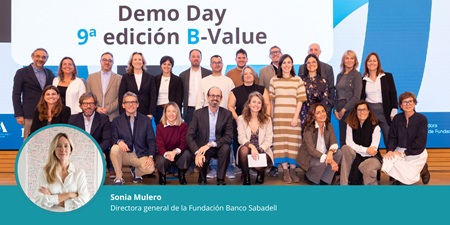
Over the past ten years, the Banco Sabadell Foundation and the Ship2B Foundation have driven B-Value, a transformation program for social organizations that has mobilized €1.5 million in financial support and pro bono assistance, directly benefiting 46 organizations and providing a full professionalization process to 93 entities. This journey has helped promote projects from a strategic perspective, design new income-generation models, strengthen value propositions, and encourage a shift toward more innovative and sustainable sector models, moving away from traditional philanthropic approaches. With this experience in mind, we asked:
8. What does reaching the tenth edition of a program that works directly on transforming Third Sector organizations mean to you?
Reaching the tenth edition is far more than a milestone; it confirms that the idea conceived years ago remains necessary and relevant. I clearly remember how it began—from conversations between the Banco Sabadell Foundation and the Ship2B Foundation about how to go further, how to turn gaps into opportunities and strengthen a sector that supports thousands of people every day across many fields. Reaching ten editions reaffirms that need and demonstrates the program’s value and the trust organizations place in us year after year. We have consolidated a network of strategic partners that provides real value: pro bono support, financial resources, and a shared fund that is now one of the most significant in the country.
Much has changed over these ten years, and I believe we have adapted well to new sector needs. Today, technology plays a decisive role—ten years ago, artificial intelligence was not even part of the shared narrative. New challenges and demands have emerged, but the program’s essence remains: supporting, strengthening, and transforming organizations so they can generate the greatest possible impact.
The most rewarding moment comes after the program ends, when we talk with participating organizations. Hearing how their ways of working have changed, how their impact has grown, and how better prepared they feel to face future challenges is the clearest proof that the effort is worthwhile.
Another important aspect is the follow-up after the program ends. Over these ten years, we have stayed in touch with organizations from the first edition to the most recent ones—continuing to connect, share learnings, and build bridges. For us, it is not just a one-off program, but the creation of a network of alliances that grows and evolves over time. Today, we can say that B-Value has become a reference space where organizations not only strengthen individually, but also learn to see themselves as part of a broader ecosystem.
“The Third Sector is not only an implementer of social solutions; it is a key actor in sustaining cohesion, dialogue, and equality in increasingly complex societies.”
9. What message would you like to convey to social organizations rethinking their impact model and considering participation in a transformation program like this?
First and foremost, I would like to tell them that we are here to contribute and to grow together. We offer a proven collaboration model backed by ten years of experience, with a team sensitive to their concerns and committed to their purpose. This program provides space to ask key questions, reflect on impact models, and explore new opportunities, always respecting each organization’s essence. Participating means entering a safe space where they can connect with strategic partners, access proven resources and methodologies, and share learnings with other organizations undergoing transformation. We know rethinking a model is not easy, but it is an opportunity to strengthen mission and amplify impact.
I would also like to reiterate the importance of the Third Sector’s involvement as a crucial actor in maintaining dialogue and mutual respect in complex societies and in safeguarding equal opportunities. It is a sector that must be prioritized, because its role is essential in addressing the challenges of the future. It is important to understand that the Third Sector is not merely an executor of social solutions; it is a key actor in sustaining cohesion, dialogue, and equality in increasingly complex societies

cloud technology axon

Addleshaw Goddard (AG), the London-headquartered international law fir...