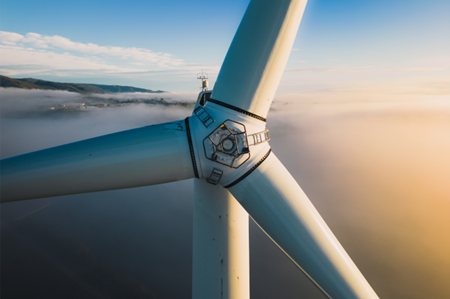
The Ministry for the Ecological Transition and the Demographic Challenge (MITECO), through the Institute for Energy Diversification and Saving (IDAE), has published the preliminary list of 149 projects selected under the second call of the Circular Repowering programme (REPOTEN 2), which provides aid for the modernization of old wind farms and hydroelectric facilities of up to 50 MW. The provisional resolution proposal includes 80 initiatives for wind turbine modernization and 69 projects for the technological and environmental upgrading of hydroelectric plants of up to 50 MW, distributed across almost the entire country.
Backed by €512 million from the NextGenEU funds under the Recovery, Transformation and Resilience Plan (PRTR), with a 75% budget increase to meet the high level of demand, this second edition reinforces the technological upgrading promoted by the first call, in which €186 million had already been awarded. In this way, greater energy efficiency is guaranteed through a reduction in the number of wind turbines and the ability to operate in “grid-forming” mode, both in Spain’s wind energy fleet and in a significant number of small hydroelectric plants.
The list published by the IDAE, which manages the REPOTEN 2 programme, highlights the broad territorial distribution of the projects, which are spread across all autonomous communities except the Balearic Islands. Particularly noteworthy are the 35 applications in Galicia — 25 in wind farms and 10 in hydroelectric plants — followed by 24 projects in Andalusia (18+6) and in Castile and León (8+16).
Storage and generation
Most of the initiatives selected at this stage correspond to wind repowering projects — programme 1, with a €462 million budget — while around one third of the hydroelectric modernization projects — programme 2, with €50 million — incorporate hybridized storage systems. Altogether, they amount to 2 GWh of new storage capacity and an additional generation capacity of 3.3 GW, mobilizing total investment exceeding €3.7 billion.
Given the provisional nature of the resolution proposal, and following the mandatory allegations period, the projects ultimately selected as beneficiaries may vary in the final resolution, as may the aggregated results.
The call is carried out under a competitive selection process, meaning that the allocation of aid takes into account criteria such as the reduction of the requested subsidy, administrative feasibility, degree of innovation in supporting the electricity system, location in Just Transition and Demographic Challenge areas, as well as resilience criteria aimed at strengthening the national and European value chain.
The initiatives selected as beneficiaries must be completed before 30 June 2030, with the possibility of extension until 31 December 2030, in accordance with the recent ministerial order issued by MITECO adapting the regulatory framework of several PRTR incentive programmes to the aid scheme criteria defined by the European Commission.
New RENOVE plan
The technological leap represented by this new RENOVE plan will lead to better use of renewable resources at already occupied sites by replacing obsolete or old systems with new state-of-the-art equipment. This will enable systems and equipment to become more productive and incorporate innovations aimed at mitigating environmental impacts; they will also have greater capacity to provide balancing and support services to the electricity system. In addition, repowered facilities will help consolidate and generate economic activity in rural areas.
In the case of wind technology, repowering also reduces landscape impact and land occupation by replacing a large number of small, old wind turbines with fewer larger units. In the projects subsidized under the first call, already operational or still under development, each new, larger and more powerful turbine replaces approximately seven older machines.
Likewise, the modernization of hydroelectric generation equipment and infrastructure, together with the incorporation of automation systems, boosts energy efficiency and enables environmental improvements. These include, among others, new fish passages to facilitate the migration of aquatic species, ensuring minimum ecological flows and sediment transport, as well as measures for territorial integration and the protection and restoration of specific habitats.
The initiatives included under the Circular Repowering aid schemes are aligned with Spain’s revised 2023–2030 National Energy and Climate Plan (PNIEC) and with the Strategic Project for Economic Recovery and Transformation (PERTE) for Renewable Energies, Renewable Hydrogen and Storage (ERHA).

cloud technology axon

Addleshaw Goddard (AG), the London-headquartered international law fir...