The Basque Government’s Minister for Industry, Energy Transition and Sustainability, Mikel Jauregi, presented this morning the “Priority Action Areas of the Basque Energy Agency (EVE) through 2030,” identified for the deployment of large-scale wind and photovoltaic generation facilities in Euskadi.
With this step, Euskadi would double its renewable electricity generation capacity in order to move towards energy autonomy. The objective is to ensure greater security of supply, industrial competitiveness, and social well-being.
Speaking at a press conference following the Government Council meeting, Mikel Jauregi stated: “In Euskadi, we must move forward in energy autonomy through the development of our own renewable electricity generation capacity. Energy autonomy is a strategic necessity for Europe and for Euskadi in the face of the new geopolitical reality. We want to strengthen Euskadi’s energy autonomy and security so that our households and industries are less vulnerable to external energy shocks.”
Jauregi announced that the Basque Government, through the EVE and in collaboration with private partners, will commit to large-scale photovoltaic and wind developments by co-investing €80 million alongside industrial partners through 2030. These wind and solar projects are expected to increase generation capacity by 450 MW. Together with an additional 300 MW of self-consumption capacity planned by 2030, this would double domestic electricity generation, improving the ratio from 7.9% to 15%.
In this regard, the EVE will accelerate its work with potential industrial partners to develop projects in the identified priority action areas through 2030.
“We need to advance the development of wind and photovoltaic electricity generation capacity at all levels,” the minister noted. “Every effort counts and is necessary. Starting with self-consumption, we also need a clear commitment to large-scale wind and solar developments. This will be a realistic and rational rollout, with a positive local impact. Greater energy autonomy with more renewables in better locations.”
Over the past five years, installed self-consumption capacity in Euskadi has increased by 186 MW, rising from 7 MW in 2020 to 193 MW in 2025. This trend is expected to help reach European levels of self-consumption before 2030.
The co-investment for large wind and photovoltaic projects through the EVE was included among the measures of the industrial protection plan approved by the Basque Government. Specifically, it falls under the Strategic Autonomy pillar, endowed with €215 million to strengthen the resilience of the Basque energy system.
Conditions of the EVE Model for a “realistic and rational” rollout
The “Priority Action Areas of the EVE through 2030” have been selected using the “EVE Model,” which establishes the conditions for a “realistic and rational” deployment of renewables in Euskadi.
The EVE Model prioritizes locations that meet the following criteria, in order:
These criteria translate into three public maps that guide EVE’s actions. In this way, deployment is concentrated where there is the greatest resource, least impact, proximity to the grid, and economic potential.
Flagship projects and 2030 horizon
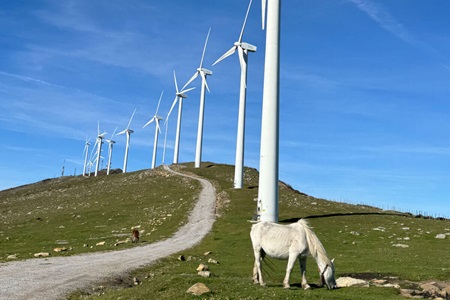
The EVE Model is already being applied to projects that will act as drivers of the new rollout. These include the Labraza Wind Farm (40 MW) and the Ekienea photovoltaic plant (108 MW), which will be the largest in Euskadi.
These milestones address two decades without new large-scale wind farms—the last being Badaia (50 MW)—and build on references such as the Ekian solar plant (24 MW, 2020).
It is worth noting that Euskadi starts from a position where domestic renewable electricity production accounted for 7.9% of electricity consumption in 2024, compared to a European average of 46.9%. The new approach accelerates local generation to bring the region closer to continental standards, combining the growth of self-consumption installations—small and medium-sized—with large-scale wind and solar developments in optimal locations.
Maps and priorities
Map 1
Identifies “environmentally and urbanistically viable areas” (with wind/solar resource). These are areas with low impact and sufficient renewable resource, according to territorial and urban planning.
Map 2
Identifies “viable areas near substations,” within 15 km. It filters Map 1 areas based on proximity to grid connections, ensuring efficient electricity evacuation and reducing infrastructure needs, timelines, and impacts.
Map 3
Highlights the final “EVE Priority Action Areas through 2030.” It integrates environmental and planning viability, grid proximity, and commercial feasibility.
This map will guide EVE’s co-investment and the preparation of mature projects for 2026–2030, with a phased schedule and ongoing dialogue with local administrations
More info: Web EVE
Image: Labraza Wind Farm

cloud technology axon

Addleshaw Goddard (AG), the London-headquartered international law fir...