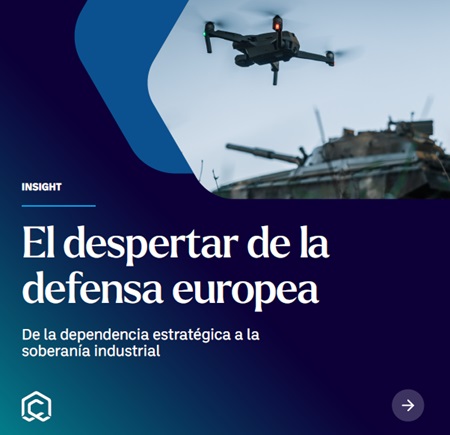
Europe faces its most decisive moment in defense since the end of the Cold War, with immediate implications for companies across the continent
A prolonged war on Europe’s eastern flank, growing geopolitical fragmentation, and shifting U.S. priorities have called into question the foundations upon which Europe has historically built its security framework.
It is clear that Europe needs to rearm and can no longer assume that others will do the heavy lifting—whether in politics, industry, or finance.
This is undoubtedly a challenge in the military domain, understood as the defense and resilience of each nation. Europe’s ability to defend itself will depend not only on political will but also on whether it can rebuild a defense industrial base that is scalable, resilient, and genuinely competitive across air, land, maritime, space, and cyber domains.
From strategic comfort to strategic autonomy
For decades, Europe benefited from a certain strategic comfort.
NATO provided deterrence, the U.S. supplied technological leadership, and Europe focused on incremental capability development while prioritizing social and economic agendas. That balance no longer holds.
The United States is increasingly focused on the Indo-Pacific. Domestic political pressures limit long-term foreign commitments. The well-known slogan “America First” is rapidly becoming a structural reality.
Europe must therefore accept that access to U.S. platforms, technologies, weapons, and logistical capabilities cannot be taken for granted, neither in scale, speed, nor political reliability. This reality is already influencing purchasing decisions, strategic alliances, and M&A operations.
Strategic autonomy is not ideological; it is practical—especially for companies making long-term investment and capability development decisions.
Rearmament is an industrial, not just a budgetary, challenge
Defense rearmament is often framed as a debate about spending. In reality, it is a question of industrial organization.
Europe does not lack engineering talent, innovation, or specialized capabilities. What it lacks is cohesion.
Across air, land, and naval systems, Europe still operates dozens of parallel platforms, incompatible standards, and fragmented national supply chains. This fragmentation raises costs, slows production, complicates maintenance, and weakens interoperability. In a high-intensity conflict, it simply does not work.
The focus must now be on common platforms and interoperable systems at a cross-border scale:
Standardization is not about uniformity for its own sake—it is about speed, resilience, and industrial depth.
Alignment of politics, industry, and capital
This transformation cannot be driven by governments alone, nor solely by large prime contractors.
Rearmament at scale requires alignment among four groups:
Here, M&A becomes a strategic tool, not just a financial exercise.
M&A as a catalyst for Europe’s defense readiness
Across Europe, M&A activity is transforming the defense ecosystem, driving greater scale, deeper specialization, and international expansion.
The sector is expected to remain highly attractive over the next five years, driven by rising defense budgets, continuous technological modernization, and persistent geopolitical tension. Financing remains available, regulatory frameworks are clarifying, and quality assets continue to attract strong interest.
A narrow window to get it right
European rearmament will not happen overnight, but the window to shape it coherently is limited.
If Europe does not consolidate its industrial base on its own terms, consolidation will happen anyway—driven by external capital, fragmented acquisitions, or urgent crisis-driven decisions.
Strategic autonomy requires tough choices: fewer platforms, greater cooperation, significant consolidation, and long-term capital commitment. It also means accepting that defense industrial policy can no longer be purely national in an inherently European security environment.
The tools, capital, and talent exist. What is needed now is execution.
Rearmament goes beyond increasing defense spending; it enters the realm of industrial sovereignty. In Europe, this sovereignty will be built through companies making the right strategic decisions collectively.
Illustrative recent transactions
Recent deals reflect this trend clearly:
In sensors, optronics, communications, armaments, maintenance, and drone systems, the message is consistent: build scale where necessary, preserve specialization where differentiation resides.
The mid-market is more relevant than ever
From our perspective, Europe’s defense ecosystem is not a homogeneous block but a layered network of suppliers, specialists, and scaled platforms:
M&A increasingly connects these layers, vertically and horizontally, creating industrial chains capable of responding rapidly and at scale.
Many of the technologies Europe most needs reside squarely in the mid-market. Supporting these companies to grow, consolidate, and internationalize without losing what makes them exceptional is key to building true industrial sovereignty.
Clearwater
Guillermo Sala – Director, Aerospace & Defense - guillermo.sala@clearwatercf.com

cloud technology axon

Addleshaw Goddard (AG), the London-headquartered international law fir...