Interview with Javier García, CTO and Co-founder of Sycai Medical: “Support from CDTI Innovación and European MRR funds has enabled us to develop a system that improves diagnostic accuracy and early detection of pancreatic cancer.”
In the field of diagnostic imaging, artificial intelligence is driving profound transformations that allow healthcare professionals to detect increasingly complex diseases at ever-earlier stages. Among these, pancreatic cancer remains one of the greatest challenges: its late diagnosis significantly limits therapeutic options and reduces survival rates. In this context, supporting high-impact technologies becomes essential to ensure that new solutions can be transferred to clinical settings and contribute to improving patient outcomes. This is precisely the environment in which Sycai Medical emerges, which counts among its shareholders several funds such as Ship2B Ventures, BStartup, Athos Capital, LUMO Labs, BSocial Impact Fund and Namarel.
From technology to healthcare
Sycai Medical was founded as a Spanish startup dedicated to applying artificial intelligence to medical imaging, originally driven by technological innovation rather than a specific clinical goal. As Javier García, the company’s CTO, recalls: “At the beginning, we didn’t have a specific medical target; we simply wanted to develop advanced image-analysis technology.”
The shift toward healthcare came with an unexpected event: the COVID-19 pandemic. Faced with an urgent need, hospital overload, and a lack of decision-support tools for radiologists, the company developed its first medical imaging software. As García explains: “With the arrival of the pandemic, we faced an urgent need: to support the healthcare system in diagnosing and managing COVID-19 patients. That led to our first product, capable of detecting signs of the disease in chest X-rays.”
This first solution marked a turning point. Its validation in real clinical environments demonstrated the tangible value of their technology and broadened the team’s perspective.
“We realized the enormous potential our technology could have in the medical field, especially in improving the precision and efficiency of imaging diagnostics,” García adds.
From that experience, Sycai Medical redirected its focus toward a high-impact clinical challenge: the early detection of premalignant abdominal lesions, especially those associated with pancreatic cancer. Often asymptomatic in its early stages, this disease is one of the deadliest worldwide. The team identified a clinical gap where AI could make a life-saving difference.
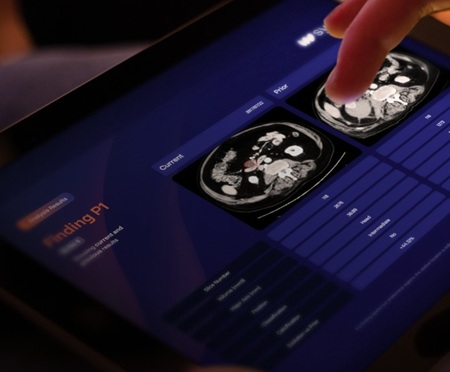
This is how the company defined its current mission: “To detect early and premalignant abdominal lesions from routine radiological studies—even those performed for unrelated reasons,” says García. Their technology, trained on more than 300,000 images and clinically validated, not only detects lesions but also monitors their evolution over time by comparing them with previous studies. “Our patented diagnostic method has proved highly accurate, reliably detecting lesions and tracking their evolution with great precision,” he notes.
A pioneering solution for early pancreatic cancer detection
At the core of the project supported by the CDTI Innovación Neotec program—co-funded by the European Recovery and Resilience Facility (MRR)—is a unique AI solution in Europe. The tool not only identifies premalignant lesions but can also detect and stratify pancreatic cancer itself, providing clinically relevant information about its possible progression.
García explains: “Before CDTI’s support, we had a minimum viable product capable of early diagnosis in patients at high risk of developing pancreatic cancer.”
However, Neotec enabled a decisive leap forward: “Thanks to this initiative, we were able to develop a more sophisticated and clinically powerful solution. We went a step further: we now detect precancerous lesions and pancreatic cancer itself.”
To achieve this, the company developed new neural networks specifically trained to detect and stratify pancreatic cancer—a highly complex technological challenge due to the disease’s heterogeneity in shape, morphology, location, and clinical behavior.
One of the biggest challenges, García acknowledges, was “Designing a set of neural networks capable of learning this heterogeneity across different medical imaging protocols.”
The clinical challenge was equally demanding. Sycai Medical’s system focuses on incidental detection:
“It can alert radiologists to lesions compatible with cancer risk in scans that were not intended to assess the pancreas,” García explains.
This required a highly reliable solution that integrates seamlessly into hospital workflows. “Our goal was to create a tool that enhances early detection, saves diagnostic time, standardizes reporting, and integrates easily with existing systems.”
Validation, clinical benefits and market readiness
The system is based on CT imaging, the most widely used modality for a patient’s initial radiological assessment.
“The neural network was trained on an extensive dataset of CT scans of patients with confirmed pancreatic cancer, as well as others with different diseases or healthy profiles,” García says.
Sycai’s technology has undergone rigorous validation and meets all regulatory requirements, including CE marking and full MDR compliance. It has also been evaluated across multiple hospitals, demonstrating real-world applicability.
“Our product has been validated to ensure reliability and precision,” García confirms.
The result is a fully developed technology now entering commercialization. According to García, it offers numerous benefits to hospitals and clinicians, including:
– Early detection
– Reduced workload
– Standardized reporting
– Elimination of inter-observer variability
– Better understanding of treatment response
Long-term vision
Sycai Medical aims to become a global leader in incidental diagnosis of abdominal cancerous lesions and prediction of their evolution.
“Reaching this goal means not only perfecting the pancreatic solution but expanding the technology to other organs and pathologies, incorporating increasingly advanced predictive capabilities,” García states.
Technology-driven healthcare innovation
In a global landscape where demand for advanced AI tools in healthcare is accelerating, Sycai Medical stands out for its combination of technological innovation, clinical evidence, and strong regulatory commitment. The company plans to extend its training dataset, integrate new clinical and temporal variables, and enhance longitudinal analysis to anticipate lesion evolution.
Toward a future of precision imaging
Today, Sycai Medical represents one of the strongest Spanish bets in AI-assisted diagnostic imaging. Its technology enables earlier detection of one of the most silent and lethal diseases, offering undeniable potential for transforming healthcare systems.
“Our goal is for this technology to become a standard tool in hospitals and radiology centers, improving early detection and ultimately saving lives,” García concludes
CDTI Innovación
The Centre for the Development of Technology and Innovation (CDTI E.P.E.) is the innovation agency of the Spanish Ministry of Science, Innovation and Universities. Its mission is to ensure that Spanish companies generate and transform scientific-technical knowledge into globally competitive, sustainable and inclusive growth. In 2024, under a new strategic plan, CDTI provided more than €2.3 billion in support to Spanish companies and startups.
Image: Sycai Medical technology, a system capable of identifying premalignant lesions and cancer.
More information
Website: www.cdti.es
LinkedIn: https://www.linkedin.com/company/29815
X: https://twitter.com/CDTI_innovacion
YouTube: https://www.youtube.com/user/CDTIoficial

cloud technology axon

This transaction reinforces Alantra’s continued momentum in Aerospac...