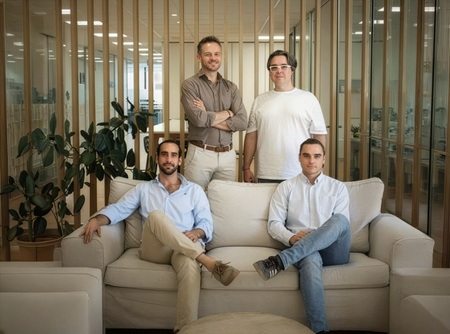
Sybol, a Spanish startup specialized in corporate digital identity and verifiable credentials, has closed a funding round exceeding €1 million to accelerate the rollout of its business verification platform and its corporate wallet based on digital identity.
The transaction combines public and private investment and is backed by the Spanish Society for Technological Transformation (SETT), a public business entity attached to the Ministry for Digital Transformation and Public Administration, as well as a group of investors including Repsol, Grupo Synaptia, Bolboreta Innova Group, Tritemius, Venturade, and Chromata Invest.
With this funding round, Sybol will drive the adoption of its platform in corporate environments, where companies need to share information with third parties in a secure, verifiable, and reusable manner, replacing manual processes and documentation that is difficult to validate.
A corporate wallet ready for eIDAS2
The new European eIDAS2 regulation introduces a common digital identity framework that will allow citizens and businesses to use digital wallets to identify themselves and share verified information across the European Union. In this context, Sybol is developing a corporate wallet aligned with this regulatory evolution and with the Business Wallet model currently being proposed in Europe.
The platform enables companies to issue, manage, and validate digital certificates linked to their digital identity and that of their clients or third parties. These certificates are generated in a standardized and reusable format, facilitating their exchange between organizations and their use as verifiable evidence, without altering existing processes within each organization.
This model replaces traditional document-based processes with traceable digital certificates, reducing operational burden and improving the reliability of information.
Verifiable ESG certificates as the first deployment path
The company’s initial deployments are focused on issuing digital certificates applied to sustainability criteria—an area where information is typically exchanged in document format without traceability or automated validation capabilities, and where multiple criteria from different sources are applied. Thanks to Sybol, certificates are issued linked to the digital identity of both the issuer and the client, in a structured format that incorporates the attributes necessary for direct consumption by third parties—digital, secure, and reliable.
This allows ESG, audit, or reporting platforms to consume the information as reliable digital evidence from the outset, eliminating reliance on manual documents and subsequent validation processes. Certificates therefore evolve from static files into traceable digital evidence linked to unique identities.
This model, aligned with eIDAS2 and the evolution of the European Business Wallet, facilitates exchange between companies, technology platforms, and public administrations, improving data quality and enabling more efficient processes based on trusted information.
“The advancement of eIDAS2 and the European Business Wallet marks a new phase for corporate digital identity. Sybol enables companies to start preparing with a corporate wallet designed for this new framework,” said Raúl López, CEO of Sybol.
A market driven by corporate digital identity
The digitalization of business processes and evolving European regulation are driving the adoption of solutions that enable organizations to certify and share information more securely and in a standardized way.
In this context, Sybol positions itself as a platform focused on corporate digital identity, facilitating the issuance and verification of digital certificates linked to companies, suppliers, and clients, while preparing organizations for new business wallet models.
About Sybol
Sybol is a Spanish startup specialized in corporate digital identity and verifiable credentials. Its platform enables the issuance, sharing, and verification of digital certificates linked to the identity of companies and organizations, facilitating secure information exchange and the digitalization of business verification processes.

cloud technology axon

Addleshaw Goddard (AG), the London-headquartered international law fir...