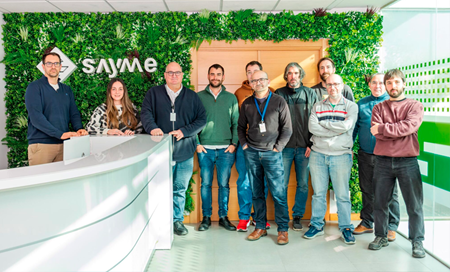
The trajectory of the Cantabrian company Sayme, an Easo Ventures portfolio company, which designs and develops wireless sensors, shows that sometimes it is easier to succeed outside the region than within it.
The company, led by Jesús Murat and now based in the Tanos-Viérnoles industrial park, was founded in 2007 as a spin-off from the University of Cantabria with a clear goal: to implement wireless systems in tower cranes to monitor performance and prevent overloads. However, the economic crisis hit the construction sector hard, and due to the sharp drop in activity, the company was forced to redefine its business model in order to survive.
In 2013, it secured a project to equip waste containers in Santander with sensors—an initiative aimed at turning the Cantabrian capital into a smart lab, equipped with a network of sensors distributed across streetlights, containers, parking spaces, buses, municipal buildings, and green areas. These systems were designed to collect highly precise, real-time data on traffic, noise levels, pollution, temperature, and humidity, among other factors. “We won the tender together with NEC and Everis. There are still devices installed in Santander, but they are not operational because they were not properly maintained,” explains Juan Manuel Fernández, the company’s COO.
This project marked a turning point for Sayme, but given the limited growth opportunities in the Cantabrian market, the company decided to focus on other regions and even pursue international expansion.
As a result of this expansion effort, it entered the UK market. The company was awarded a contract by Westminster City Council to install—together with the French multinational Veolia—600 sensors to measure container fill levels in real time. In Mafra and Faro (Portugal), around 1,200 similar devices were installed through Compta, a Portuguese telecommunications company.
Multiple functionalities
Part of the company’s success lies in the innovative nature of its products, supported by investment in R&D and the daily work of its 15 employees.
With its IoT-based sensors, waste management companies can optimize collection routes based on container fill levels, reduce operational costs, and minimize carbon dioxide emissions, while also improving recycling planning and landfill logistics.
These devices, powered by low-consumption batteries, are robust and compatible with any type of waste and container, regardless of manufacturer or size. Their versatility is significant: they can detect fires, tipping, emptying, movement, and low battery levels, notifying clients immediately for rapid response.
By generating early alerts, emergency services can act before a container is completely burned or before damage occurs to urban furniture or nearby vehicles. “We carried out a test with Zaragoza’s fire brigade and confirmed that only two and a half minutes passed between lighting a match and the alert being received.”
The data collected by these sensor systems—now installed in nearly all provinces—is accessible to clients, but Sayme can also monitor it from its headquarters, enabling quick notifications in case of incidents.
A lock that identifies users
Another of its developments is the Sayme Dumpster Lock, an electronic container lock equipped with an NFC reader that allows user identification and even records waste deposits. This is a significant advancement aligned with European Union policies aimed at applying the “polluter pays” principle. The system not only enables charging users but can also reward those who recycle or generate less waste. Specifically, “Westminster Council’s intention was to reward neighborhoods with higher recycling rates through social benefits,” explains Fernández.
With this system—compatible with its wireless sensors—Sayme has reached cities such as New York, where waste management is a major challenge due to population size and density, largely manual collection systems, and the proliferation of rats. “For them, the concept of a container is almost revolutionary,” Fernández notes.
Until now, it was common practice to leave garbage on the street and wait for a team of workers to load it onto trucks—an approach that is both unhygienic and inefficient. “Leaving garbage on the street is like feeding rats.”
Sayme’s arrival in New York was no coincidence. To make this leap, the company partnered with the Spanish container manufacturer Contenur as a strategic ally. Contenur had won a contract in the United States to deploy and maintain side-loading containers in New York and relied on Sayme to provide the necessary technology. “We did a great job, deploying a network of 1,500 devices,” Fernández highlights.
Contenur had previously tested both Sayme’s sensors and electronic locks, and what ultimately tipped the balance was Sayme’s ability to deliver a complete solution—from hardware and casing to electronics, software, and after-sales service. Above all, they provide customized solutions tailored to client needs, something large multinationals often do not offer, as they typically sell closed products. “We are a small company in Cantabria, but we have a very strong engineering team,” emphasizes its manager. This approach has led organizations such as Ecoembes and Contenur to trust them with their developments.
The same locks installed in New York will also be deployed in Torrelavega, as the company has recently been awarded a contract together with Itgest to install 450 units in the municipality.
Sensors for industry
Although sensors and electronic locks for waste management have become the company’s main business line, diversification has always been a key part of its strategy. Over the years, it has also developed custom wireless sensors for asset tracking and internal logistics in factories and warehouses, serving industrial clients such as Campofrío, Textil Santanderina, and Mercedes-Benz.
One of its standout products is the Sayme Button, a personal safety device integrated into helmets, bracelets, or work equipment for employees working alone or in hazardous conditions.
The device sends alerts—either via a button or automatically—if it detects a fall, impact, or loss of consciousness, along with the worker’s location. Initially used in electrical maintenance, it has been adapted to factories, night shifts, ski resorts, and even field hospitals like IFEMA in Madrid during the COVID-19 pandemic. Together with Vodafone, Sayme installed these wireless buttons at patients’ bedsides. “In a conventional hospital there are switchboards, but at IFEMA there was no time to deploy all the wiring.”
Less than five years ago, Sayme also secured a public contract to implement tracking systems that monitor the full traceability of all trains in the Rio de Janeiro metro system in Brazil. Using beacons integrated into the tracks and devices installed at the front and rear of each train, the system manages line flow and optimizes operations, maintenance, and safety across a network that serves nearly one million passengers annually.
Its devices are also used to monitor cold chain temperatures for companies such as Starbucks and Grupo Vips, and in several Disney theme parks in the United States they are used to detect door openings in food trucks.
For the Australian company ATF Services, a manufacturer of temporary fencing and safety equipment, Sayme has supplied 3,000 devices to track both workers and industrial assets in real time.
European regulation is driving the adoption of sensor-based systems, which makes Murat optimistic about the future. However, he acknowledges that in a sector like theirs, past success does not guarantee future success, and continuous innovation is essential: “Some of our solutions become obsolete, and we are constantly adapting to market needs,” he admits.
Source:Cantabria Economía

cloud technology axon

The vehicle, which exceeded its initial €100 million target, was fun...