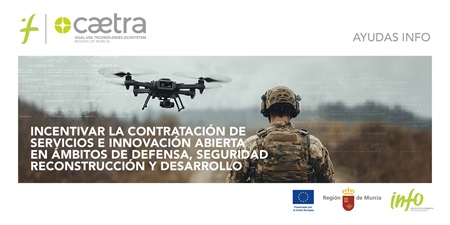
The Regional Government of Murcia promotes 26 open innovation projects in defence and security
The third edition of the “Caetra Challenges” line, focused on AI-based solutions, has approved eight new projects and increased public funding mobilised through public-private collaboration to more than €859,000.
Security, emergency response, defence, critical infrastructure surveillance, and marine environment protection are the focus of developments that connect real needs with technological solutions from companies in the Region of Murcia.
The Regional Government is already promoting a total of 26 open innovation projects to address defence and security challenges through the three grant calls under the “Caetra Challenges” programme, an initiative promoted by the Regional Ministry of Enterprise, Employment and Social Economy, through the Institute for Development (INFO), aimed at transforming real needs into high-value technological solutions.
These grants have involved a total public investment of €859,821, leveraging further investment exceeding €1 million, consolidating a strategy that places dual-use technology at the service of defence, security, emergency response, and territorial resilience.
Specifically, the third edition of the programme, focused on artificial intelligence solutions applied to underwater technologies and endowed with €280,000, received 34 applications and will fund the development of eight projects corresponding to eight different challenges, fully allocating the budget of this third funding line.
These figures highlight the strong attractiveness of an initiative that has successfully connected demand for solutions from the Spanish Navy, the Alcantarilla Air Base, the San Javier Air Force Academy, the Directorate-General for Security and Emergencies, the Port Authority of Cartagena, and INFO itself, with the innovative capacity of the business and technology ecosystem of the Region of Murcia.
The Regional Minister for Enterprise, Employment and Social Economy, Marisa López Aragón, stated that the “Caetra Challenges” programme “is demonstrating that innovation is most effective when it emerges from real-world needs and finds in our companies the ability to turn those challenges into practical solutions.” “We are not talking about abstract technology, but applied tools to strengthen people’s safety, improve public service response, and boost strategic sectors in the Region of Murcia,” she added.
Among the challenges recently approved are the development of an autonomous vehicle for cleaning ship propellers; artificial intelligence solutions for discrepancy management and material forecasting in the maintenance of S-80 submarines; non-invasive vibration measurement systems for rotating equipment to facilitate maintenance tasks; and a smart firefighter helmet with radar and a front-facing HUD display.
Other technological developments include a hyperbaric chamber simulator for training and instruction in defence; an AI-based predictive control system for self-generated noise; and tools for AI-assisted root cause analysis in non-conformities.
López Aragón stressed that “all these challenges reflect the growing maturity of the ‘Caetra Challenges’ programme and its ability to address increasingly complex and strategic technological needs.”
Among already implemented results are AI-based training tools for 112 emergency operators; systems for detecting incidents in the homes of vulnerable people in rural areas, connected to the ECHO112 platform; monitoring solutions for hydrants and critical infrastructure; developments aimed at providing GPS alternatives or complementary systems for aircraft and drones; and technologies to improve tool control in aircraft maintenance.
The second call expanded the scope of this initiative with new solutions, including projects for locating parachute bells; portable runway signalling systems; automated vehicle inspection at access points to sensitive facilities; the use of unmanned aerial vehicles for intrusion assessment and deterrence; monitoring underwater pollution through smart buoys; and acoustic attenuation of marine activities using microbubble screens.
The Regional Minister for Enterprise stressed that “the strength of this initiative lies in mobilising knowledge, specialisation, and business around concrete challenges, allowing innovation to be tested, validated, and ultimately generate value for society.”
“With these three calls resolved, this reflects the way forward chosen by the regional government: detect earlier, collaborate better, and transform knowledge into solutions with real impact in strategic areas,” she concluded.

cloud technology axon

Addleshaw Goddard (AG), the London-headquartered international law fir...