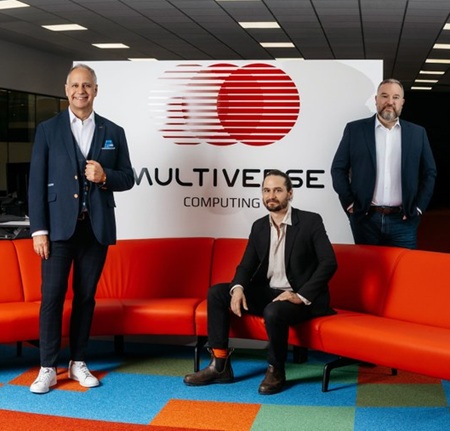
Interview with Enrique Lizaso, Co-founder and CEO of Multiverse Computing: “AI adoption will continue to grow, but the real leap to scale will depend on making it more efficient”
MONDRAGON Ventures, the corporate promotion center, together with its cooperatives, has invested in around 40 companies over the past decade. Multiverse Computing is one of them—a leading company in AI model compression and quantum software—backed alongside the cooperatives Ikerlan and LKS Next.
How did the Multiverse Computing project come about?
Multiverse Computing was founded in 2019 by four co-founders (Román Orús, Alfonso Rubio-Manzanares, Sam Mugel, and myself), who came together in a WhatsApp group with a clear idea: bringing quantum technology to real industrial problems.
From the outset, the company was built with a strongly practical orientation, aiming to translate cutting-edge research into software that is usable and measurable in business environments. In that early stage, the focus was on the financial sector, where optimization and decision-making challenges allow impact to be clearly quantified—whether in reduced computation times, improved operational efficiency, or performance gains.
Subsequently, the quantum software developed was applied to projects in other sectors such as energy, manufacturing, and defense, until, in an industrial project, we were able to apply our quantum-based technology to compress AI models.
What areas does the company currently focus on, and what solutions does it offer?
Today, Multiverse Computing focuses on addressing one of the main bottlenecks to the mass adoption of advanced artificial intelligence: the cost, latency, and energy consumption involved in running large-scale models, especially foundation models and language models. In practice, many organizations clearly see the value of AI but face infrastructure constraints, rising budgets, privacy requirements, regulatory restrictions, or deployment needs in environments with limited hardware.
To address this challenge, we compress and optimize AI models with CompactifAI, our compression platform designed to make models lighter and more portable while maintaining performance. This allows companies to adopt open-source models in optimized versions and deploy them in the environment that best fits their reality—whether in the cloud, in their own data centers, or in edge scenarios and devices.
The core value of this offering is making AI viable where it was previously prohibitively expensive or complex, significantly reducing model size, lowering inference costs, and decreasing the energy consumption associated with daily operations. In addition, by enabling local or edge deployments, key factors for many sectors—such as technological sovereignty, data control, and regulatory compliance—are reinforced.
When did the collaboration with MONDRAGON and its cooperatives begin, and how has the company’s journey been since then?
The relationship with the MONDRAGON ecosystem was consolidated during Multiverse Computing’s pre-seed investment round, when entities from the ecosystem joined as investors and technology partners, notably with MONDRAGON’s participation in 2020 and the involvement of the cooperatives Ikerlan and LKS Next. In addition, we have also worked together on commercial projects.
How is the funding obtained being used?
Overall, the funding is being allocated to scaling CompactifAI as a key technology platform, accelerating the global adoption of compressed and efficient artificial intelligence models. This includes expanding the catalog of optimized open-source models, continuously improving performance and applicability across different sectors, and strengthening distribution, integration, and strategic partnership capabilities with international technology and industrial partners.
What have been the key milestones in the company’s trajectory?
Some of the most notable recent achievements include:
How do you see the medium- to long-term future for Multiverse Computing?
In the medium to long term, the future of Multiverse Computing is built on a simple thesis: AI adoption will continue to grow, but the real leap to scale will depend on making it more efficient. In this context, we aim to establish ourselves as a benchmark in model compression and optimization, enabling organizations to run advanced AI with lower costs, reduced energy consumption, and greater deployment flexibility.
Growth will be driven by the ability to bring optimized models to multiple infrastructures—from cloud to on-premise and edge environments—addressing increasingly relevant needs around privacy, latency, sovereignty, and compliance. At the same time, the company will seek to expand partnerships and international presence, integrating into the enterprise technology ecosystem so that optimization becomes not an add-on, but a natural step in putting models into production.
In short, our goal is to be an efficiency layer that enables advanced AI to be deployed in a sustainable, operational, and economically viable way.

cloud technology axon

Addleshaw Goddard (AG), the London-headquartered international law fir...