How to choose the most appropriate pricing mechanism depending on cash generation, time to closing, and business stability.
The entrepreneur received the LOI and, within the economic section of the offer, read the following:
“The price will be 8.5x 2024 EBITDA, on a debt-free and normalized working-capital basis.
The pricing mechanism will be Locked Box, with an effective date of 12/31/2024 and no adjustments after closing.”
That part caught his attention and he decided to ask directly:
“What exactly is this Locked Box thing?”
And that’s where the conversation began.
ENTREPRENEUR:
“What is this Locked Box? Are you buying the company in a sealed box, like a mystery gift?”
BUYER:
“Not exactly. Look: if we sign the letter of intent now in February, we make you an offer based on the balance sheet closed on December 31. That ‘snapshot’ is the basis of the price.
Then we do due diligence in March and April and, if everything fits, we close in May. But you already know the price today.”
ENTREPRENEUR:
“And there are no adjustments on closing day?”
BUYER:
“No. In a Locked Box, we do not recalculate net debt or working capital at closing. The price does not change. It’s a mechanism designed to avoid discussions in the final phase.”
ENTREPRENEUR:
“And what about the cash the company generates from January until closing?”
BUYER:
“In principle, that cash remains in the company. You continue managing normally, but without extracting value for yourself.”
ENTREPRENEUR:
“And if I want to take something out? A bonus, a dividend…”
BUYER:
“If we agree on it now and put it in writing, it can be done. That’s called permitted leakage: very specific exceptions we agree upon together.
But our proposal is that there be none — meaning nothing is extracted from the Locked Box date until closing.”
ENTREPRENEUR:
“And what if I take something out without telling you?”
BUYER:
“That would be improper leakage. And then it is deducted from the price euro-for-euro. We’re talking about unauthorized dividends, shareholder loans, personal payments…”
ENTREPRENEUR:
“So the cash generated before closing is captured by the buyer.”
BUYER:
“Correct. That is how the Locked Box works.”
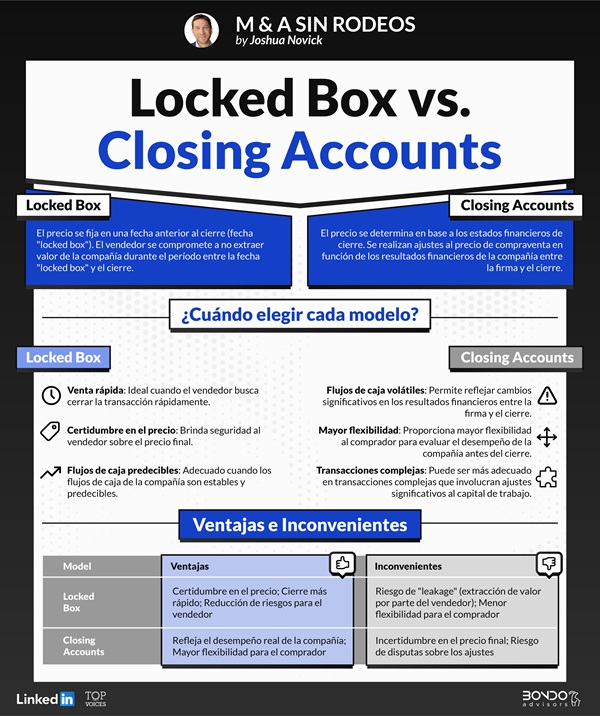
Infographic: Locked Box vs. Closing Accounts. Advantages and disadvantages of each model.
Thank you for reading M&A sin Rodeos – Joshua Novick. Subscribe for free to receive new posts and the weekly newsletter.
The key question is:
How much value moves between the Locked Box date and closing?
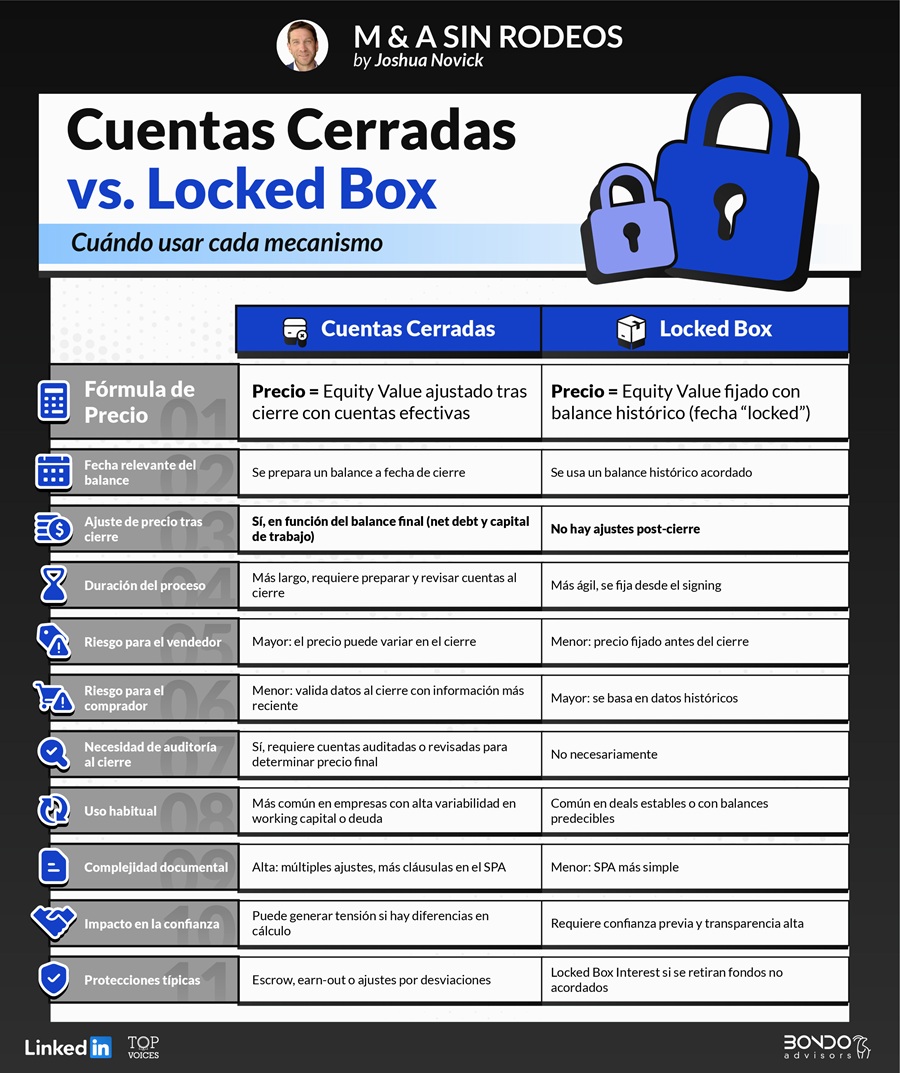
Very simple:
It’s not necessarily bad for the seller —
It’s just that it can be very good for the buyer.
By Joshua Novick, partner at Bondo Advisors
Source:https://www.joshuanovick.com/p/locked-box-o-closing-accounts

cloud technology axon

Axon Partners Group, Tresmares Capital, Sabadell Venture Capital, Inve...