How They Work, How They Differ, and Which One You Need Depending on Your Process

Before moving forward with a sale process, the same fundamental question usually appears:

“Do I need both an M&A advisor and a lawyer?
Isn’t one of them enough?”

The short answer is yes, you need both.
But, as with most things in M&A, there are nuances.

To simplify, there are really two types of processes:

  1. When you already have a buyer.
  2. When you still need to find a buyer.

And depending on which situation you’re in, the combination “M&A advisor + legal advisor” may be essential—or not as much.


If You Already Have a Buyer

This is where many founders say:

“Since I already have a buyer, I’ll skip the M&A advisor and negotiate myself.”

It makes sense: theoretically, you save a 2% to 6% success fee—meaning hundreds of thousands of euros in fees.

But the reality is that many deals fall apart between the LOI and the closing, and this is precisely where the absence of an advisor tends to show its impact.

Even so, if you decide to skip the M&A advisor because you already have a buyer, there is something you cannot avoid:

You need a lawyer from minute one.

Among other things, for:

  • NDAs (Non-Disclosure Agreements)
  • LOI (Letter of Intent)
  • Due diligence
  • SPA (Share Purchase Agreement)
  • Management contracts
  • Good leaver / bad leaver agreements
  • Non-compete clauses

You need a lawyer specialized in M&A, with real transaction experience and who knows exactly what they’re doing. Not just any lawyer with corporate law experience will do.

Beyond reviewing contracts (usually drafted by the buyer) and the fine print, a good M&A lawyer is often a strong negotiator. In many cases, they can cover part of what an M&A advisor would normally handle—particularly when legal terms have direct economic implications.

In short: a generalist lawyer is not enough.
You need someone who understands deal dynamics and M&A market practices.


If You Need to Find a Buyer

Here, the M&A advisor is not just recommended: they are essential.

Not only for negotiating, but for something simpler and more critical:

A company can never put a “FOR SALE” sign on its door.

If the company starts calling potential buyers directly:

  • Within five calls, the entire market knows you’re for sale.
  • Competitors, customers, suppliers, partners all find out.
  • And eventually, your employees do too.

The result: uncertainty, stress, rumors, talent loss, and sometimes even revenue impact.

An M&A advisor prevents this by using:

  • Blind teasers (to hide your identity at first)
  • NDAs before sharing information
  • Buyer outreach without compromising confidentiality

Additionally, it’s almost impossible for a founder to identify all potential buyers on their own.

An M&A advisor:

  • Knows who is consolidating the sector
  • Knows international players
  • Knows which funds are active
  • Who has raised new vehicles
  • Who has real synergies
  • Who has acquired your competitors

This information is not on Google nor ChatGPT. It’s in paid databases (MergerMarket, PitchBook, TTR) and proprietary databases used by advisors.


When Does the Lawyer Join If You Want to Save Money?

Some sellers, trying to reduce initial expenses (when they already have an M&A advisor), bring in the lawyer only from due diligence onwards, and during SPA negotiation.

Not ideal, but it happens.

The recommendation is to have them from the beginning, even with a lighter role early on.


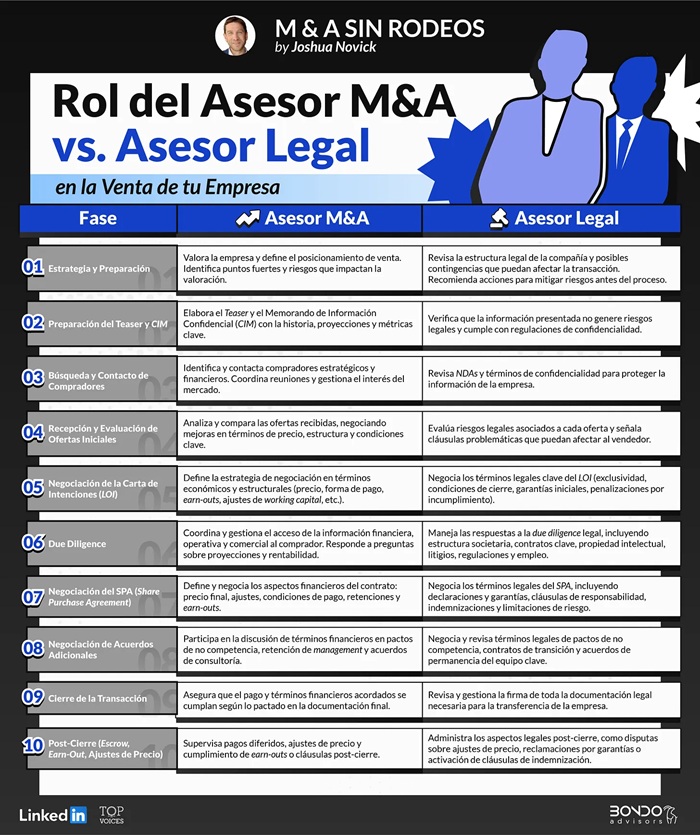
The Role of Each Actor During the Process

Below is the explanation of each phase, with additions and clarifications.

1. Strategy and Preparation

M&A Advisor:

  • Defines how to position your company to maximize price and competition.
  • Identifies strengths, risks, and key messages.

Legal Advisor:

  • Reviews corporate structure, key contracts, and legal contingencies.
  • Analyses tax risks.

2. Teaser and Information Memorandum

M&A Advisor:

  • Prepares documents that generate market interest: story, metrics, cohorts, unit economics, growth, projections…

Legal Advisor:
Usually not heavily involved, except when:

  • There are significant litigations
  • Regulatory or licensing risks
  • Imminent legislative changes

3. Buyer Outreach

M&A Advisor:

  • Manages all communication with buyers without compromising your identity.
  • Schedules meetings and filters buyers.

Legal Advisor:

  • Prepares or reviews the NDA model.
  • Negotiates requested NDA modifications (buyers almost always request changes).

4. Review and Evaluation of Initial Offers

M&A Advisor:

  • Analyses offers, compares them, and negotiates improvements.

Legal Advisor:

  • Detects hidden risks: unusual limitations, impossible deadlines, unjustified holdbacks, ambiguous conditions…

5. Negotiation of the LOI

M&A Advisor:

  • Negotiates economic aspects: price, earn-outs, payment structure, working capital adjustments, timelines, closing conditions.

Legal Advisor:

  • Negotiates exclusivity, penalties, legal closing conditions, governance, initial warranties.

Some buyers use multi-page LOIs where they try to pre-negotiate key elements of the final agreement (price structure, exclusivity, indemnities, non-compete…).
In such cases, having a specialized M&A lawyer is essential, because a poorly drafted LOI can constrain you for the entire process.

And in some processes, the LOI is fully or partially binding.
When this happens, legal assistance from the beginning is not optional.


6. Due Diligence

M&A Advisor:

  • Manages information flow, responds to financial and operational questions, coordinates teams.

Legal Advisor:

  • Handles the legal side: contracts, IP, data protection, employment, regulation, permits, litigation.
  • Ensures shared information does not create new risks.

7. Negotiation of the SPA

M&A Advisor:

  • Negotiates final numbers: definitive price, holdbacks, adjustments, earn-outs, escrows.

Legal Advisor:

  • Negotiates warranties, liability limitations, and indemnities.

8. Signing and Closing

Signing

M&A Advisor:

  • Confirms economic terms match the negotiated ones.
  • Prevents last-minute changes unfavorable to the seller.

Legal Advisor:

  • Coordinates the signing, reviews all documents, ensures accuracy.

Closing

M&A Advisor:

  • Confirms payments are executed as agreed.
  • Ensures closing conditions are not used to renegotiate price.

Legal Advisor:

  • Manages corporate documentation for the transfer.
  • Reviews certificates, powers, declarations, and required documents.

9. Post-Closing (Earn-outs, Adjustments, Options)

Earn-outs and future metrics

M&A Advisor:

  • Reviews earn-out calculations, adjusted EBITDA, KPIs…
  • Prevents “creative adjustments” that reduce payment.

Legal Advisor:

  • Ensures disputes are handled according to the SPA.
  • Intervenes if the buyer tries to reinterpret or misuse clauses.

Partial sales, puts and calls (when the founder keeps equity)

M&A Advisor:

  • Analyses future valuation and multipliers.
  • Helps negotiate disagreements.

Legal Advisor:

  • Ensures proper execution of contractual options.
  • Handles legal documentation and protects against aggressive interpretations.

The Conflict of Interest

Something I often explain to founders, because almost no one mentions it:

It’s better if your M&A advisor and your lawyer are NOT from the same firm.

Why?

  • The M&A advisor is success-fee driven: they want the deal to close.
  • The lawyer gets paid regardless: they act as a healthy counterweight.

If both belong to the same firm:

  • The lawyer may feel pressured.
  • They may hesitate to block a deal generating 90% of the firm’s revenue.

This is why at Bondo Advisors:

  • We don’t offer legal services.
  • We never receive commissions or finder fees from law firms.
  • When a client asks for lawyer recommendations, we offer several options and are not tied to any of them.

No conflicts. No strange incentives. No interference.

Your lawyer protects you. Your M&A advisor maximizes price and gets the deal closed. Each one in their role.

By Joshua Novick, partner at Bondo Advisors

Source: https://www.joshuanovick.com/p/asesor-legal-vs-asesor-de-m-and-a

Subscribe to Directory
Write an Article

Highlight

Axon moves into Cloud Technology

by Axon Partners Group

cloud technology axon

Incosa, a Waterland portfolio company, a...

by Waterland Private Equity

JG Ingenieros and Incosa, whose majority shareholder is Waterland Priv...

Photos Stream