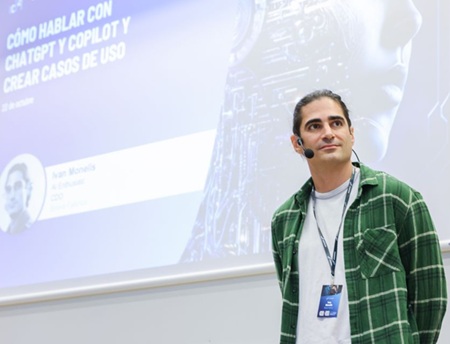
At a time when artificial intelligence is redefining the way we work, make decisions, and manage our time, at Ship2B we want to better understand how to apply all that potential to the world of social impact and impact investing.
That’s why we spoke with Ivan Monells, a purpose-driven entrepreneur and expert in AI applied to growing businesses.
Ivan is the co-founder of the sustainable fashion brand Brava Fabrics and is currently leading the startup MNLabs, specialized in artificial intelligence for business productivity. His hybrid background —with experience both in building purpose-driven brands and applying cutting-edge technology— makes him a key voice in understanding how AI can become an ally of social impact.
In this interview, we talked with him about purpose, automation, organizational culture, and how to start integrating AI into the daily life of any team.
What led you to found Brava Fabrics? What was the purpose behind launching a brand with a sustainable focus in a sector like fashion?
The founding of Brava Fabrics was the result of a chance encounter and a strategic opportunity. I met my partner during our MBA at ESADE, and although neither of us had prior experience in the fashion industry, we shared the motivation to start a business and build a digitally native brand within the e-commerce ecosystem.
The decision to focus on fashion wasn’t driven so much by an aesthetic or textile vocation, but by a macroeconomic trend analysis: fashion was the sector leading the growth of e-commerce at the time, and we found it appealing.
In that sense, Brava was born more as an e-commerce project than as a purpose-driven brand. Sustainability wasn’t a starting point, but rather a natural evolution: as we dug deeper into how the textile industry really worked and the impact it generated, we realized the role we could play. About a year later, we began incorporating sustainability as a core element, seeing that it was possible to do things better without major sacrifices.
Looking back at your journey with Brava, what key learnings do you take with you as an impact entrepreneur? And what would you say have been your biggest achievements so far?
The most valuable learning has been understanding that, above all the digital tactics, social media ads, and e-commerce “hacks,” what truly makes the difference is the product. It might sound obvious, but once you dive into the digital growth world, it’s easy to lose sight of the essential: you’re selling fashion, not just web traffic or conversion metrics.
The quality, design, and authenticity of the product are the foundation of everything. And within that product, sustainability is part of what makes it meaningful. If your product doesn’t connect, doesn’t excite, isn’t “cool,” no matter how good your marketing strategy is, you won’t generate impact.
As for achievements, we’ve reached €5.5 million in revenue, with 80% of our sales coming from international markets. We operate across multiple channels —e-commerce, multi-brand retail, and our own stores— and we now have three physical shops. We’ve also built a strong team both at headquarters and in retail, and we’ve managed to place hundreds of thousands of sustainable garments into wardrobes around the world. That’s something we’re extremely proud of.
What challenges remain for purpose-driven brands that want to scale without losing sight of sustainability and business ethics?
One of the main challenges is avoiding the temptation of turning purpose into a marketing strategy. Purpose must be authentic, embedded in the company’s culture, not just a tool to decorate campaigns.
Also, brands need to recognize that sustainability alone doesn’t sell. Consumers buy because they like the product, not only because of its values. That said, sustainability does make them feel better about their choice. It adds an emotional bonus, but it can never replace the attractiveness of the product itself.
And while this is especially true in Spain, the situation varies in other markets. In Northern Europe, for example, sustainability may be an entry requirement to be stocked in many multi-brand stores or even to reach the wardrobes of more conscious consumers. Still, the design must win hearts —values alone are not enough.
How have you experienced the balance between purpose and technological innovation? What can each learn from the other to generate transformative solutions?
I don’t think of it as a balance, but as a synergy. In my experience, purpose and technological innovation are not opposites but complementary forces. Often, technology acts as an enabler of purpose: it allows you to scale impact, improve processes, and do more with less.
Applied correctly, technological solutions can greatly amplify a brand’s ability to generate positive impact. So, I don’t think we need to choose between them. The real transformative power comes when both are integrated.
You’re now leading a startup focused on AI for productivity. What potential do you see in AI for scaling impact-driven projects?
I currently lead MNLabs, a consultancy specialized in artificial intelligence —the name comes from my last name, Monells. The project started with the idea of building proprietary software, but we soon realized the market wasn’t ready. Most companies didn’t need yet another piece of software, but rather understanding: what AI is, how it can be applied, and in which specific areas of their business it can make a real difference.
That’s why MNLabs has become a hybrid between consultancy, training provider, and solution builder. We help organizations design a coherent AI strategy, establish usage policies, identify processes where generative AI can create impact, and develop tailored automation solutions. We also train their teams to integrate AI tools into their daily work in a useful and practical way.
I firmly believe any professional, in any sector, should be able to save at least three hours per week thanks to AI. Scaled across an entire organization, that translates into massive productivity gains. And we’re only at the beginning. This feels very much like the birth of ERPs or CRMs —a structural disruption that will shape the next decade of business.
"Many times, companies want to apply AI in areas where it doesn’t yet work, while neglecting areas where it can be deeply transformative."
In your training sessions, you focus heavily on the practical use of AI in day-to-day work. What use cases would you highlight that are already saving time and improving processes?
My approach is always practical, with immediate impact. That’s why I focus on use cases that are already demonstrating real time and resource savings. Some of the most common are:
We also develop custom applications to automate key internal processes. In many cases, these solutions eliminate the need for human intervention, freeing up teams for higher-value tasks.
That said, it’s important to manage expectations: often companies want to apply AI in areas where it’s not yet ready or where other solutions are more suitable, while overlooking areas where it could be truly transformative. Part of my role is guiding that focus so technology actually delivers value.
Looking back, how do you think AI could have helped you at Brava Fabrics? Do you see specific applications in fashion or sustainable product companies?
AI is already helping Brava Fabrics a lot. Looking back, there are many areas where its application would have meant a revolution in efficiency, creativity, and agility:
And the most interesting part is that Brava is not an exception. Any company —even the smallest or most artisanal— can benefit from these tools. The only requirement is knowing where to apply them and how to integrate them strategically.
"Artificial intelligence doesn’t take the wheel: it helps us go further and faster, but we’re still the ones driving."
Beyond specific tools, how can an organization foster an ‘AI-friendly’ culture without losing its human essence and impact-driven focus?
I always explain that AI should be understood as a co-pilot. In that sense, I find Microsoft’s choice of the name “Copilot” for its AI suite very fitting. It perfectly reflects what this technology represents in our daily lives: an intelligent assistant that accompanies us, enhances our abilities, and helps us go further and faster without taking control of the wheel.
If you think about it, AI is simply the logical evolution of other technologies that revolutionized our productivity —the personal computer, email, Excel, or enterprise management systems. Each of those tools multiplied what we could do. Generative AI is taking that role, but with a radical difference: it breaks paradigms once thought impossible, like creating, reasoning, drafting, designing, or even making decisions with some autonomy.
So, fostering an AI-friendly culture doesn’t mean dehumanizing work —quite the opposite. It means freeing people from mechanical or repetitive tasks so they can focus on those requiring judgment, empathy, and vision. The key is adopting AI as a tool, not a substitute, and training teams to integrate it with discernment, ethics, and purpose.
What common mistakes do you see in teams that want to introduce AI quickly but without a clear strategy?
The most frequent mistake I see is the lack of clear leadership in AI adoption. Many organizations start experimenting with tools without defining an overall strategy, without truly understanding what the technology can and cannot do, and without establishing proper governance.
This leads to a chaotic environment where each employee uses different solutions without coordination, oversight, or shared learnings. Worse still, many do so without notifying anyone, which represents both operational and security risks. In such contexts, there are no synergies between departments, best practices aren’t shared, and the real transformative potential of AI is lost.
AI can redefine entire processes, not just help isolated individuals work a bit faster. But for that to happen, you need a cross-company strategy with clear objectives, technical leadership, and proper change management. Without that, AI becomes a scattered experiment rather than a true driver of transformation.
If we truly manage to unlock AI’s full potential in the coming years, how do you imagine the daily life of an impact-driven organization will look? What new habits or ways of working could emerge?
I don’t think an impact-driven organization powered by AI should necessarily function very differently from any other adopting this technology. What differentiates them is their purpose, not their processes. The core tasks are quite similar —what changes is the “why” behind them.
That said, AI will clearly shift the relevance of many skills. Just as having a calculator made knowing how to do square roots irrelevant, AI will diminish the importance of certain competencies —even some creative ones. On the other hand, strategic skills, critical thinking, conscious direction of technology, and the ability to give meaning to work in an automated context will gain value.
In the near future, we’ll see organizations that are leaner, more agile, and more value-focused. Some, like Duolingo, are already leading that shift by using AI not only to optimize processes but to redesign entire products. Others will take a more limited approach, and that’s fine too. The key is for each company to define its own path, tailored to its reality and vision.
What truly matters is having a clear mindset: knowing what we want to achieve with AI, and how we want it to enhance —not replace— our impact.
Image: Ivan Monells, Founder of MNLabs and Co-Founder of Brava Fabrics

cloud technology axon

Addleshaw Goddard (AG), the London-headquartered international law fir...