Scaling up ‘cleantech’ (also known as clean technologies) means expanding innovative projects, those that aim to decarbonize the economy, so they can grow and adapt to market demand. To do so, adequate financing is fundamental in order to produce and distribute this technology at a greater scale and lower cost, boosting competitiveness and the reindustrialization process. According to Cleantech for Europe, banks remain, by far, “the largest financial institutions in Europe” contributing to this effort.
In the race to create innovative solutions that help to mitigate climate change through emission reduction, or adapt to its consequences, there are two key aspects: investment in the initial stages and investment for the roll-out and scalability. In the cleantech ecosystem there are first-tier, more mature technologies that are already being implemented on a massive scale such as renewable energy– and second-tier technologies, which are pioneering projects with a green premium cost known as ‘First of a Kind’ (FOAK). Once these technologies are implemented, they need to grow (such as storage or carbon capture technologies).
While more than €11 billion of venture and growth capital was invested in EU clean technologies in 2023, a 15 fold increase over 2011, in 2024, debt financing rose for these projects, growing from €7.9 billion in 2023 to €23.4 billion in 2024, according to ‘Cleantech for Europe’.
Nevertheless, their report entitled ‘Mobilising Private Finance to Scale European Cleantech’ underscores that the continent is currently facing “a cleantech investment gap.” In terms of financing, European cleantech needs the following:
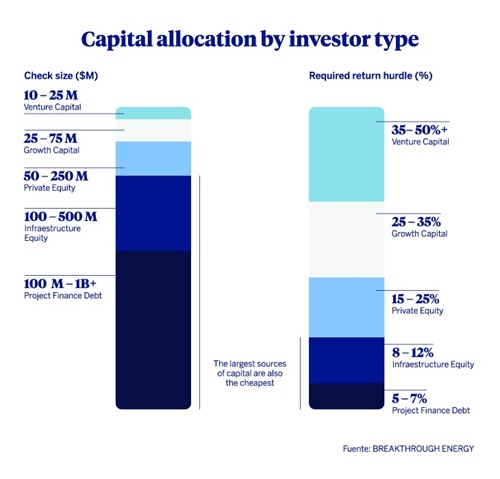
In its report, ‘Cleantech for Europe’ stressed the importance of cleantech companies being able to “get improved access to debt, credit or project finance, as they come with a lower cost of capital compared to early-stage equity financing, which requires a higher return for the higher level of risk taken.”
It also stresses that public markets and private capital are a “critical” part of a strategy that integrates this complementary financing to boost the decarbonization of the economy. In this regard, it underscores that “public financing instruments can play a vital role in signalling confidence and direction to private investors to fund investment opportunities in European clean technologies.” In particular, these instruments can “create new markets and bolster demand for cleantech products and services, improving the economic viability and therefore, making it more attractive to private investors.”
The report ‘Cleantech for Europe’ underscores the financial limitations that need to improve in order to advance clean technologies:
In order to make progress in the decarbonization of the economy, boost competitiveness through productivity and reinforce resilience and security by reducing critical dependencies, Europe needs profound reform of capital markets and greater mobilization of private financing, according to the ‘Cleantech for Europe’ report. In addition, public bodies need to send clear signs that build the confidence needed so that investors back the development and adoption of clean technologies.

cloud technology axon

Addleshaw Goddard (AG), the London-headquartered international law fir...