The difference between EBITDA, net profit, and cash flow, and how it affects your company’s valuation
In most M&A transactions, a company’s price is communicated as a multiple of EBITDA. That is what appears in headlines, press releases, and conversations between buyers and sellers.
Even though EBITDA multiples are communicated, the analysis used by the buyer is usually different.
The EBITDA multiple is simply how they package the final offer so that it looks comparable to other transactions. It is a communication format, not the basis of the calculation.
Although EBITDA is useful for measuring operating profitability before interest, taxes, and amortization, it has two important problems:
This is why most buyers ask themselves:
How much of your EBITDA actually becomes available cash?
This metric is called EBITDA-to-Free Cash Flow conversion, and it evaluates the real ability of the business to generate cash.
“Infographic showing how to move from EBITDA to Free Cash Flow. It explains the adjustments required to calculate cash flow, including CapEx, changes in working capital, taxes, and interest, and shows the impact of each component on EBITDA-to-cash-flow conversion.”
Investors typically calculate this ratio:
EBITDA-to-Cash Flow Conversion (%) = (Operating Cash Flow / EBITDA) × 100
Where Operating Cash Flow is obtained by subtracting from EBITDA:
A 70%, 60%, or 40% conversion completely changes how a buyer evaluates a company.
Two companies with the same EBITDA may have very different values if one requires more investment or has more demanding working capital.
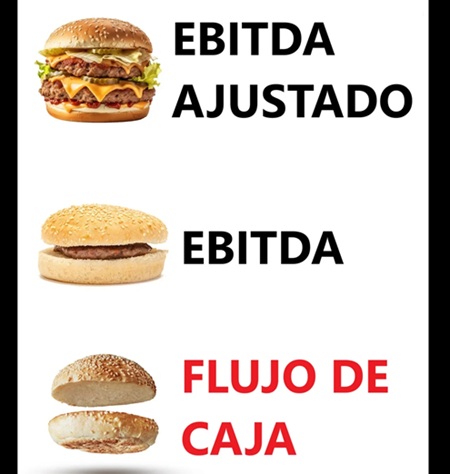
This aligns with many of the typical comparisons in your infographics: EBITDA, Net Profit, and Cash Flow can tell completely different stories.
Because it allows them to:
A business with high working capital or CapEx needs converts EBITDA poorly, which directly affects valuation.
It doesn’t matter if EBITDA is €1M if only €600k becomes operating cash.
The buyer thinks in terms of investment recovery.
In asset-intensive sectors such as logistics, industry, or retail, EBITDA conversion is more important than growth itself.
Your practical-case infographics make this very clear.
Businesses with rising EBITDA but declining cash raise red flags.
In M&A, cash is what confirms whether the model truly works.
Because a buyer may say:
“Your EBITDA is €1M, but your free cash flow is only €300k.
My offer has to reflect that.”
And what they do is translate that cash flow analysis into an EBITDA multiple so it looks like they are “paying X times EBITDA.”
But the real basis of the valuation is FCF.
This is why you see deals “at 5x,” “at 8x,” or “at 12x,” when the buyer is actually doing:
This part never appears in the press release, but it determines the price.
Income Statement
Sales: €10,000,000
COGS: minus €6,500,000
(costs directly associated with the service such as fuel, maintenance, driver salaries, and tolls)
Gross Margin: €3,500,000
Operating Expenses: minus €2,500,000
(indirect costs such as administration, rent, utilities, and marketing)
Depreciation and Amortization: minus €200,000
EBIT: €800,000
(profit before interest and taxes)
Interest Expense: minus €100,000
(costs associated with debt)
EBT: €700,000
Taxes (15%): minus €105,000
Net Profit: €595,000
EBITDA = EBIT + Depreciation and Amortization
EBITDA = €800,000 + €200,000
EBITDA = €1,000,000
From EBITDA, the buyer subtracts all elements representing actual cash outflows:
FCF = €1,000,000 – 300,000 – 100,000 – 100,000 – 105,000
Free Cash Flow = €395,000
If you take only operating cash flow, conversion is around 70%.
If you take FCF after CapEx and working capital, conversion is closer to 40%.
The difference is huge and completely changes the valuation, because it shows how a company with an attractive EBITDA can generate much less cash after covering its operating and investment needs.
In listed companies, net profit often plays a central role because it is used to calculate earnings per share, assess accounting profitability, and compare multiples such as PER. In that context, net profit matters because it is directly tied to the performance demanded by the market quarter after quarter.
In M&A the logic is different.
The buyer does not analyze the company thinking about shares or earnings per share. They analyze it as a complete economic unit and need to understand how much cash the business actually generates after covering all operating, tax, and investment requirements.
Net profit includes many elements that do not represent real cash outflows, such as:
Since that financing structure almost always changes after the acquisition, net profit stops being a useful reference for the buyer.
This is why, in an acquisition, net profit helps understand accounting profitability, but it is not the metric that determines valuation. What the buyer wants to know is:
When comparing EBITDA, net profit, and cash flow, it is common to find very large differences between the three figures. A company may show an attractive net profit and solid EBITDA yet generate little cash if its CapEx is high or its working capital consumes resources repeatedly.
By Joshua Novick, partner at Bondo Advisors
Source: https://www.joshuanovick.com/p/como-se-valora-una-empresa-ebitda

cloud technology axon

Axon Partners Group, Tresmares Capital, Sabadell Venture Capital, Inve...