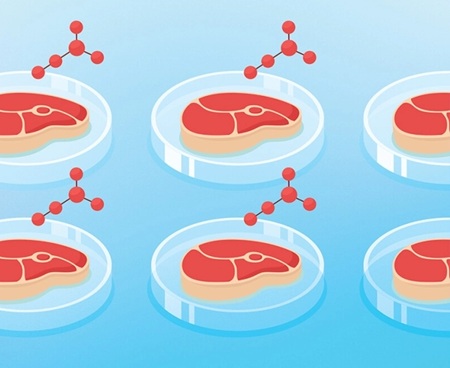
A growing global population, increased demand for protein, and a desire for sustainability are driving greater interest in alternatives to the conventional food chain. Cultivated meat has the potential to provide real animal protein with 10x less environmental impact and without the animal welfare concerns of traditional farming. Technological advances are creating a path toward cost parity with conventional meat, but can this be successfully realized? This Viewpoint examines best practices and the success factors that can help the sector achieve its potential.
Feeding the world’s increasing population will require 50% more protein availability by 2050, according to the United Nations. Meeting this need is vital for global health and cannot occur merely by improving yields from existing production methods or adding to arable land under cultivation (which would have a negative environmental impact).
The world must diversify its protein sources via sustainable alternatives, such as vertical farming, hydroponics, and plant-based alternatives to meat. Another important option is cultivated (also known as “cultured”) meat, which involves growing real animal cells under controlled conditions, enabling meat production that doesn’t involve raising or slaughtering livestock. Cultivated meat mitigates animal welfare, sustainability, and food security issues while delivering a product closer to the traditional taste of meat than plant-based products.
The cultivated meat sector is seeing major growth and interest from both investors and consumers, with the Good Food Institute Europe predicting it will become a €510 billion (~US $570 billion) global market by 2050. Preliminary approvals for the sale and consumption of cultivated meat have been made by Singapore, the US, and the UK (although the latter is only for pet food), with other countries set to follow. Technological advances are bringing down costs by simplifying production processes, creating a path to cost parity with conventional meat production by delivering a sub-€10/kg (~US $11/kg) finished product.
First-generation cultivated meats were created using a two-stage process. First, adult animal stem cells (e.g., satellite or mesenchymal stem cells) were expanded in bioreactors during upstream processing. Over the course of one to three weeks, these cells differentiated into muscle or fat cells, often with the aid of scaffolds to mimic the structure and texture of conventional meat. Next, the cells were harvested during downstream processing (DSP) and blended into final products (often with plant-based components), resulting in compositions that contained 30%-50% cultivated cells. This process is batch-based, rather than continuous, contributing to increased time and cost. First-generation processes deliver a finished product at a cost of €250-€300/kg (~US $279-$335/kg) — well above conventional meat prices of €8-€20/kg (~US $9-$22/kg).
Second-generation processes involve continuous bioreactor operation lasting 60 days or more. These systems focus on harvesting proliferative, undifferentiated cells that serve directly as edible biomass. This approach allows for larger-volume, long-term harvesting while reducing reliance on expensive growth factors through media recycling, optimized cell lines, and cost-effective formulations. Collectively, these innovations pave the way to finished products at under €10/kg under optimized conditions — approaching cost parity with conventional meat and opening a large market opportunity.
In addition to cost improvements, second-generation systems narrow the gap in production efficiency. The feed conversion ratio (FCR) of current cultivated meat processes already rivals that of intensive chicken farming, with first-generation systems achieving an FCR of 3.3-4.7 and second-generation systems aiming for as low as 1.2 — comparable to or better than conventional poultry (see Figure 1). This demonstrates economic and biological efficiency gains that facilitate long-term scalability.


Companies such as Believer Meats and Gourmey are early adopters of second-generation cultivated meat processes. They focus on continuous or semicontinuous cultivation, undifferentiated cell harvesting, and the use of food-grade, cost-efficient media to scale production (see Figure 2).

The final price of cultivated meat products is based on five factors:
Second-generation processes address these areas via the following practices.
First-generation processes rely on expensive, pharmaceutical growth factors to provide the mixture for cell development. These growth factors cost more than €300/liter (~US $335/liter) at lab scale, €10-€20/liter (~US $11-$22/liter) in the expansion phase, and €1-€5/liter (~US $1-$6/liter) during the differentiation phase (if optimized and food-grade). Shifting to protein-free, food-grade ingredients dramatically lowers costs, from €1-€1.5/liter (~US $1-$2/liter), toward a target media cost of €0.2/liter (~US $0.22/liter) at scale. Costs can be further reduced by optimizing formulations to maximize nutrient-use efficiency (preventing the oversupply of expensive amino acids) and minimizing waste products like lactic acid and ammonia by avoiding the use of unnecessary nutrients. Several companies are exploring AI technology as a way to further tailor media mixes and reduce costs.
Focusing on growing undifferentiated stem cells leads to a rapid doubling time, increasing capacity and improving asset productivity. With second-generation processes, cells can be grown in suspension without scaffolds and have higher genetic stability, so they can be replicated with contained levels of mutation, a factor essential to successfully running longer continuous processes.
Maximizing cell performance relies on growth media optimization and requires extensive research and testing. AI and in-silico models may accelerate the process of optimizing media and overall conditions to best match cell needs.
Transitioning from traditional batch processes to a continuous perfusion-based[1] system, in which waste and byproducts are regularly removed and growth media is replenished, is critical to achieving cost-effective cultivated meat production. In a continuous process, cells are cultured for extended periods, with constant harvesting of biomass and media replenishment. This approach dramatically increases bioreactor productivity compared to conventional seven- to 10-day batch cycles.
Continuous processes require fewer ancillary systems, such as the large buffer and storage tanks needed to manage frequent batch transitions. Labor costs are also reduced, as less manual intervention is required for bioreactor turnaround operations. However, continuous processing requires robust control strategies to maintain culture stability over long periods. It may also require scaled perfusion systems; real-time monitoring of cell density, metabolites, and contaminants; and a viable cell density of >60 million cells per milliliter.
Formulating the final product is key to achieving cost and consumer-acceptance goals. Currently, most cultivated meat products are hybrids, blending cultivated cells (typically 30%-70%) with plant proteins, binders, fats, and flavorings to reduce cost and improve texture, flavor, and nutritional balance.
Looking ahead, advances in precision fermentation-derived fats, mycelium-based binders, and structured layering or 3D printing are set to expand the possibilities for replicating whole-cut meats. These innovations offer better control over marbling, mouthfeel, and cooking performance, which are key to unlocking premium product formats and broader market appeal.
Building larger bioreactors does not deliver economies of scale, as CAPEX/metric ton capacity in a continuous process eventually flattens, due to higher installation and tailored maintenance costs.
This approach also concentrates risk: any contamination will affect larger product volumes, increasing waste. Cultivated meat production is largely unproven above 10 cubic meter scale reactors, and inherent issues with mixing nutrients and/or oxygen and stresses on cells represent sources of technical risk at larger scale. In one pilot process, deploying six bioreactors with around 3 cubic meters working volume delivered about 90% of scale effect while reducing operational complexity and industrial risk. Additionally, optimizing the DSP yield maximizes throughput at low cost.
Third-generation processes are expected to further optimize production. Closed-loop perfusion processes will increase biomass concentrations by factors of two to five and provide greater process control. These are expected to be industrial-scale production-ready in the next three to five years.
Gourmey: Commercializing cultivated meat
Launched in 2019, deep tech company Gourmey — an Arthur D. Little client — is an emerging player in cultivated meat. Gourmey combines second-generation processes, including continuous harvesting, suspension, non-differentiated stem cells, and protein-free media. Its Paris-based lab has been proven twice as cost-efficient as competing cultivated meat processes, a factor it aims to double in the next two to three years. With a target media cost around €0.2/liter and a projected industrial setup of six bioreactors, Gourmey’s platform is expected to achieve a cost below €10/kg for a finished product. This is the lowest cost level in publicly reported techno-economic models to date, demonstrating a high level of CAPEX efficiency at this €35 million (~US $39 million) facility.
To reach this target while de-risking its industrial deployment, Gourmey has adopted a modular approach to industrial setup, favoring replication or scale-out over pure scale-up (i.e., six 5,000-liter bioreactors with 2,500-liter working volume each). To prove its technology while delivering revenue, Gourmey intends to focus on high-value products such as cultured foie gras. These products command higher prices than commodity meats, creating a lower-risk market entry and the potential for broader opportunities as costs decline over time. Since traditional foie gras requires force-feeding of ducks or geese, its production and/or import is banned in multiple countries and US states, including California. Concerns about avian flu have impeded foie gras consumption in Japan and other countries. In both cases, cultivated meat has the potential to reopen closed or reduced markets.
Achieving a sub-€10/kg finished product target is key to large-scale adoption of cultivated meat. Success will require progress on all technical drivers, pushing the limits of technology and processes. For example, although the levers to reduce media costs to €0.3/liter are clearly identifiable, making the jump to below €0.2/liter will require further R&D and a deeper understanding of cell line metabolics and nutrient optimization (see Figure 3). Around half of the effort needed to successfully reach the target higher cell density in continuous processes has yet to be achieved.
In parallel, industry growth hinges on navigating complex regulatory frameworks and addressing consumer perception of novel cultivated products. Tackling these challenges simultaneously with technical innovation is essential to realize the sector’s ambitious goals and sustainability promise.

Current cultivated meat production prices and volumes cannot compete with the cost of traditional commodity meats (e.g., chicken or beef). Since production processes can be easily adapted for niche products with higher market prices, producers should concentrate their efforts there. These cost-optimized processes will generate revenues that can be used for R&D and strategic growth, de-risking rollouts.
Many players plan to fundraise to grow production and achieve industrial scale. Rather than investing heavily in large bioreactors, companies should focus on modular, scalable facilities with multiple small bioreactors that can be increased to match demand. It is vital to control CAPEX (and technical risk) and allow sufficient contingency for industrializing processes, reducing the need to quickly return to investors for further funding.
Four countries have approved the sale of cultivated meat, beginning with Singapore in 2020 and followed by the US (on a state-by-state basis), Israel, and the UK (in animal food applications). However, approval is given to individual products/companies, meaning that new players must apply individually to gain permission. Companies should anticipate regulatory requirements and file an application that allows room for process improvements while engaging with authorities about accelerating approvals in major markets and lobbying to both harmonize standards and reduce regional discrepancies around cultivated meats.
Many consumers have concerns about animal welfare standards in traditional meat production. At the same time, most lack knowledge about cultivated meat. Potential concerns around the production process and safety of lab-grown meat must be tackled through transparent communication that stresses the health and sustainability benefits of the technology while differentiating it from alternatives like plant-based and fermentation proteins. The industry will need to entice customers by showcasing the gastronomic and flavor advantages of its products, demonstrating they are a valid, sustainable alternative, especially as production prices fall.
The cultivated meat industry is approaching an inflection point. With rising global demand for protein, accelerating technological progress, and strong sustainability credentials, the foundations for success are in place. To fully realize its potential, the sector must:
Focused actions can pave the way toward cost parity with conventional meat, establishing cultivated meat as a scalable, trusted, sustainable solution to growing protein demand.
Note
[1] Perfusion is an additional process to continually harvest and supply media, in which fresh nutrient media is constantly supplied while waste and byproducts are removed, allowing for sustained cell growth and high-density cultures grown without interruption.
By Clément Santander, Simon Guyomard-Norman, Nicolas Malherbe

cloud technology axon
INVENTIA Kinetics, a Spanish engineering company specializing in advan...