Interview with Susana Amorós, CTO of NIMBLE Diagnostics: "Support from CDTI Innovación has been key to turning our non-invasive stent monitoring technology into a real solution for patients"
Millions of patients live with implanted stents, yet their monitoring still relies on invasive techniques such as catheter angiography. NIMBLE Diagnostics offers an alternative with WAEVE, a microwave-based technology that, with the support of CDTI Innovación, enables simple and non-invasive monitoring.
Cardiovascular diseases remain among the leading causes of death worldwide. Coronary stents—small metallic devices that reopen blocked arteries—have become a common treatment, saving millions of lives each year. However, post-implantation monitoring remains challenging, as existing tools are not always easy to use repeatedly and often involve invasive procedures that limit continuous patient follow-up.
In this context, NIMBLE Diagnostics was founded as a deep-tech company focused on non-invasive diagnostic technologies based on electromagnetic systems. Its main development is WAEVE, a system designed to detect and quantify alterations such as re-occlusion or structural changes in the stent without invasive intervention.
Until now, stent monitoring has been largely reactive, relying on symptom onset. NIMBLE Diagnostics aims to move toward regular, non-invasive monitoring integrated into routine clinical practice.
Susana Amorós, CTO of the company, explains: "Support from CDTI Innovación has been key to turning our non-invasive stent monitoring technology into a real solution for patients."
From clinical need to technological solution
NIMBLE Diagnostics originated from a specific clinical problem. The company was created as a spin-off of the Institut d’Investigació en Ciències de la Salut Germans Trias i Pujol (IGTP), Universitat Politècnica de Catalunya (UPC), and Universitat de Barcelona (UB) to address a clinical need that lacked an adequate solution.
As Amorós notes: "In the absence of symptoms, it is assumed the evolution is favorable, which hinders early detection of complications such as a second heart attack or sudden death. Many patients present non-specific symptoms, requiring invasive tests that are not always necessary."
The initial hypothesis about stent interaction with electromagnetic signals was developed in collaboration with the signal theory department at UPC, evolving over ten years into a technology capable of extracting useful information about the implant.
WAEVE: interpreting the interior without intervention
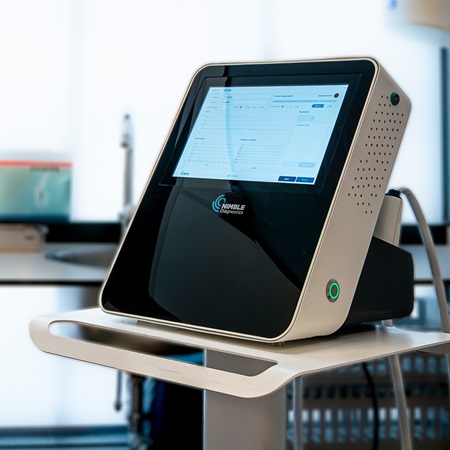
The result is WAEVE, a microwave interferometry system that analyzes the stent’s condition from outside the body. Two transducers are placed on the patient’s chest, emitting very low-power microwaves that interact with the stent and its environment.
Amorós explains: "That electromagnetic signature is analyzed using algorithms designed to determine whether re-occlusion exists and estimate its severity. This allows the cardiologist to quickly assess the stent without invasive techniques."
Measurements can be repeated with minimal impact, enabling regular monitoring of both symptomatic and asymptomatic patients and detecting issues before clinical episodes occur.
A different approach from traditional techniques
Microwaves are non-ionizing and safe for patients. Amorós highlights: "They allow interaction with tissues and implants without damage and can also be more economically accessible."
Unlike other techniques that focus on tissue analysis, WAEVE focuses on the stent itself, providing a direct and specific reading, unlike catheter angiography which requires sedation, radiation, and hospitalization.
From reactive to preventive monitoring
Re-occlusion may progress for months without symptoms. WAEVE allows periodic measurement even before symptoms appear, enabling personalized treatment. Amorós notes: "We move from a reactive logic based on symptom onset to a more preventive approach."
Clinical validation
The Alpha prototype is currently being tested in a clinical study with over 50 patients, validating the system and refining the algorithms. Preliminary results confirm that the stent’s electromagnetic signature is reproducible and informative.
The role of CDTI in the project
Amorós emphasizes: "It has been a key support to accelerate WAEVE’s development and help transform a research-born technology into a solution with business and clinical potential."
CDTI support has also reinforced the project structure, facilitating the transition from academic research to a company capable of delivering real innovation to healthcare.
Looking ahead
NIMBLE Diagnostics continues clinical validation and aims to expand applications to other implants and pathologies, positioning itself as a key player in the next generation of personalized and preventive medicine.
More info
Web: www.cdti.es
LinkedIn: https://www.linkedin.com/company/cdti/
X: https://x.com/CDTI_innovacion
YouTube: https://www.youtube.com/user/CDTIoficial
Image: WAEVE device, developed by NIMBLE Diagnostics for non-invasive stent monitoring

cloud technology axon

This transaction reinforces Alantra’s continued momentum in Aerospac...