The CDTI Innovación Strategic Plan 2024–2027 places support for Spain’s science industry within the Growth pillar linked to R&D&I, targeting companies that are already innovating and need to scale their capabilities to address more complex challenges with an international dimension. This approach is complemented by two specific objectives. First, to enhance the technological capabilities of Spanish companies in the sector by supporting R&D&I projects with the potential to secure future contracts at major international scientific facilities with Spanish participation, as well as at the Singular Scientific and Technical Infrastructures (ICTS) included in Spain’s national roadmap. The second objective is to maximize the technological returns generated by the facilities in which Spain participates as a member country, a task that CDTI carries out in its capacity as Industrial Liaison Office (ILO) for organizations such as CERN, ESO, SKAO, ITER Organization, F4E, EURATOM, the Einstein Telescope, and ESS.
The Plan also seeks to strengthen the role of Spain’s ICTS as a mechanism for validating and scaling technological and industrial solutions through a dedicated procurement platform and a Pre-Commercial Public Procurement instrument specifically aimed at these facilities. This strategy is already delivering results: in 2025, Spain surpassed €100 million in technology contracts linked to major international scientific facilities, while the first edition of the Big Science Industry Forum Spain was also held. Organized by CDTI in collaboration with Ineustar, the initiative is designed to consolidate Spain’s Big Science ecosystem at the national level through a recurring relationship-based model aligned with similar European initiatives such as the Big Science Business Forum.
CDTI Innovación deploys a wide range of initiatives and services that connect Spanish companies with opportunities in Big Science. The CDTI Industrial Capabilities Catalogue for Large Scientific Facilities already includes more than 100 Spanish companies with proven expertise in particle physics, matter structure, astronomy, fusion, and other highly specialized disciplines. This tool is complemented by a unified ICTS tender repository, a Procurement Handbook, and technology-specific distribution lists covering civil engineering, mechanics and optomechanics, power electronics, cryogenics and vacuum technologies, remote handling and robotics, diagnostics and instrumentation, among others. Through these channels, CDTI directs opportunities toward Spain’s qualified industrial base.
SKA: Spanish Industry Demonstrates World-Class Capabilities
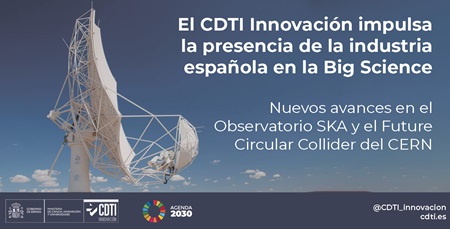
The SKA Observatory (SKAO), one of the largest scientific engineering projects of the 21st century, is building the world’s largest distributed radio telescope across South Africa and Australia. CDTI Innovación participates as a Delegate on the SKAO Procurement Subcommittee while also serving as the Industrial Liaison Office (ILO) for Spanish industry.
Within this framework, Spanish companies EOSOL and COMPOXI have recently passed the Factory Acceptance Test for the construction project of the SKA-Mid telescope sub-reflectors. This milestone validates both the product and the manufacturing process and marks the transition to serial production of the 44 contracted units. The sub-reflector, a 4.5-meter metallized composite structure, is designed to operate throughout the telescope’s 50-year lifespan in the Karoo Desert. Production will take place at Compoxi’s new facilities in Girona, a 3,000-square-meter plant equipped with clean rooms, an autoclave, and a metrology laboratory.
Partially funded by the European Union through the NextGenerationEU programme, this contract represents another milestone in the industrial return strategy promoted by CDTI Innovación, positioning Spanish companies as qualified suppliers of critical components for world-leading scientific projects while strengthening manufacturing capabilities within Spain.
CERN’s Future Circular Collider
A similarly significant milestone is the recent preliminary market consultation launched by CDTI’s Innovative Public Procurement Office for CERN’s Future Circular Collider (FCC-ee). Through another strategic approach, CDTI is proactively anticipating major scientific projects of the coming decade and promoting the development of a candidate prototype for a representative section of the FCC-ee. This challenge has been proposed by the Instituto Galego de Física de Altas Enerxías (IGFAE), a joint research center of the Universidade de Santiago de Compostela and the Government of Galicia.
This initiative represents CDTI’s fourth pre-commercial public procurement project focused on major scientific facilities, within a track record that has already mobilized more than €80 million in investment and is expected to generate industrial returns for Spain of approximately €1 billion across the FCC-ee project as a whole.
The FCC-ee, a 91-kilometer circular accelerator that will succeed the LHC in the 2040s, is a priority within the 2026 update of the European Strategy for Particle Physics. CDTI’s initiative approaches Pre-Commercial Public Procurement as a mechanism for validation and scaling aimed at Spain’s ICTS and major international scientific facilities. The technologies developed will extend well beyond the FCC itself, finding applications in fourth-generation European synchrotrons such as ALBA, the Einstein Telescope, IFMIF-DONES (currently under construction in Granada), and future medical hadron therapy accelerators.
A Leading Reference for the Next Decade
The SKA and FCC cases represent outstanding achievements for Spanish industry, resulting from the early identification of technological opportunities within major international scientific projects, the strengthening of Spanish industrial capabilities to compete for them, and support throughout the entire cycle—from market consultation and development to serial production and the realization of industrial returns.
In line with the objectives set out in the Strategic Plan 2024–2027, a further intensification of CDTI’s Big Science agenda is already anticipated. This will include the continuous expansion of the catalogue of companies with supply capabilities, new Pre-Commercial Public Procurement initiatives aimed at Spanish ICTS facilities, strengthened cooperation with CIEMAT in the fields of nuclear fusion and superconductivity, and closer collaboration between the scientific and industrial dimensions of these infrastructures through regular meetings between Spanish researchers and supplier companies.
In an international environment where strategic autonomy and technological sovereignty have become central priorities on the European agenda, the positioning of Spanish industry within Big Science takes on even greater significance. As Spain’s national industrial contact point for the major Big Science infrastructures in which the country participates, CDTI Innovación is further consolidating its role as a driving force, facilitator, and internationally recognized reference point, helping Spanish industry continue to expand its presence in some of the world’s most advanced scientific and technological projects.
About CDTI Innovación
The Centre for the Development of Technology and Innovation (CDTI E.P.E.) is the innovation agency of Spain’s Ministry of Science, Innovation and Universities. Its mission is to promote technological innovation within the business sector.
CDTI’s objective is to ensure that Spanish companies generate and transform scientific and technological knowledge into globally competitive, sustainable, and inclusive growth. In 2025, within the framework of the Strategic Plan 2024–2027, CDTI provided €2.423 billion in support to Spanish companies and startups.
Web: www.cdti.es
En Linkedin: https://www.linkedin.com/company/29815
En X: https://x.com/CDTI_innovacion
En Youtube: https://www.youtube.com/user/CDTIoficial

cloud technology axon

Cuatrecasas has advised on the €15.1 million financing granted by pr...