Interview with Alfredo Brugos, CEO of Sitelec: “Support from CDTI Innovación and FEDER funds makes projects like E-PAVE possible, transforming roads into electrified infrastructure for a sustainable future”
Turning roads into energy-active infrastructures capable of generating, storing, and managing renewable energy is the goal of E-PAVE, an innovative project led by Sitelec and co-financed by CDTI Innovación and the European FEDER funds. Drawing on its experience in energy services and public lighting, the company is driving a disruptive solution to advance transport electrification and the transition toward smarter, more sustainable cities.
For nearly two decades, Sitelec has built its trajectory around a clear principle: energy efficiency as a central driver of transformation for public services and urban infrastructure. Founded in 2006 to meet the demand for engineering services for commercial and industrial installations in the private sector, the company soon expanded into the public sector, where it established a specialized technical profile in outdoor lighting, electrical maintenance, and comprehensive energy services management.
"The company’s natural evolution led us to participate in technical assistance services and public tenders, especially in the municipal sector," explains Alfredo Brugos, CEO of Sitelec. A turning point came in 2009, with the award of its first major comprehensive electrical maintenance contract in a municipality, covering both outdoor lighting and public buildings. This experience also built on the technical legacy of the family company DITRA Cantabria, with a long-standing presence in the city of Santander.
Since then, Sitelec has expanded its portfolio to manage more than 20,000 lighting points across municipalities in Cantabria, Andalusia, La Rioja, and other regions, in addition to multiple buildings and electrical facilities. This growth has been accompanied by a corporate structure currently employing 35 to 37 professionals, with offices in Bilbao, Santander, Madrid, and Seville.
From Energy Services to Technological Innovation
The experience gained managing large public contracts has driven a gradual evolution of the business model toward energy services companies. "Today, our profile is clearly focused on energy efficiency, digitalization of urban services, and smart infrastructure management," Brugos notes. In this context, the company already manages long-term contracts—up to 15–20 years—in municipalities in Cádiz, Huelva, and La Rioja, where it has carried out comprehensive outdoor lighting system upgrades.
Alongside this consolidation in services, the company has taken a decisive step toward R&D+i as a strategic lever. In recent years, Sitelec has developed innovative projects supported by CDTI Innovación, such as Intilum, focused on intelligent indoor lighting, and Fenisos, aimed at developing sustainable energy storage systems based on iron-nickel technology.
"This support has been key for an SME like ours to undertake projects of high technological complexity," emphasizes Brugos. Thanks to it, the company has strengthened its technical team, incorporated specialized human resources, and collaborated with research centers, as well as made investments in equipment, prototypes, and testing that would otherwise be unaffordable. This momentum has allowed Sitelec to evolve from a service-oriented company to a technological developer with proprietary solutions focused on sustainability and the circular economy.
Roads for the Energy Transition
Built on this technological and strategic foundation is E-PAVE (Electrified Roads for a Sustainable Future), a project co-financed by CDTI Innovación and European FEDER funds that aims to change the way road infrastructure is conceived. "The project was born as a response to one of the major challenges of the energy transition: turning roads, traditionally passive, into active elements of the energy ecosystem," explains the CEO.
E-PAVE proposes transforming these infrastructures into platforms capable of generating, storing, and managing renewable energy, contributing to transport electrification and the development of smart cities. From a technological standpoint, the project integrates distributed generation, energy storage, and intelligent management through AI, optimizing the entire infrastructure lifecycle.
Environmentally and socially, the objective is to reduce CO₂ emissions and advance transport decarbonization, in line with Spain’s Integrated National Energy and Climate Plan (PNIEC) and the European Sustainable Mobility Strategy. Strategically, E-PAVE is also conceived as a key tool for the company’s internationalization. "The disruptive nature of the project and its focus on sustainability position us as an attractive technological partner for countries seeking innovative solutions in energy-active infrastructure," notes Brugos, seeing E-PAVE as a way to compete in international tenders and form strategic alliances in emerging markets, particularly in Europe and North Africa.
Technology Integrated into Existing Infrastructure
One of E-PAVE’s differentiating features is its ability to leverage existing infrastructure. The project incorporates photovoltaic modules integrated into roads, designed to withstand traffic and adverse weather conditions without requiring new land use. This renewable generation is complemented by a sustainable energy storage system, based on high-durability, recyclable batteries aligned with circular economy principles.
The entire system is managed through an advanced digital architecture. AI algorithms optimize generation, storage, and energy distribution, anticipating consumption patterns, traffic, and environmental conditions. IoT sensor networks monitor the infrastructure and energy production in real time, while a centralized digital platform enables remote supervision and predictive maintenance.
"Thanks to AI, we can reduce operational costs by over 20% and improve the system’s overall energy efficiency by 15–18%," Brugos details. Predictive maintenance also allows for detecting anomalies before they become critical failures, increasing infrastructure reliability and availability throughout its lifespan.
Science, University, and International Cooperation
The project has a strong scientific and technical foundation thanks to collaboration with the Energy Technology Group at the University of Vigo. This partnership provides academic rigor to the design and validation of solutions, enables testing under real conditions, and allows the application of advanced methodologies such as lifecycle and carbon footprint analyses.
"Working with a reference center like the University of Vigo strengthens our technological credibility and facilitates participation in European and international projects," highlights Brugos. E-PAVE is also developed within an international consortium with partners from Spain and Morocco. Sitelec leads the project and coordinates technological integration, while the Moroccan counterpart handles regulatory adaptation and pilot implementation on strategic roads. Universities from both countries, along with entities such as Enerbasque, provide scientific support and experimental validation, fostering knowledge transfer.
Technical Challenges and Future Vision
The disruptive nature of E-PAVE entails significant challenges, such as integrating photovoltaic generation into roads without compromising traffic safety, developing durable and recyclable storage systems, and complying with technical and safety standards across countries. "Each challenge is addressed through technological innovation, scientific validation, and close collaboration with authorities and regulatory bodies," explains Brugos.
The project’s expected environmental impact is significant. On a large-scale deployment, E-PAVE could contribute to a reduction of 25,000–30,000 tons of CO₂ annually, by integrating renewable energy into road infrastructure and promoting transport electrification. Using existing surfaces, reducing critical materials, and applying circular economy principles further reinforce its sustainability contribution.
Over the next five years, Sitelec envisions E-PAVE as a consolidated, replicable solution capable of evolving from the pilot phase to larger-scale implementations. "We are cautious, as this is a conceptually disruptive solution requiring a solid foundation of testing and prototypes, but we believe it could play a key role in strategic corridors and future cities," Brugos says.
Beyond technological impact, co-financing from CDTI Innovación and European FEDER funds has generated tangible economic and social benefits, enabling the company to accelerate R&D+i, reduce financial risks, create qualified jobs, and energize the innovation ecosystem. "In short, this support has not only transformed Sitelec’s innovative capacity but also acts as a strategic lever for Spain to advance toward a more technological, sustainable, and competitive productive model," concludes Alfredo Brugos.
CDTI Innovación
The Centre for the Development of Industrial Technology and Innovation (CDTI E.P.E.) is the innovation agency of the Spanish Ministry of Science, Innovation, and Universities, aimed at promoting technological innovation in the business sector. CDTI’s mission is to ensure that Spanish companies generate and transform scientific and technical knowledge into globally competitive, sustainable, and inclusive growth. In 2024, under a new strategic plan, CDTI provided over €2.3 billion in support to Spanish companies and startups.
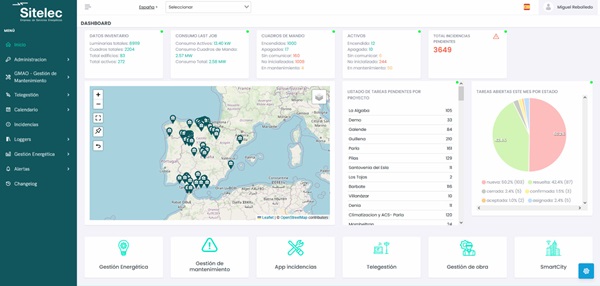
Image: Sitelec company platform
Web: www.cdti.es
Linkedin: https://www.linkedin.com/company/29815
X: https://twitter.com/CDTI_innovacion
Youtube: https://www.youtube.com/user/CDTIoficial

cloud technology axon

Cuatrecasas has advised on the €15.1 million financing granted by pr...