Interview with José Solís, Director of R&D&I at CEMOSA: "CDTI Innovation's Support Is Key to Transforming Water Management and Anticipating the Risks of Climate Change"
Through the E-HYDRO project, CEMOSA is leading a consortium of companies and research organisations developing a digital platform designed to transform the water sector. Supported by CDTI Innovación, the initiative combines digital twins and advanced LiDAR technology to revolutionise the management of river basins and waterways, enabling a predictive, efficient and climate-resilient approach to water resource management.
The water infrastructure sector is undergoing an unprecedented transformation driven by digitalisation and the urgency of addressing climate change. Against this backdrop, the efficient and sustainable management of water resources has become a global strategic priority. With more than 50 years of experience, Málaga-based engineering company CEMOSA is at the forefront of this transition, evolving from a traditional engineering consultancy into a technology-driven and digitally connected business.
This transformation is reflected in the company's latest innovation project, E-HYDRO, which is funded by CDTI through its Science and Innovation Missions programme. The initiative supports collaborative R&D&I projects that develop solutions to major cross-sector and strategic societal challenges.
The ambition of E-HYDRO is to fundamentally transform water management.
"Our goal is to move from reactive management to genuine prevention strategies for droughts and floods," explains José Solís, Director of R&D&I at CEMOSA, who leads the consortium. The project brings together technology companies ADASA, Aeroláser and INSITU, alongside three leading Spanish public research organisations: the Applied Geotechnologies Research Group (GeoTech) at the University of Vigo, the TIDOP Research Group at the University of Salamanca, and IDAEA-CSIC.
More Than 50 Years of Technical Expertise and International Growth
The origins of CEMOSA (Centro de Estudios de Materiales y Control de Obra, S.A.) date back to 1972 in Málaga. Founded by three construction materials specialists—Luis Jiménez Zamorano, Juan Durán and José María Frade—the company emerged during a period of rapid infrastructure development in Spain, when both public and private construction projects required independent quality control and technical supervision services.
Over the years, CEMOSA steadily expanded its capabilities. In 1980, it established its civil engineering division to provide integrated engineering services, and from the early 2000s onwards it expanded its regional offices before launching its international expansion in 2011. Today, CEMOSA is a global family-owned engineering company operating in more than 20 countries.
According to José Solís, one of the company's defining milestones was the creation of its dedicated R&D&I department in 2007.
"Our commitment to research, development and innovation has enabled CEMOSA to anticipate the engineering challenges of the 21st century. It has allowed us to build expertise in BIM, digitalisation, artificial intelligence and digital twins, participate in innovation projects, strengthen our market positioning, and evolve from a traditional engineering firm into a technology-led and innovation-driven organisation."
For Solís, the company's long-term success is rooted in steady, consistent evolution rather than radical transformation.
"CEMOSA has grown through a coherent strategy: maintaining its strong technical foundations in quality control while progressively expanding its value chain into engineering, certification and sustainability. Achieving the right balance between specialisation and innovation has probably been the key to our long-term sustainability."
A Digital Twin for Smarter Water Management
E-HYDRO addresses one of today's biggest challenges in water management: the enormous volume of information required is typically fragmented across multiple independent systems, making real-time analysis difficult and slowing response times during emergencies.
To overcome this challenge, the project is developing a digital platform capable of creating a comprehensive digital twin of an entire river basin and waterway.
"In simple terms, we are building a virtual representation of a river basin that integrates data and analytics from multiple sources, including satellites, sensors, LiDAR, hydrological models, climate information and water quality monitoring," explains Solís.
The platform transforms isolated datasets into actionable intelligence, enabling faster and better-informed decision-making.
One of its key differentiating features is the use of advanced LiDAR technology. The system employs laser pulses to generate highly accurate three-dimensional maps of terrain, including riverbeds, hydraulic infrastructure and flood-prone areas.
Its unique value lies in combining two complementary scanning methods: terrestrial LiDAR for difficult-to-access environments and bathymetric LiDAR capable of penetrating shallow water to accurately model reservoir beds and river channels.
Rather than replacing existing monitoring systems, E-HYDRO is designed to integrate and enhance them by providing a holistic view of the entire river basin.
"The objective is not simply to understand what is happening at a specific location," says Solís. "It is to understand how the entire system evolves—from waterways and water resources to infrastructure, land use and associated risks."
From Reactive Management to Climate Resilience
Thanks to the digital twin developed through E-HYDRO, public authorities and water management organisations will be able to shift from reactive management to a predictive and preventive approach, enabling better-informed decision-making, more effective prioritisation of interventions, and greater resilience to extreme weather events.
In the case of prolonged droughts, the platform makes it possible to analyse water reserves, groundwater recharge and consumption demand simultaneously, supporting more efficient planning while identifying the areas most vulnerable to water scarcity. During flood events, the virtual representation of the river network combines meteorological and topographical information to identify at-risk areas in advance, helping protect urban centres, critical infrastructure and agricultural land.
A Public-Private Partnership Driven by CDTI Innovation
The scale and complexity of the project has required a coordinated scientific and industrial collaboration model. The E-HYDRO consortium is led by CEMOSA and brings together four leading technology companies: CEMOSA, ADASA, Aeroláser and INSITU. They work closely with three of Spain's most prestigious public research organisations: the Applied Geotechnologies Research Group (GeoTech) at the University of Vigo, the TIDOP Research Group at the University of Salamanca, and the Institute of Environmental Assessment and Water Research (IDAEA-CSIC).
This public-private structure ensures that methodologies developed through scientific research can be rapidly transformed into practical solutions for real-world market challenges, strengthening competitiveness while fostering highly specialised technical talent.
Within this framework, the support provided by CDTI Innovation has become a strategic pillar for both CEMOSA and the E-HYDRO consortium.
"CDTI enables us to undertake R&D&I projects with a much higher level of ambition, assume technological risks that would be difficult to face independently, and accelerate the development of solutions with genuine market applications," says Solís.
For the company, this public support extends well beyond funding a single project.
"It helps us strengthen our internal capabilities, generate new knowledge, develop proprietary technologies and prepare solutions with long-term commercial potential," he explains. "It is the catalyst that allows us to continue advancing towards a more digital, competitive and innovation-driven engineering model capable of addressing society's greatest challenges."
The initiative is also closely aligned with the United Nations 2030 Agenda. By improving water resource management and strengthening resilience to natural disasters, E-HYDRO directly contributes to Sustainable Development Goal (SDG) 6 – Clean Water and Sanitation and SDG 13 – Climate Action. At the same time, its application of digital technologies to civil engineering supports SDG 9 – Industry, Innovation and Infrastructure, positioning data-driven engineering as a key enabler of sustainable development.
Looking Ahead: Data-Driven Engineering
According to José Solís, CEMOSA's strategy over the coming years will focus on consolidating digital platforms, advanced data analytics and digital twins as standard tools throughout the entire infrastructure lifecycle—from planning and design through to operation and maintenance.
Beyond water management, the company also aims to improve resource and energy efficiency in urban environments while developing dual-use technologies capable of serving both civil and defence applications for the protection of critical infrastructure.
More than five decades after its foundation, CEMOSA remains committed to the same guiding principle.
"Innovation must ultimately improve the quality of our services, enhance the company's competitiveness, and contribute to the development of infrastructure that is more efficient, safer and better prepared for the challenges of the future," concludes Solís.
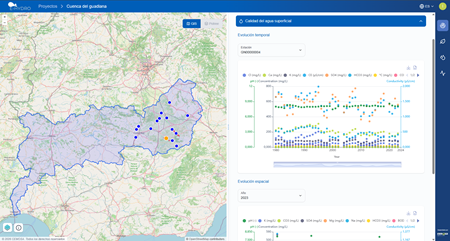
Image caption:The E-HYDRO platform integrates mapping and data analytics to monitor surface water quality in real time.
About CDTI Innovación
The Centre for the Development of Industrial Technology and Innovation (CDTI E.P.E.) is the innovation agency of Spain's Ministry of Science, Innovation and Universities. Its mission is to promote technological innovation within the business sector and help Spanish companies transform scientific and technological knowledge into globally competitive, sustainable and inclusive growth.
In 2025, under its 2024–2027 Strategic Plan, CDTI provided €2.423 billion in support to Spanish companies and startups.
More information
Website: www.cdti.es
LinkedIn: https://www.linkedin.com/company/29815
X: https://twitter.com/CDTI_innovacion
YouTube: https://www.youtube.com/user/CDTIoficial

cloud technology axon
Through the E-HYDRO project, CEMOSA is leading a consortium of compani...