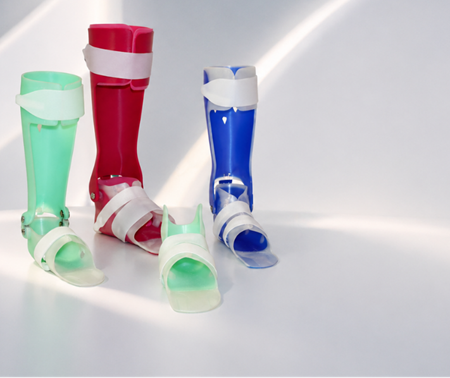
Interview with Alberto Regidor, Co-Founder of Orthoprint3D: “For a Young Technology-Based SME, CDTI Innovación and ERDF Funds Have Enabled Us to Develop New Orthotic and Prosthetic Products with Less Risk”
From Castilla y León, Orthoprint3D is working to transform the way orthotic and prosthetic products are designed and manufactured. Its project for the development of customized-stiffness dynamic ankle-foot orthoses (DAFOs), supported by CDTI Innovación and the European Regional Development Fund (ERDF), combines 3D digitalization, biomechanics, advanced additive manufacturing, and objective gait analysis to provide more precise, reproducible solutions tailored to the real needs of each patient.
Orthoprint3D was founded in mid-2020 through the convergence of two seemingly unrelated fields: automotive testing and clinical orthotics. Its founding partners—four engineers from the automotive sector and several orthotic technicians with experience in the orthotics and prosthetics field—recognized that technologies already available in other industries could radically change the way customized medical devices are manufactured.
“We wanted to bring together technological expertise, clinical experience, and a realistic understanding of the orthotics and prosthetics market,” explains Alberto Regidor, co-founder of the company.
Based in Castilla y León, Orthoprint3D now employs six industrial, design, and biomedical engineers, as well as orthotic technicians, supported by interns and university collaborations. According to Regidor, this structure helps attract specialized talent and creates opportunities for highly qualified technical professionals to develop their careers in the region.
Research and development plays a central role within the company. Much of Orthoprint3D’s activity is focused on creating new products, improving digital workflows, and objectively validating the solutions it manufactures.
Its portfolio includes cranial orthoses, customized insoles, bespoke postural seating systems, hand splints, and facial masks, all produced using 3D printing technology. In 2025, the company’s revenue approached €200,000, primarily generated in Spain. However, Orthoprint3D has already begun its international expansion by supplying cranial orthoses to an orthotics provider in Peru and engaging in discussions with clinics in Brazil. Participation in OTWorld, one of Europe’s leading orthopedic trade fairs, marks the beginning of a stronger commitment to both European and Latin American markets.
A Technological Gap in the Orthotics and Prosthetics Sector
The project to develop dynamic ankle-foot orthoses originated from a clear observation: traditional orthotic manufacturing still relies heavily on manual craftsmanship and the individual expertise of technicians.
“That expertise is extremely valuable, but it also means results can vary significantly from one professional to another,” says Regidor.
In addition, many clinical decisions are still based on visual observation of a patient’s gait, without objective data to determine the most appropriate stiffness, fit, or functional performance.
Existing advanced solutions, such as spring-assisted or hydraulic orthoses, offer strong performance but are often expensive, bulky, and difficult to integrate into public healthcare reimbursement systems.
“We wanted to develop an alternative: a customized, 3D-printed orthosis capable of combining precision, repeatability, patient-specific adaptation, sustainability, and a more competitive cost,” Regidor explains.
Multiple Technologies Integrated into a Single Product
What makes the project unique is the integration of several technological disciplines into the development of a single device.
The process begins with 3D patient scanning and CAD-based design tailored to the individual’s anatomy. It then incorporates biomechanical gait analysis to understand how the patient actually moves and what functional support is required.
From there, simulation tools, mechanical testing, and advanced 3D printing technologies are used with materials such as TPU, polypropylene, polyamides, and continuous-fiber reinforcements.
“Our goal is not simply to create an orthosis that fits the patient anatomically, but also one whose mechanical behavior is specifically tuned to that patient’s needs,” Regidor explains.
Every design and material decision seeks to balance durability, lightness, comfort, and cost.
To accurately analyze patient movement, the project employs the VICON motion-capture system, which records three-dimensional joint behavior throughout every phase of gait.
“This information is far more precise than visual observation because it allows us to measure exactly how the ankle behaves at every moment,” Regidor notes.
The system is complemented by instrumented insoles that measure plantar pressures and sensors that evaluate contact between the orthosis and the leg. The objective is to base device design on measurable data rather than subjective assessment.
The Challenge of Controlled Stiffness
One of the project’s greatest technical challenges is achieving personalized and controlled stiffness in a 3D-printed orthosis while ensuring durability, comfort, lightweight performance, and economic viability.
“Stiffness is critical because it directly influences how a patient walks. If the orthosis is too rigid, it can restrict movement; if it is too flexible, it may not provide sufficient support,” Regidor explains.
To address this challenge, the team is simultaneously working on material selection, variable-stiffness mechanisms, fatigue testing, mechanical testing, and analyses of the relationship between ankle movement and orthotic resistance.
The goal is not simply to manufacture a 3D-printed component, but to ensure that component delivers a specific functional performance tailored to each patient.
This level of complexity has made collaboration with the University of Valladolid essential.
“Orthoprint3D contributes expertise in orthotic products, additive manufacturing, and practical market and patient needs. The University contributes scientific and technical knowledge in biomechanics, materials, mechanical testing, fatigue analysis, simulation, and gait analysis,” says Regidor.
The Importance of CDTI Innovación and ERDF Funding
In this context, support from CDTI Innovación and the European Regional Development Fund has been crucial.
“For a young technology-based SME such as Orthoprint3D, this type of funding is a fundamental instrument for accelerating new product development and reducing the technological risk associated with highly complex R&D projects,” Regidor states.
The funding has enabled investment in equipment, materials, testing, software development, and the recruitment of specialized technical personnel. It has also helped generate proprietary knowledge and expertise.
“Thanks to this type of support, a young company can undertake developments that would be extremely difficult to finance solely with its own resources due to their technical uncertainty and validation requirements,” he adds.
Personalization and Sustainability
Orthoprint3D considers sustainability an integral part of its manufacturing process rather than a secondary objective.
3D printing uses only the material required, minimizes waste, and enables on-demand production, avoiding the surplus associated with more traditional manufacturing methods. The thermoplastic materials employed also offer greater recycling potential.
“Our vision is that personalization and sustainability should reinforce each other. We want to create customized products that are more efficient and have a lower environmental impact,” says Regidor.
The project aligns with several United Nations Sustainable Development Goals (SDGs), including:
The Future of Digital Orthotics
The ankle-foot orthosis project extends beyond a single product.
“DAFOs are an important first step because they bring together many of the challenges we aim to solve: anatomical customization, mechanical performance, stiffness control, comfort, lightweight design, and gait adaptation,” Regidor explains.
If the methodology is successfully validated, the company believes it can be applied to other lower-limb orthoses, functional assistive devices, and even custom scoliosis braces.
“Our objective is to build a new way of working: more digital, more objective, more reproducible, and focused on the real needs of patients,” he summarizes.
Regidor also highlights the broader impact of public funding on the innovation ecosystem:
“These programs strengthen the competitiveness of Spanish industry, promote the creation of highly skilled jobs, support the retention of technical talent in local regions, and encourage collaboration among companies, universities, and clinical centers.”
Ultimately, the benefits of projects such as this are reflected in improved outcomes for patients.
“The development of more precise, comfortable, functional, and accessible orthoses can improve clinical outcomes, support healthcare professionals, and provide more personalized treatments,” he concludes.
In this sense, public and European funding not only supports business growth but also helps ensure that technological advances reach society in the form of better products, better treatments, and healthcare solutions more closely adapted to patients’ real needs.
CDTI Innovación
The Centre for the Development of Technology and Innovation (CDTI E.P.E.) is the innovation agency of Spain’s Ministry of Science, Innovation and Universities. Its mission is to promote technological innovation within the business sector and to help Spanish companies transform scientific and technical knowledge into globally competitive, sustainable, and inclusive growth.
In 2025, as part of its 2024–2027 Strategic Plan, CDTI provided €2.423 billion in support to Spanish companies and startups.
More info:
Web: www.cdti.es
Linkedin: https://www.linkedin.com/company/29815
X: https://twitter.com/CDTI_innovacion
Youtube: https://www.youtube.com/user/CDTIoficial

cloud technology axon

Axon Partners Group, Tresmares Capital, Sabadell Venture Capital, Inve...