Interview with Diana Ballart, CEO and Co-founder of The Smart Lollipop: “The support of CDTI Innovación and European MRR funds has been decisive in accelerating the development of non-invasive saliva-based diagnostic solutions”
With the support of CDTI Innovación through its Neotec programme, The Smart Lollipop is advancing in the development and validation of a deeptech technology aimed at improving the early detection of diseases, with a particular focus on paediatrics.
In a context shaped by the need to move towards more preventive, personalised and patient-centred medicine, technological innovation plays a key role in transforming clinical diagnostic processes. The search for non-invasive, accessible and digital solutions is especially relevant in areas such as paediatrics, where the patient experience strongly influences follow-up and early disease detection.
Against this backdrop, Happy Innova S.L., operating under the brand name The Smart Lollipop (TSL), was founded in November 2020 as a Spanish deeptech startup with a very clear objective: to develop non-invasive, agile and digital medical diagnostic solutions that improve the clinical experience for both patients and healthcare professionals. Behind this vision is Diana Ballart, CEO and co-founder of the company, who defines its mission as “creating happy medical experiences through technological innovation”.
The project originated from Ballart’s interest in applying technological innovation to real challenges in healthcare. Together with other colleagues, she began shaping the idea of The Smart Lollipop by working with user-centred innovation methodologies. “During a hackathon, we were given a healthcare challenge that we had to solve using the Design Thinking methodology,” she recalls. The recognition obtained at this early stage, along with expert feedback, helped confirm the solution’s potential and prompted the decision to turn the idea into a company. “That’s when I realised the potential of The Smart Lollipop and decided to embark on this adventure,” she explains. From that point on, the search began for the co-founders who would eventually lead to the creation of Happy Innova.
From the outset, The Smart Lollipop has worked under a clear premise: saliva is a diagnostic fluid with enormous potential that remains underutilised compared to more invasive samples such as blood. “There is a clear lack of non-invasive techniques, especially in paediatrics, where blood tests often generate rejection and hinder the early detection of asymptomatic diseases,” notes the CEO.
Based on this idea, the company has developed a non-intrusive medical device in the form of a smart lollipop capable of detecting diseases from a single saliva sample of up to one millilitre. The goal is to position saliva as a valid and reliable tool for the diagnosis and clinical monitoring of certain pathologies.
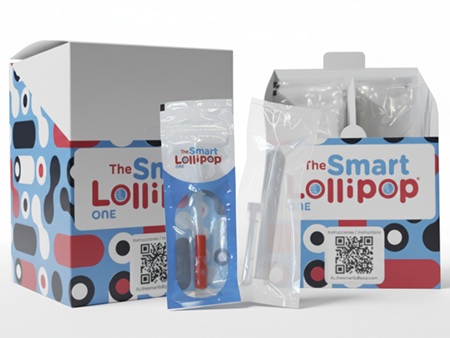
Currently, TSL’s technology is structured around two complementary products. On the one hand, TSL One, which is already on the market and functions as a saliva collection device for subsequent laboratory analysis. On the other hand, TSL Core, still under development, which incorporates specific biosensors and an optical reader that enables certain diagnoses to be carried out directly, without the need for laboratory equipment. “The idea is that all the technological complexity is integrated into the device, offering the user a simple, fast and non-invasive experience,” explains Ballart.
The development of this technology has been supported by CDTI Innovación through the Neotec programme, co-financed by European funds from the Recovery and Resilience Mechanism (MRR). According to the CEO, this support has been key to tackling the project’s main technological challenges. “The support from CDTI Innovación has been decisive for us,” she states.
As Ballart explains, “Thanks to this funding, we have been able to identify which biomarkers can replace blood-based ones and how they behave under different clinical conditions, allowing us to ensure reliable diagnoses from a non-invasive sample.”
In addition, the project has enabled the development and optimisation of several key components, including enzymatic biosensors for the diagnosis of hypercholesterolaemia and the saliva collection device itself. All of this has been essential for validating the technology and preparing the launch of the first device.
In its initial phase, The Smart Lollipop has focused its proof of concept on the diagnosis of hypercholesterolaemia, particularly in paediatric populations. This condition is often asymptomatic at early ages, making early detection through traditional methods more difficult. “In paediatrics, blood extraction is avoided as much as possible, which means there is a lot of clinical information we don’t have until the disease is diagnosed too late,” says the CEO.
Using saliva as an alternative opens the door to more frequent and accessible screening, facilitating early detection and the monitoring of risk factors from a young age. The progress achieved in this first proof of concept has also served as a foundation for the future expansion of the technology to adult populations, by adjusting biosensor sensitivity and validating performance in different clinical settings.
One of the project’s differentiating elements is the strategy of integrating digitalisation from the initial design stage of the second product under development, TSL Core. “Digitalisation will add significant value for both doctors and patients, as it will facilitate follow-up, traceability and clinical decision-making,” explains Ballart.
For healthcare professionals, the platform represents a tool that can be easily integrated into daily practice, while for patients it offers a more comfortable and less invasive experience. The company’s philosophy places both profiles at the centre from the very beginning of development: “We think about the patient and the professional at every stage of the process, because both are key stakeholders,” the CEO emphasises.
Beyond technological progress, CDTI’s backing has also provided important external validation for the startup. “When investors see that CDTI is supporting a deeptech startup like ours, their confidence increases and, indirectly, it becomes easier to raise funding,” Ballart acknowledges.
This pull effect is particularly relevant for projects with high scientific and technological complexity, where development timelines are long and risk is high. In this context, European funds channelled through initiatives such as Neotec play a fundamental role in strengthening the innovation ecosystem and supporting startups during their early growth stages.
Looking ahead, The Smart Lollipop is already working on expanding the use of its technology to other saliva-based analytes with high clinical impact. Among the next targets are coeliac disease and cortisol analysis. “These are two biomarkers that have generated strong interest from hospitals and researchers,” explains the CEO.
Since obtaining CE marking at the end of 2025, the company has received interest from various institutions, both to open new R&D lines and to directly use TSL One for biomarker monitoring. The prioritisation strategy combines three key factors: potential impact on clinical practice, the scientific robustness of the saliva biomarker, and real demand from healthcare professionals who are already keen to work with the technology.
The long-term vision of The Smart Lollipop involves a profound transformation of preventive medicine. “Saliva is a diagnostic fluid with enormous potential, although it requires extensive research to learn how to work with it properly,” notes Ballart. Since 2020, the CEO has observed steady growth in scientific publications and patents related to salivomics, confirming the rapid evolution of this field.
The ultimate goal is to position saliva as a key tool for screening and monitoring a wide range of diseases, both in paediatrics and adults, through a device that for the patient is “as simple as a candy” and for professionals, easy to integrate into clinical practice. “All the scientific and technological complexity is hidden behind a simple, non-invasive experience,” she summarises.
With the support of CDTI Innovación, the company continues to advance its purpose of merging science, technology and design to develop solutions that make healthcare more efficient and humane, contributing to a more preventive, accessible and people-centred health system.
The Centre for the Development of Technology and Innovation (CDTI E.P.E.) is the innovation agency of Spain’s Ministry of Science, Innovation and Universities. Its mission is to promote technological innovation within the business sector, enabling Spanish companies to generate and transform scientific and technical knowledge into globally competitive, sustainable and inclusive growth. In 2024, as part of a new strategic plan, CDTI provided more than €2.3 billion in support to Spanish companies and startups.
Image: TSL One: saliva collection device for subsequent laboratory analysis
More information:
Web: www.cdti.es
Linkedin: https://www.linkedin.com/company/29815
X: https://twitter.com/CDTI_innovacion
Youtube: https://www.youtube.com/user/CDTIoficial

cloud technology axon

Santander Corporate & Investment Banking has acted as Financial Adviso...