Interview with Roger Grau, CEO of Ditec Comunicaciones: “CDTI Innovación and European ERDF Funds Help Sustain Projects Whose Return in Healthcare Goes Far Beyond Financial Results”
Transforming the operating room into an intelligent digital environment is not something that happens overnight. Ditec Comunicaciones has spent more than 15 years building that path, and ORISTIC is its most ambitious response to date. A project made possible through the support of CDTI Innovación and the co-financing of European ERDF funds, which provide the long-term backing required for innovation in the healthcare sector.
Few environments combine so much technology while simultaneously showing such resistance to change as the operating room. Ditec Comunicaciones has spent nearly three decades working at the intersection of these two realities: introducing advanced audiovisual solutions into the most demanding clinical settings without disrupting workflows that ultimately save lives. Founded in Barcelona in 1996, the company is now undertaking its most ambitious project yet: ORISTIC, a comprehensive next-generation digital operating room platform through which its CEO, Roger Grau, aims to take healthcare digitalization to a new level.
The company has a family-owned shareholder structure organized through its parent company, Empire Soluciones, which brings together both the first and second generations of the Grau family. According to Grau, this model goes beyond preserving family assets: “It represents a long-term strategic vision and a strong commitment to technological innovation.” This philosophy is reflected in a client portfolio that ranges from major hospital groups to healthcare multinationals such as Grifols, Philips Healthcare, Siemens Healthcare, Medtronic, and Abbott Laboratories, as well as leading organizations including Amazon, Fundació La Caixa, and Boston Consulting Group.
Ditec’s operations are organized into three main divisions. The first, Solutions, focuses on the engineering, design, and implementation of audiovisual and technology projects. The second, Services, manages equipment rental and technical support. The third, Medical, applies these capabilities to the healthcare sector by developing specialized solutions for hospitals and healthcare centers. It is within this latter division that most of the company’s innovative activity is currently concentrated.
Accumulated Innovation Experience
ORISTIC did not emerge overnight. It is the result of more than fifteen years of R&D efforts that have gradually built a level of expertise that is difficult to replicate. The company developed its first conventional digital operating room platform between 2009 and 2011 as part of a CDTI-funded project. Since then, it has continued to evolve, developing a broadband signal distribution platform between 2013 and 2015, followed by ORISTIC I and ORISTIC PRO—both focused on conventional digital operating rooms—between 2018 and 2020. ORISTIC HYBRID now represents the next step toward state-of-the-art hybrid digital operating rooms.
Ditec’s R&D department, consisting of four professionals—two full-time and two part-time—manages investments that typically represent between 2% and 3% of annual revenue. While this figure may not appear extraordinary on paper, its qualitative impact is significant: every euro is invested in highly complex, long-term projects within a sector where solution validation and gradual adoption by hospitals require both patience and sustained investment.
What Operating Rooms Were Asking For
Why ORISTIC now? Roger Grau’s answer is straightforward: “Innovation is not an option; it is an obligation if we want to continue offering useful and competitive tools to the healthcare sector.”
The clinical environment has changed substantially in recent years. Modern hospitals demand the integration of multiple software applications within the surgical environment, the incorporation of artificial intelligence-based tools, the management of ultra-high-definition content—including 4K, 8K, 3D technology, virtual reality, and augmented reality—and the integration of robotic systems. At the same time, healthcare providers require stronger cybersecurity measures and more advanced connectivity and mobile communications infrastructure.
In response to these growing demands, ORISTIC offers a comprehensive solution. The platform provides healthcare professionals with an intuitive environment while incorporating advanced capabilities for managing and distributing high-quality audiovisual signals. However, according to Grau, its true differentiating factor lies in its ability to facilitate medical education. By efficiently transmitting complex surgical content, ORISTIC enables procedures to be shared in real time for training and educational purposes—something that has traditionally been technically challenging in high-resolution environments.
The Technical Challenge of 3D
The project has not been without obstacles. When asked about the greatest challenges, Grau points to one in particular: ensuring the transport and visualization of 3D signals within hospital environments and their reproduction in training rooms without any loss of quality.
Added to this is the challenge of transmitting 4K content—and eventually 8K content—while maintaining minimal latency. In critical medical applications, milliseconds matter. A surgeon working with real-time images cannot afford a degraded signal or a delay that may be imperceptible to the average observer but critical during a precision procedure.
Ditec’s team is actively working to overcome these challenges without compromising quality, fully aware that there is no room for technical mediocrity in the operating room.
Technology in the Service of People
ORISTIC has been designed from the ground up with the people who work in—and are treated within—the operating room in mind.
For surgeons, the platform provides an advanced multimedia environment that integrates all relevant sources of information into a single interface, offering real-time image visualization at the highest quality, customizable interfaces, and videoconferencing capabilities that enhance collaboration with other specialists during procedures.
For nursing staff, ease of use is paramount. ORISTIC offers an intuitive interface that reduces training time, solutions designed to simplify cleaning and disinfection of control equipment, and a design adaptable to the ergonomic requirements and specific equipment of each operating room.
For patients, although the technology may not be visible from the operating table, its impact is very real. “The main benefit for patients is greater safety during surgical procedures,” explains Grau. “By providing healthcare professionals with better technological tools, we enable more efficient decision-making and more precise execution of interventions.”
Ultimately, all this technological development serves a final beneficiary: not the hospital or the surgeon, but the patient lying on that operating table every day.
Regulation and Long-Term Financing
Deploying a solution such as ORISTIC in hospital environments requires navigating an evolving regulatory landscape. The European Medical Device Regulation (MDR) is imposing increasingly stringent safety and quality standards for healthcare equipment and software. Ditec is therefore working actively to ensure that ORISTIC complies with all requirements necessary for deployment in hospitals. This is no minor administrative process; healthcare regulation does not wait for late adopters.
Regarding project financing, Roger Grau highlights that “the support of CDTI Innovation and European ERDF funds has been essential for undertaking a project of this nature, as it provides access to long-term financing for technological initiatives whose return on investment requires several years to materialize.”
In healthcare, where development, validation, and adoption cycles are particularly lengthy, such long-term support is crucial. “In many technology projects, it can take between six and ten years to recover the initial investment,” Grau explains. He adds that “public funding helps reduce risk, accelerate the development of new solutions, and strengthen the competitiveness of Spain’s business ecosystem.”
Beyond the economic impact, Grau emphasizes that in sectors such as healthcare the benefits extend far beyond business performance. They translate into better tools for medical professionals and, ultimately, into improved patient care and safety.
The Road Ahead: Advancing International Expansion
Ditec Comunicaciones’ roadmap for the coming years focuses on continuing to enhance ORISTIC’s technological capabilities, advancing its international expansion strategy, and consolidating its position as a benchmark solution in the digital operating room market.
This ambition aligns naturally with several United Nations Sustainable Development Goals (SDGs) under the 2030 Agenda: SDG 3 (Good Health and Well-Being), by helping improve the safety and precision of surgical procedures; SDG 9 (Industry, Innovation and Infrastructure), by driving advanced technological solutions for critical healthcare environments; and SDG 17 (Partnerships for the Goals), as the project is built upon collaboration between private enterprise and European public funding aimed at delivering societal benefits.
According to Grau, “artificial intelligence will play an increasingly important role across all sectors, including healthcare,” and Ditec has no intention of falling behind.
Today, 90% of the company’s revenue is generated in Spain, with Portugal and Mexico serving as its primary export markets. However, its ambitions extend much further. The digital operating room that Ditec has spent three decades learning to build now has a shape, a name, and a technology platform. What remains is its expansion—and all signs suggest that this may simply be a matter of time.
CDTI Innovation
The Centre for the Development of Technology and Innovation (CDTI E.P.E.) is the innovation agency of Spain’s Ministry of Science, Innovation and Universities. Its mission is to promote technological innovation within the business sector and to help Spanish companies transform scientific and technological knowledge into globally competitive, sustainable, and inclusive growth.
In 2025, under its 2024–2027 Strategic Plan, CDTI provided €2.423 billion in support to Spanish companies and startups.
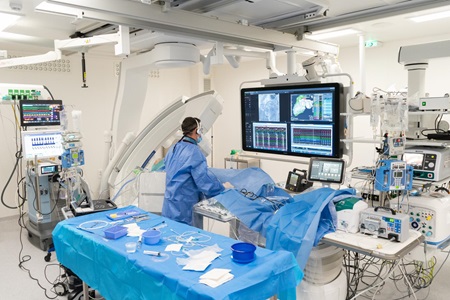
Image: Intelligent operating room developed by Ditec.
More information:
Web: www.cdti.es
Linkedin: https://www.linkedin.com/company/29815
X: https://twitter.com/CDTI_innovacion
Youtube: https://www.youtube.com/user/CDTIoficial

cloud technology axon

Axon Partners Group, Tresmares Capital, Sabadell Venture Capital, Inve...