Catalonia is among the 10 regions in the world that have attracted the most foreign investment projects in the technological and digital sphere over the past five years. These figures come from the study The Technology and Digital Sector in Catalonia, prepared by ACCIÓ, the agency for business growth under the Department of Business and Labour. According to the report, Catalonia ranks eighth globally in the number of projects attracted during the 2021–2025 period and is the second region in the European Union—only behind Île-de-France—with a total of 388 projects (+32% compared to the previous five-year period).
In this regard, the report highlights that over the past five years Catalonia has attracted a total of €9.323 billion in foreign investment in this field, representing growth of 165% compared to the previous five-year period (2016–2020). The study underscores the presence of companies such as Microsoft, Amazon, Alphabet, NTT Data and HP among the foreign technology investment projects attracted in recent years in Catalonia. In fact, it notes that Barcelona is the second most attractive city in the world for foreign investment in R&D, according to the Global Cities Investment Monitor.
A Strategic Sector for the Country’s Economy
The report, published on the occasion of the upcoming celebration of the Mobile World Congress in Barcelona next week, reveals that Catalonia has 28,122 companies in the digital and technology sector (2025 data), 13% more than the previous year. These companies generate €41.495 billion (2024 data, the most recent available), 4.7% more than in 2023, and have surpassed the €40 billion revenue threshold for the first time. The report also concludes that companies in this sector employ 218,598 people (2024 data, +10% year-on-year growth).
For the purposes of the report, the technology and digital sector includes any economic activity with a significant digital and/or technological component. The core segment is the ICT sector itself, but it also encompasses other highly technological fields such as video games, the audiovisual industry, smart cities and govtech, among others, as well as companies that develop and provide technological solutions.
Overview of the Technology and Digital Sector in Catalonia
This is a young and dynamic sector, with 46% of companies established less than 10 years ago. Of the total companies in the sector, 8% are startups and 7% maintain regular export activity.
Companies specializing in ICT and telecommunications represent the majority group, accounting for 87.6% of the total. They are followed by companies operating in digital technology–intensive sectors (23.7%) and providers of key technologies such as AI, IoT, cybersecurity, semiconductors and supercomputing (5.8%).
Territorially, the province of Barcelona stands out as Catalonia’s main digital hub, accounting for 86.3% of companies. The counties of Barcelonès (54.1%), Vallès Occidental (10.8%) and Baix Llobregat (7.5%) lead the list of areas with the highest concentration of technology and digital companies.
Catalonia’s Technological Potential: A Magnet for International Talent
The report emphasizes the factors that make Catalonia a world-class technology hub. Catalonia is the leading startup ecosystem in southern Europe, with 2,403 startups, and Barcelona is the top city in the EU and the third in the world for attracting foreign investment projects in AI, according to IBM.
The study also recalls that Catalonia has been awarded the European Commission’s Regional Innovation Valley label, holds the status of “strong innovator” in the European Innovation Scoreboard (EIS) ranking, and boasts scientific infrastructure and R&D centers such as the ALBA Synchrotron, the MareNostrum supercomputer, the Barcelona Biomedical Research Park and the Institute of Photonic Sciences, along with universities and clusters that complete the digital economy ecosystem and foster technology transfer. It also hosts major international technology events such as Integrated Systems Europe and the Mobile World Congress, which closed 2025 with a record-breaking edition in terms of economic impact and this year celebrates its twentieth edition in the city.
Regarding international talent, the document notes that Barcelona is home to more than 42,000 sector professionals from outside Catalonia, and that London is the leading exporter of digital talent to the Catalan capital (12%), according to 2024 data. Among the digital specializations attracting foreign talent to the city are cybersecurity, application development and web development.
Government Support for the Sector within the Framework of the MWC
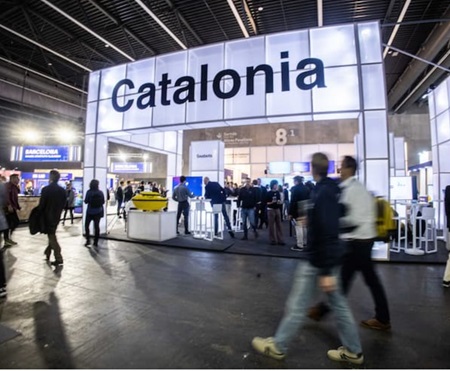
This year’s Mobile World Congress kicks off tomorrow. Under the slogan “AI. Shared Responsibility” and through a light-based experience presiding over the Catalonia stand, the Government of Catalonia will showcase at MWC 2026 its strong commitment to the development and use of trustworthy, safe and human-centered AI. In addition, the Government will facilitate the participation of 106 Catalan companies and startups in its spaces with the aim of connecting them with potential new partners and clients, local and foreign investors, increasing visibility and opening up new international markets.
Specifically, the exhibition area of the Catalonia pavilion at MWC will once again host individual stands for 44 companies and technology centers from Catalonia’s digital ecosystem to showcase their products, solutions and services and negotiate international cooperation agreements.
Moreover, the Government will facilitate the participation of 62 Catalan startups at 4 Years From Now (4YFN), where they will present their projects accompanied by the Generalitat. Through ACCIÓ, 36 startups from various sectors will be showcased to help them connect with potential new partners and clients, local and foreign investors, and expand into new international markets. Four of these startups will have a dedicated space for high-impact technological demonstrations. In collaboration with Biocat and other entities, 16 health-sector startups will be featured at the Catalonia Health Tech stand within 4YFN, strengthening Catalonia’s positioning as a digital health innovation hub. Meanwhile, the Catalan Institute for Cultural Companies (ICEC), under its internationalization brand Catalan Arts, will showcase the projects of 10 Catalan digital companies at 4YFN.
ACCIÓ will also promote various business events as part of MWC. One of the initiatives organized by the agency is the Open Innovation Challenge, a series of meetings where Catalan and international companies pose technological challenges for Catalan startups or technology providers to propose innovative solutions. The aim is to connect emerging companies with more established businesses. This year, participating companies include Banc Sabadell, Fluidra, Desigual, RACC, Mesoestetic, Repsol, LG and Swiss Post, seeking solutions related to technologies such as artificial intelligence, big data, connectivity, the Internet of Things and cloud computing. According to ACCIÓ estimates, around 700 meetings between companies, startups and solution providers are expected to take place during the congress. This activity is organized by ACCIÓ as a member of the Enterprise Europe Network (EEN) of the European Commission in Catalonia.
Regarding 4YFN, ACCIÓ will organize several events aimed at entrepreneurs and investors, including an elevator pitch session for startups located in its pavilion, sessions to promote co-investment among Catalan startups, and a workshop focused on advice for emerging companies seeking international expansion. Networking meetings and sessions led by key ecosystem organizations such as Barcelona Health Hub, Norrsken House Barcelona and Netmentora Catalunya will also be held.
For the purposes of the report, the technology and digital sector includes any economic activity with a significant digital and/or technological component.

cloud technology axon

Addleshaw Goddard (AG), the London-headquartered international law fir...