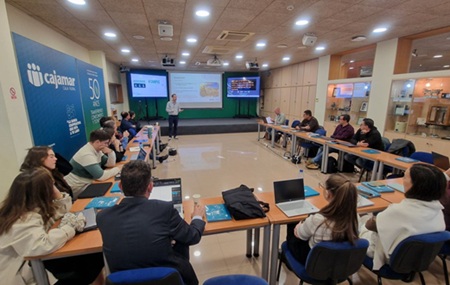
The latest call attracted 197 applications from startups specializing in biotechnology, artificial intelligence and precision robotics for the agrifood sector
Cajamar Innova, the comprehensive and personalized entrepreneurship support programme promoted by Fundación Grupo Cajamar, has selected 22 entrepreneurial projects for the latest cohort of its three acceleration programmes: Water, Agrotech and Foodtech. The call received a total of 197 applications, highlighting the growing interest among startups in the opportunities offered by the agrifood sector.
The selected projects reflect the technological trends reshaping the industry: artificial intelligence as a cross-cutting management layer for complex systems; biotechnology as a practical alternative to chemical inputs; and precision technologies that deliver objective, data-driven insights exactly where agricultural expertise alone was previously relied upon.
Water: from real-time data to intelligent management
The sixth edition of Cajamar Innova Water reinforces a dual vision: water is not only a resource that must be managed more efficiently, but also a system about which real-time information remains limited.
Among the selected startups focused on monitoring are AiQUOS, which has developed electrochemical probes with embedded artificial intelligence capable of measuring multiple parameters directly at the point of use without relying on cloud connectivity; MizuSense, whose sensors mimic plant roots to monitor the rhizosphere without disturbing it; and Kimedes AI, which uses satellite technology to detect leaks in underground water networks without requiring physical inspections.
Other companies focus on improving water quality. Electraqua has developed a reactor that generates oxidizing agents from air and electricity to remove micropollutants—particularly pharmaceutical residues—without external chemical reagents. Agrodit applies multi-level sensing technologies to optimize irrigation management for natural grass sports fields, while BluMind is building the data infrastructure needed for AI models to make reliable decisions in complex water management operations such as desalination.
Agrotech: biotechnology moves from the laboratory to the field
The third edition of Cajamar Innova Agrotech demonstrates how biotechnology is evolving from experimental research into practical agricultural solutions.
Evolving Therapeutics is developing bacteriophages to control plant pathogenic bacteria, while Terrana Biosciences is advancing RNA-based platforms to provide systemic protection against emerging crop viruses such as Tomato Brown Rugose Fruit Virus (ToBRFV). Meanwhile, Agrikola.ai is developing robotic systems that replace fungicides with precision UVC radiation.
Technologies that only a few years ago remained confined to research laboratories are now being tested under real farming conditions. Available field data show significant reductions in crop protection costs while achieving disease control levels comparable to—or even exceeding—those of conventional treatments.
Other startups are approaching farm digitalization from different perspectives. Ulture digitalizes day-to-day farm operations through highly practical management software; Agrisens replaces manual pest monitoring with AI-powered automated detection systems; Inbiota integrates soil microbiology into agronomic decision-making for the first time, paving the way for data-driven regenerative agriculture; Cropi provides end-to-end traceability from the field to final certification; and Solaris Vita integrates solar panels into greenhouse infrastructure, enabling farms to generate part of the energy they consume.
Foodtech: reducing environmental impact without compromising food safety
The second edition of Cajamar Innova Foodtech brings together companies pursuing a shared objective: reducing the environmental footprint of food production while maintaining effectiveness, food safety and nutritional value.
Entomo Agroindustrial transforms agrifood waste into protein, fat and chitin through insect bioconversion. Bioceanics produces highly bioavailable omega-3 from fish oils or algae with nutritional properties comparable to krill oil, without harvesting krill. Nuna encapsulates microalgae in edible hydrogels, allowing them to reach aquaculture hatcheries alive without requiring refrigerated transport.
Reducing chemical inputs throughout food production and distribution is another recurring theme. Nat4Bio has developed a post-harvest bio-adjuvant that can reduce fungicide use in fruit and vegetables by up to 75% without compromising food safety. Fibtray replaces up to 96% of the plastic used in food trays with a cellulose-based solution compatible with modified-atmosphere packaging, while Alcheme Bio has developed enzymes that eliminate undesirable flavours in plant proteins by acting directly on the responsible compounds without adding ingredients or extending product labels.
Two startups operate at the intersection of nutrition and healthcare. Cyanoterra has developed a platform that bio-integrates micronutrients into microalgae cells during cultivation, with an initial application targeting iron deficiency through improved bioavailability compared with conventional supplements. Eubiomic Health has created the first food for special medical purposes designed to rehabilitate the excluded intestinal segment in patients undergoing colorectal surgery, addressing an unmet therapeutic need.
A unique ecosystem where innovation is validated under real-world conditions
Since its launch in 2018, Cajamar Innova has built an extensive network of strategic partners, including leading water utilities, agrifood corporations and entrepreneurship support organisations.
Selected companies gain access to Cajamar's Experimental Centres in Almería and Valencia, receive specialised mentoring and are able to validate their technologies under real farming and production conditions.
Presenting the new cohort, Ricardo García Lorenzo, Director of Cajamar Innova and Director of Agrifood Innovation at Fundación Grupo Cajamar, highlighted the breadth of innovation represented by this year's selection:
"This edition reflects better than any previous one the breadth of innovation taking place across the agrifood sector. Molecular biotechnology, artificial intelligence applied to water management, novel ingredients and precision robotics: this is not simply a thematic programme, but a roadmap of where the industry is heading. It has been built by teams that are not working on future challenges—they are solving the problems that farmers, water managers and the food industry face today."
Eight years, 95 companies and three specialised programmes
Cajamar Innova was established in 2018 with the conviction that efficient water management would become the defining cross-sector challenge for agriculture under climate change and increasing regulatory pressure.
In 2024, it expanded with the launch of Cajamar Innova Agrotech, focused on agricultural production technologies including robotics, mechanisation, precision agriculture, digital farm management, biotechnology and the bioeconomy. One year later, Cajamar Innova Foodtech was launched to support technologies transforming food production, including personalised nutrition, innovative food processing, waste reduction and alternative proteins.
Since its inception, Cajamar Innova has organised 11 acceleration programmes and supported 95 technology companies, including 13 international startups from eight different countries. With the addition of 22 new companies in this latest cohort, the accelerator further strengthens its position as one of Spain's leading agrifood innovation platforms.

cloud technology axon
Bohr Energie, a French scaleup specialized in the aggregation, optimiz...