The Italians who buy digital companies that no longer grow, restructure them, and bet that the soup won’t spill.
In recent months, we’ve been watching Bending Spoons acquire, one after another, some of the most recognizable brands in the recent history of the internet: Eventbrite, AOL, Vimeo (some of them even publicly traded companies that they ended up taking private). Everyone is talking about it, but very few really understand the model they’re applying and whether it makes sense in the long term (I’m not entirely sure I fully understand it myself, frankly).
The first model is buy & build, where an investor acquires a “platform” company and then adds complementary businesses. It’s a well-known model: buy, integrate, generate synergies, cross-sell, and after a few years of consolidation-driven growth, sell the whole group to another fund or to a strategic buyer willing to pay a higher multiple. Its logic is both industrial and financial, and its mechanics are highly predictable.
The second model is buy & hold. The most cited example is Constellation Software, although it’s not exclusive to tech. It consists of acquiring relatively stable businesses, letting them operate with minimal interference, and extracting cash flow for decades, without obsessing over integrations or future exits. It’s a sort of federation of small companies, managed more or less autonomously but under a common umbrella that ensures financial discipline.
Bending Spoons doesn’t fit into either.
They don’t try to consolidate a sector or build a platform with dozens of add-ons. Nor do they simply buy businesses and let them run untouched. And although it’s sometimes confused with this, it’s not the classic distress pattern either. Distressed-asset funds typically buy very cheap, make only the essential adjustments, and sell as soon as the business stabilizes. Here, the opposite happens: Bending Spoons looks for companies that aren’t dead, but are clearly stuck, and bets on managing them for the long term after making the changes they consider necessary.
The closest approach would be a buy–fix–hold: acquiring mature or stalled businesses, followed by an intense restructuring phase—costs, product, pricing, teams. Once stabilized, these assets become permanent pieces of the group, unlike what a portfolio-rotation-oriented fund would do. This approach is not trying to replicate a disguised buy & build, although there is an intention to share technology, infrastructure, or AI capabilities across the companies, which introduces a logic different from a mere financial holding.
Still, the most striking part of this strategy isn’t the theory, but the names they’ve been acquiring.
For those of us who’ve been in the tech sector for a while, these companies feel like digital archaeology. They are tools we used at some point in our lives, enjoyed their peak years, and eventually abandoned.
In my case, Evernote was my notes app for a while, more than fifteen years ago. Then it stopped evolving, better alternatives appeared, and I simply left it behind. My experience with Vimeo was similar: in 2009 I used it to upload some videos during the Antevenio Media to Antevenio Rich&Rich rebranding, and from then on it disappeared from my radar. And if I go even further back, I had an AOL account in 1999, when I lived in the US—sort of the entry door to the internet that we all used at the time. I cancelled it when I returned to Spain in 2001, and it remained as a relic of a completely different era.
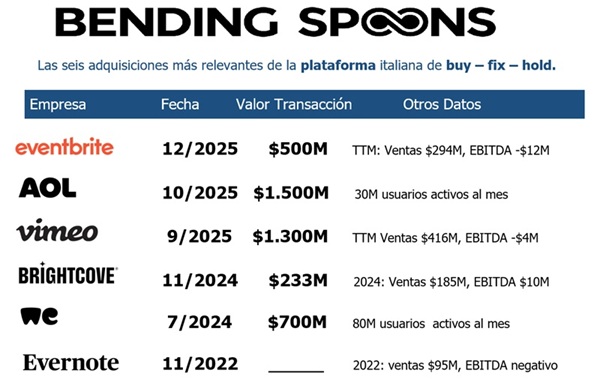
Eventbrite, Brightcove, and WeTransfer fit the same category: they grew, had a moment when they seemed poised to occupy a relevant space, and eventually stagnated. They work, generate revenue, and have users, but never fully consolidated or built a truly sustainable model. That mix of past visibility, residual use, and zero growth is exactly what makes these companies typical targets for an investor like Bending Spoons.
Looking at the numbers, the pattern is evident:
Eventbrite
What it is: a ticketing and event-management platform, mostly for independent promoters.
Revenue: $327M (2019) → $326M (2023) → $294M TTM
EBITDA: –$12.6M TTM, never consistently profitable
Price: ~$500M (~1.7× sales)
Vimeo
What it is: a professional video platform for businesses and creators, offering hosting, analytics, and collaboration tools.
Revenue: $391M (2021) → $433M (2022) → $417M (2023/24) → $416M TTM
EBITDA: from $23M (2023) to ~ $4M TTM
Price: $1.38B (>300× current EBITDA)
Brightcove
What it is: enterprise video solutions, focused on corporate streaming and OTT.
Revenue: $200M (2022) → $186M (2023) → $185M (2024)
EBITDA: ~ $10M stable
Price: $233M (~1.25× sales)
WeTransfer
What it is: simple large-file transfer service with massive free-user base.
Users: ~80M MAU
Revenue: flat since 2021
Price: estimated ~€700M (in line with IPO attempt)
Evernote
What it is: notes and productivity app widely used in the 2010s.
Revenue: ~$90M (2019) → ~$95M (2022)
EBITDA: recurring losses
Price: undisclosed (but clearly fitting the “stagnant” profile)
AOL
What it is: historic email + basic digital-marketing provider, with a very stable user base of legacy users.
Valuation history:
• >$166B in the Time Warner merger (2000)
• Sold to Verizon for ~$4.4B (2015)
• Included in Yahoo+AOL sold to Apollo for ~$5B (2021)
• Sold again, now separately, to Bending Spoons for ~$1.4–1.5B (2025)
Current business: ~30M monthly active users; stable but with no real growth.
All these assets share the same diagnosis: stable or slightly declining revenue, low or nonexistent margins, little innovation, and a user base held together by inertia more than dynamism. A type of business that growth funds don’t want, traditional private equity can’t scale, and distress funds wouldn’t buy because they’re not deteriorated enough to justify a rescue thesis.
Part of the explanation is obvious: price. Many of these companies are acquired at relatively low revenue multiples—usually between one and three times (for a reason: they’re not growing or are shrinking). But the key isn’t what they pay; it’s what they expect to do afterward. Their model depends on cutting, reorganizing, automating, optimizing, and possibly raising prices, with the aim of turning businesses that barely generated cash into EBITDA (adjusted) machines.
The problem is that the word “adjusted” hides many things that don’t magically disappear. Closing offices, reducing teams, eliminating projects, raising prices for low-activity users, and improving margins overnight. But a strategy based on cuts only works for a limited time. Beyond that, you need real organic growth—much harder to achieve in businesses that haven’t grown for five or ten years. (I’ve lived this personally in a couple of acquisitions we made when I was CEO at Antevenio—we bought three companies that were no longer growing, or shrinking, and all ended up shutting down in the medium term.)
The other question—perhaps the most important—is their financing structure. The company has leveraged itself heavily, with significant debt packages to finance all these acquisitions. If the technical integration, product repositioning, or internal synergies don’t generate the expected return, the pressure from leverage can become a very serious issue.
This is not a criticism of the strategy itself, which has interesting elements and some industrial logic, but of the possibility that everything depends on quick improvements that may not be sustainable in the medium term. Time will tell whether we’re seeing a new constellation of the buy–fix–hold model or a good idea that won’t be executed properly. Because, let’s be honest: buying stable, cash-flow-positive businesses (as Constellation Software does extremely well) is one thing; diving into companies with problems that need fixing is a much harder bet.
In any case, what they’re building is something that at the very least deserves close attention
Want to place a bet?
By Joshua Novick, Partner at Bondo Advisors

cloud technology axon
Axon Partners Group, Tresmares Capital, Sabadell Venture Capital, Inve...