Interview with Eudald Bover, CEO of AWAYTER: “The support of CDTI Innovación and the European MRR funds has enabled us to develop an Automated Gastronomic Space, offering healthy, intelligent and sustainable food”
The growing demand for healthy food options, together with increased attention to sustainability and service efficiency, is redefining everyday access to food. In environments such as companies, hospitals or universities, traditional catering and vending models have shown clear limitations when it comes to offering quality products that are accessible and continuously available.
It is within this context that AWAYTER was created—a technology company committed to automation, digitalisation and advanced industrial design to develop new food solutions tailored to these challenges. With the support of the Neotec programme of CDTI Innovación, an initiative co-financed by the European Recovery and Resilience Mechanism (RRM) funds, the company is developing an R&D project that lays the foundations for a new concept: the Automated Gastronomic Space.
AWAYTER: industrial innovation at the service of wellbeing
The origins of AWAYTER are directly linked to a very specific concern: how to improve people’s health and wellbeing in collective spaces where access to balanced nutrition is not always guaranteed. As explained by its CEO, Eudald Bover, the initial motivation stemmed from observing an everyday reality: “AWAYTER arose from the desire to improve the health and wellbeing of employees in companies and other collective environments.”
In these settings, working hours do not always align with traditional canteen schedules and, in many cases, the only available alternative is conventional vending—an option that falls short of today’s expectations in terms of quality, variety and convenience. “We identified that traditional canteens and conventional vending were insufficient to meet current needs, especially in scenarios with extended shifts and a growing demand to deliver more value with fewer resources,” says Bover.
This situation is compounded by the limited availability of healthy food solutions with continuous access in the Spanish market. At the same time, more advanced self-service models had already been implemented in other European countries, allowing the AWAYTER team to identify an opportunity to develop and adapt such solutions to the context and needs of the domestic market.
The project is also closely linked to the professional background of its founders. The team brings extensive experience in the design and sale of industrial machinery for large-scale international production—expertise that has decisively shaped the company’s approach. “Our previous experience has been key to gaining an in-depth understanding of the industrial machinery design process, as well as the real challenges faced by manufacturers and what customers expect from us as suppliers,” the CEO explains.
From this perspective, AWAYTER does not see itself as a provider of one-off solutions, but rather as a technology partner capable of supporting its clients over the medium and long term. “Our clients are not looking for a one-time collaboration, but for a relationship of trust that allows them to evolve over time. That is the way of working we want to consolidate at AWAYTER,” adds Bover.
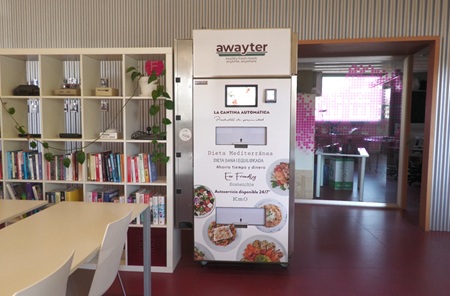
This vision is embodied in Awayter Canteen—a refrigerated, healthy food automatic canteen with continuous availability, designed to integrate seamlessly into corporate, healthcare or educational environments, placing people’s wellbeing at the heart of organisational strategy.
The Automated Gastronomic Space: a project driven by CDTI
Thanks to the support of the Neotec programme of CDTI Innovación, AWAYTER is currently developing the Automated Gastronomic Space project—an initiative with a strong technological component that combines advanced mechatronics, intelligent software and artificial intelligence to deliver a comprehensive automated collective catering solution.
In the CEO’s words, the concept can be summarised simply: “AWAYTER’s Automated Gastronomic Space is an automatic canteen offering healthy, refrigerated food with continuous availability, designed primarily for companies, hospitals, universities or offices.”
One of the system’s key differentiating features is its compact, high-capacity design. Thanks to an optimised architecture, the solution can store up to 100 refrigerated products in less than one square metre, allowing it to be installed even in limited spaces.
This level of spatial efficiency is made possible by the development of a proprietary, patented mechatronic system known as Opti-Stack. “It is a system that allows up to 100 products to be stored in a very small space, while always ensuring delicate handling of the product,” explains Bover.
Developing this system has involved significant technical challenges. On the one hand, it required the design of extremely precise and reliable movement mechanisms in a high-density environment. On the other, the AWAYTER team had to solve the system’s thermal management, particularly during product extraction. “One of the major challenges has been ensuring homogeneous temperature across all levels without increasing energy consumption, especially at the moment when products leave the refrigerated module,” notes the CEO.
However, the project goes beyond hardware development. Another fundamental pillar of the Automated Gastronomic Space is the software specifically developed to bring intelligence to the machine. “Thanks to the software, the canteen becomes fully intelligent. It allows remote monitoring and management of stock, sales and consumption, applies artificial intelligence to optimise restocking and reduce waste, and automates maintenance processes and expiry-date control,” explains Bover.
This digital layer is integrated into the Awayter Connect platform—an IoT solution that acts as the management core of the ecosystem. From a single dashboard, operators can manage multiple machines, analyse data in real time and optimise operations. “We offer an end-to-end solution that integrates mechanical infrastructure with our IoT platform, creating a unified hardware and software ecosystem that is robust and scalable,” summarises the CEO.
The project’s objectives are clear and closely aligned with current sector challenges: improving wellbeing in collective environments, digitalising and automating operations to gain efficiency and visibility, and moving towards a more sustainable model.
In this process, the support of CDTI Innovación has been decisive: “Having the backing of CDTI has been essential to accelerating technological development, strengthening our R&D team and validating key processes with greater rigour,” states the CEO.
Scalability, sustainability and future vision
The impact of the Automated Gastronomic Space extends to both operators and end users. “Restocking prediction and remote monitoring enable much more efficient management, with fewer journeys and better use of resources,” explains Bover.
For consumers, the value translates into continuous access to healthy food, with a fast, convenient and safe purchasing experience, aligned with a more efficient supply chain and a commitment to recyclable packaging.
Looking ahead, AWAYTER sees additional growth potential in the evolution of its IoT platform into other industrial sectors. “The AI-powered remote control software we have developed for canteens can be applied to other areas of industrial machinery,” notes the CEO.
Sectors such as healthcare, climate control, agriculture or livestock farming could benefit from the monitoring, control and remote optimisation capabilities of Awayter Connect, significantly expanding the company’s diversification opportunities.
Over a three- to five-year horizon, AWAYTER aims to consolidate the commercialisation of its healthy food automatic canteens nationwide, while continuing to expand its technological platform in parallel. “Our vision is to grow sustainably, both in the deployment of canteens and in the expansion of Awayter Connect into new sectors and applications,” concludes Bover.
AWAYTER thus positions itself as an example of how the combination of industrial experience, technological innovation and public support for R&D can give rise to solutions with real impact on the economy, sustainability and people’s wellbeing.
The Centre for the Development of Technology and Innovation (CDTI E.P.E.) is the innovation agency of Spain’s Ministry of Science, Innovation and Universities, whose objective is to promote technological innovation within the business sector. CDTI’s mission is to ensure that the Spanish business fabric generates and transforms scientific and technical knowledge into globally competitive, sustainable and inclusive growth. In 2024, as part of a new strategic plan, CDTI provided more than €2.3 billion in support to Spanish companies and startups.
More information
Web: www.cdti.es
Linkedin: https://www.linkedin.com/company/29815
X: https://twitter.com/CDTI_innovacion
Youtube: https://www.youtube.com/user/CDTIoficial

cloud technology axon
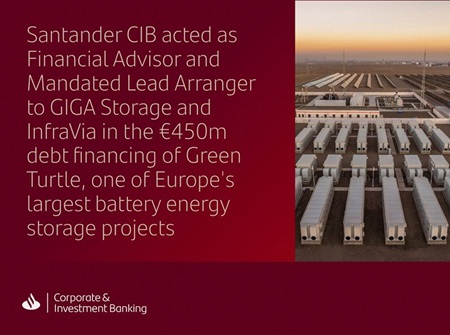
Santander Corporate & Investment Banking has acted as Financial Adviso...