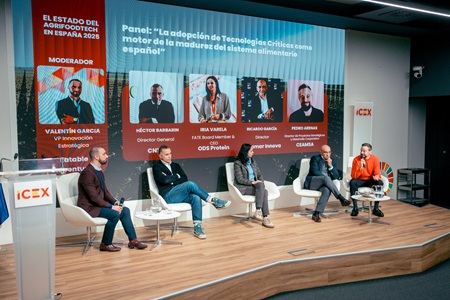
Eatable Adventures, a global leader in Foodtech acceleration, has today released the findings of its annual report “The State of Agrifoodtech in Spain 2025.” The study, produced by the accelerator with institutional support from ICEX, provides an in-depth analysis of the food-innovation ecosystem in another year marked by the global contraction of venture capital.
In 2025, venture capital has entered a phase of greater selectivity, prioritizing technologies that offer fast validation and immediate returns, which reduces the flow of investment into vertical sectors such as Agrifoodtech. Globally, investment in the sector has fallen by 12%, and in Spain it is down 31.3%, reaching €123 million—closely aligned with this shift in capital allocation. According to the report, this is not a structural decline but rather a repositioning of the ecosystem towards projects capable of demonstrating technological impact and industrial scalability.
However, the Spanish ecosystem has shown resilience and continues to grow steadily. Proof of this is that the number of startups has risen to 416, a 5% increase over the previous year. The launch of pioneering initiatives at the European level also stands out, such as the first Agrifoodtech Sandbox, promoted by CNTA with the support of national administrations (MAPA and MCIU) and the regional governments of Navarre and La Rioja, as well as the Raíces acceleration program developed by Eatable Adventures as a strategic bridge between the ecosystems of Spain and Latin America.
The report highlights a higher level of maturity among founders: the average age has risen to 42, with a strong educational background and previous experience in the sector. This reflects a clear evolution toward greater professionalization.
There is also a strong female presence among founding teams: 58% are led by women, far above the national average for the tech sector.
Geographically, the ecosystem shows greater diversity than in previous years. Most founders are based in Madrid (28%), Catalonia (18%) and Castile and León (12.3%). Galicia has climbed to fourth place (7.38%), overtaking Andalusia and Valencia, which traditionally occupied the third and fourth spots.
In terms of verticals, the ecosystem maintains a stable distribution, with Novel Foods, Agritech and Retail & HORECA as the main areas of innovation. These are joined by advances in logistics, sensors, automation, precision agriculture and circular economy solutions, consolidating an ecosystem increasingly focused on industrial application.
The origin of technological innovation has not changed significantly over the past year. Internally developed technology continues to lead, representing 58% of the sample. However, the report points out that technology transfer remains a major challenge. Only 15% of the technological base of startups originates from universities or research centers, underscoring the need to strengthen these connections to maximize the impact of innovation in the sector.
Among the most widely used technologies, artificial intelligence stands out at 48%, up 9% from last year. It is followed by biotechnology (36%), SaaS (25%), specialized hardware (15%) and IoT (21%).
The report highlights that, despite the predominance of more mature, market-ready projects, there has been an exceptional increase (500%) in startups at lower maturity levels. This surge signals the emergence of early-stage technologies that are beginning to gain traction and could shape the next wave of innovation in the sector.
Spain maintains a strong position in applied research and emerging fields with transformative potential. The challenge, however, is no longer generating more knowledge but converting it into validated, scalable technology. The emergence of these nascent technologies marks a key moment: the scientific foundations are being built, but greater industrial and financial capacity is needed to bring them to market.
Some 68% of startups surveyed believe that public institutions actively support the sector, but only 40% say accessing public funding is easy. Regarding investment, only 49% feel that Spanish investors have a deep understanding of the sector and actively bet on it, compared with 68% in the case of international investors. Additionally, 90% call for a more open industry willing to run pilots, tests and co-development processes.
Internationalization is another key need: 87% of startups surveyed consider it essential to have programs that facilitate access to foreign markets. One example is the initiatives within the Desafía program, promoted by ICEX, which provide specialized guidance in leading innovation ecosystems.
In short, although startups recognize progress in public and scientific support, bureaucracy, the lack of specialized investment and the weak connection between industry and research remain structural barriers that limit Spain’s global competitiveness.
“The drop in investment is not just cyclical; it reflects a shift to a new stage requiring validated technologies, scalable models and faster results. Technological innovation in Agrifoodtech has spent years proving its transformative power and its potential to tackle the sector’s major challenges. The sector has shown resilience—now it must take the step toward strategic leadership that turns technological innovation into real impact,”
said José Luis Cabañero, Founder and CEO of Eatable Adventures.
For more information about the report,download the full document here.

cloud technology axon
Over little more than a decade, Regenera has built a strong track reco...