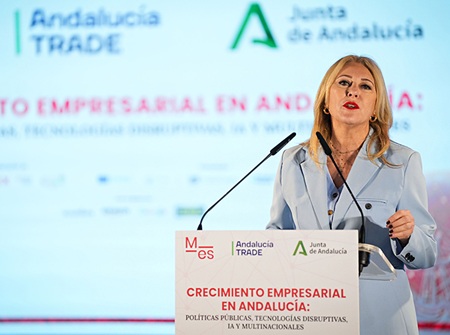
The regional Minister of Economy, Finance, European Funds, and Social Dialogue, spokesperson for the Andalusian government and president of Andalucía TRADE, Carolina España, has announced the launch of a new fund to invest in Andalusian technology companies, through equity participation or participatory loans, with a budget of €30 million, “and for the first time in Andalusia, regardless of the company’s size,” she emphasized.
Carolina España made this announcement during the inauguration of the conference “Business Growth in Andalusia: Public Policies, Disruptive Technologies, AI, and Multinationals,” an event organized in Seville by Andalucía TRADE and Multinational Companies in Spain.
This is the first time that this entity, which brings together a large part of the foreign multinationals operating in the country, holds a meeting outside of Madrid, “a gesture we especially appreciate, as it recognizes the strength of our region and positions Andalusia as a community undergoing transformation and offering a favorable ecosystem for companies to invest here.”
“Many companies are well aware of the opportunities and benefits that investing and establishing themselves in Andalusia has offered them over the past few years—a region now synonymous with growth, productivity, and leadership, but also safety, stability, and trust,” the minister stated, noting that all incentives and financial instruments that the Andalusian government will provide to companies until 2027 are expected to mobilize corporate investment exceeding €1 billion.
During her speech, the regional economic leader referred to the importance of addressing one of the main challenges for Andalusia and Spain: having a productive fabric with more medium- and large-sized companies. To this end, she announced the creation of the new Strategic Technology Fund in Andalusia, a pioneering initiative with a budget of €30 million from the Andalusian government’s own funds.
This instrument, which for the first time from the public sector targets non-SMEs and is set to be operational before summer 2026, will allow the development of digital and high-value innovation projects: digital technologies and deep tech innovation, clean and resource-efficient technologies, and biotechnology, she explained.
Specifically, through a mostly public venture capital fund, €2–6 million will be allocated per project, either through equity investment or participatory loans.
“Once again, this is about supporting Andalusian companies, in this case for the first time more focused on non-SMEs, which face a lack of financing options for technology projects, both from public and private sources. The first, because its support is mainly aimed at SMEs, and the second, due to conditions not tailored to the needs of capital-intensive, long-term technology projects.”
“As I’ve said, this Andalusia is ambitious and wants more: more growth, more companies, larger companies, more exports, more innovation,” the minister stressed, adding that the Andalusian government is contributing to this with the approval of the 2026 budget, which “increases support for the business fabric to €7.4 billion and entails a historic investment: €6.4 billion, 73.3% more than in 2018.”
The creation of this new fund, Carolina España indicated, is part of the development of the MidMarket Club Andalucía TRADE, a forum of meetings, actions, services, and financing aimed at helping mid-sized companies grow and reach the next level of development. It was presented at the conference by the agency’s Director General, Antonio Castro.
This initiative by Andalucía TRADE aims to support midmarket companies—those in the middle segment—helping them advance to the next stage of development. These companies face two main challenges when trying to grow into the large-enterprise segment: lacking the necessary resources relative to their size and being minimally addressed, if at all, by public policies supporting business development, which are largely focused on small businesses.
Midmarket companies are defined as those with annual revenues between €50 million and €500 million, a net balance exceeding €43 million, or employing between 250 and 3,000 workers. In Andalusia, there are 366 companies meeting these criteria, collectively generating €31.255 billion in revenue and employing 163,169 workers, averaging €85.39 million in revenue and 446 employees per company.
The Club’s goal is to support midmarket companies in overcoming challenges, provide a forum for collaboration, and highlight the crucial role of these companies in Andalusia’s economic development. It offers actions, financing, and tailored services organized around six areas: business intelligence, innovation, financing, internationalization, strategy, and networking.
Through this initiative, midmarket companies will have access to Andalusian government financial instruments totaling €136 million, including the €30 million from the technology fund, €1 million for an alternative finance market access incentive line, and €105 million from ERDF calls for R&D&I projects—both non-competitive, currently available, and competitive calls to be launched throughout 2026.
Among these measures is the establishment of the Andalusian Midmarket Observatory, responsible for researching and analyzing the midmarket business fabric in greater depth: collecting data, conducting studies, and producing reports to identify trends, opportunities, and challenges specific to this business segment.
Additionally, Club members will have access to advisory services in the above areas and can participate in networking events designed specifically for them. Registration, to be completed online at www.andaluciatrade.es/club-midmarket
, will open in January 2026.
During the conference, Multinational Companies in Spain presented its study “Driving Spain’s Growth: The Role of Technology, AI, and Multinationals,” coordinated by Andrés Pedreño, Professor of Applied Economics at the University of Alicante, and carried out in collaboration with ICEX–Invest in Spain. The study highlights the role of multinationals in the country’s technological development, as well as the potential of technologies—especially Artificial Intelligence—to activate key sectors of the Spanish economy.

cloud technology axon
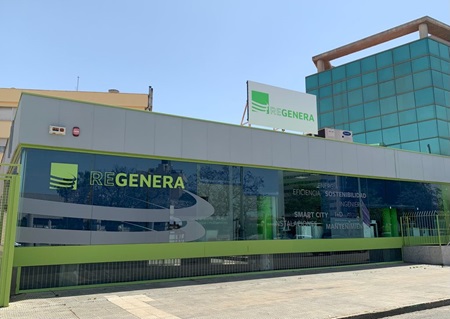
Over little more than a decade, Regenera has built a strong track reco...