The integration into this European network strengthens the regional technology ecosystem and its international projection.
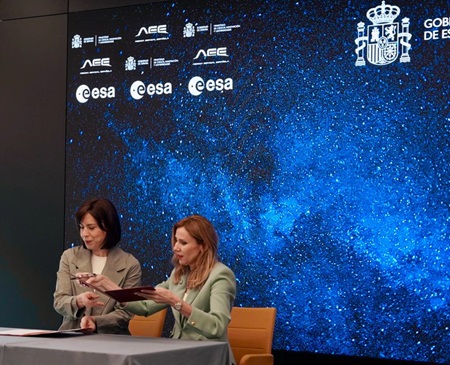
The Region of Murcia is joining the European Space Agency’s network and opening a new stage for technology startups. The Regional Minister for Business, Employment and Social Economy, Marisa López Aragón, took part today in the signing ceremony for the incorporation agreement, held at the European Space Astronomy Centre (ESAC) in Madrid, and attended by the Minister of Science, Innovation and Universities, Diana Morant.
With this step, the Region of Murcia joins Castilla-La Mancha and the Basque Country in the national call promoted by the Spanish Space Agency and the Ministry to expand the ESA Business Incubation Centre (ESA-BIC) network in Spain. With these new incorporations, there are now seven Spanish regions represented in the European organization.
In this regard, the Regional Minister for Business highlighted that “this incorporation confirms that the Region of Murcia is following a clear strategic direction in innovation.” She added that “joining the ESA-BIC network means placing ourselves within the European circuit of knowledge, technology, and space-related investment, with a direct impact on the competitiveness of our companies and the generation of skilled employment.”
In this way, the region becomes part of the leading European incubation network for space-related startups, which brings together more than 2,100 companies, strengthening its position within the European ecosystem of innovation, technology transfer, and investment.
The future incubator will be located at the former civil airport of San Javier, which is currently undergoing transformation driven by the regional government to host activities related to the development of satellite data-based applications, as well as technology companies linked to emerging sectors.
The program will support companies during their early development stages, offering specialized mentoring, technical support, and access to European investment and collaboration networks. These incubators act as catalysts, enabling space-developed technologies to find applications in the real economy.
Importance of the Caetra programme and the Regional Industrial Plan
López Aragón explained that “this progress is the result of a sustained strategy to promote dual-use technologies, developed through the Caetra programme, which has helped build an ecosystem where companies, technology centers, universities, and public administrations collaborate around new industrial opportunities.”
She also highlighted that the region’s industrial strategy includes emerging high-value technological sectors such as the space economy and dual-use technologies. These sectors are included in the Region of Murcia’s Industrial Plan, developed by the Ministry of Environment, Universities, Research and the Mar Menor.
During the 2026–2030 period, the centre will host up to 12 business projects, with joint funding from the European Space Agency and the Institute of Development (INFO), under the Regional Ministry for Business, Employment and Social Economy. Selected startups will be eligible for grants of up to €30,000 per project, in addition to mentoring and access to European networks.
The Region of Murcia’s bid was supported by 74 public and private entities, including institutions, companies, and innovation ecosystem stakeholders. According to the regional minister, this support “demonstrates the alignment of the regional ecosystem to turn technological innovation and the space sector into drivers of economic growth and industrial development.”

cloud technology axon

Alantra has acted as exclusive M&A advisor to RIVE Private Investment,...