For years, we have simplified capital allocation by reducing it to what appears to be a binary choice: either you donate or you invest. In doing so, however, we have overlooked something fundamental. The reality of the impact ecosystem is not black and white; it is far more complex.
At the same time, concepts such as strategic philanthropy, impact investing, and sustainable finance have gained significant prominence in recent years. Yet there remains a widespread lack of understanding about the different financing tools available and how they can be combined to maximize social and environmental impact. The purpose of this article is to introduce the impact financing continuum and explain the role that Venture Philanthropy can play as a bridge between traditional philanthropy and impact investing.
The False Dilemma: “Donation or Investment”
When an organization, foundation, or investor seeks to contribute to solving a social or environmental challenge, they are often presented with two seemingly opposing paths.
On one side is traditional philanthropy, based on donations or grants whose primary objective is to generate impact without expecting a financial return.
On the other side is impact investing, which seeks to combine the creation of positive impact with the achievement of a financial return.
The implicit message appears straightforward: you must choose a side.
However, this perspective oversimplifies reality. There are organizations and initiatives that are too complex to be sustained solely through donations, yet are not sufficiently mature to attract investment. It is precisely within this middle ground that many projects with transformative potential struggle to grow.
The Continuum We Are Not Seeing
Rather than two opposing extremes, what actually exists is a financing continuum.
This continuum represents a spectrum in which different financial instruments respond to varying levels of risk, different stages of organizational maturity, and different expectations regarding financial sustainability and impact.
A simple way to visualize this continuum is as follows:
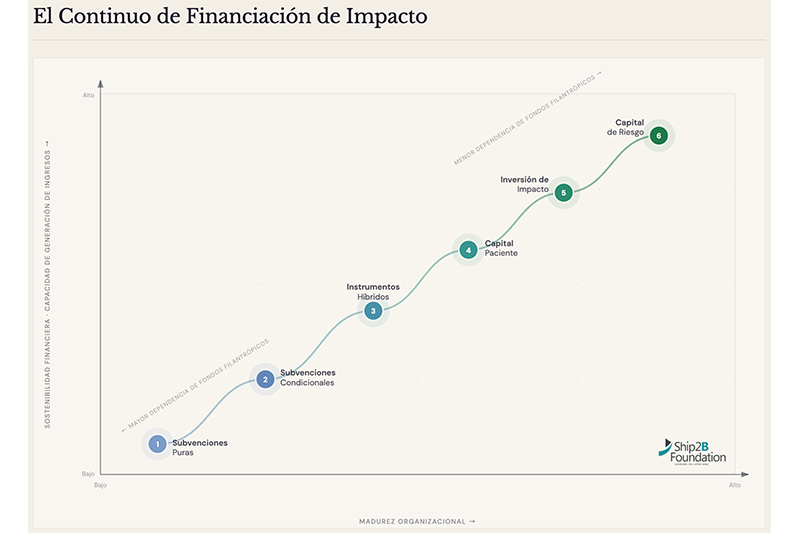
Each of these instruments addresses different needs:
As we move further along the continuum, the requirement for financial sustainability increases, while dependence on philanthropic resources decreases. At the same time, organizations are expected to demonstrate stronger execution capabilities, scalability, and measurable results.
The Gap We Are Ignoring
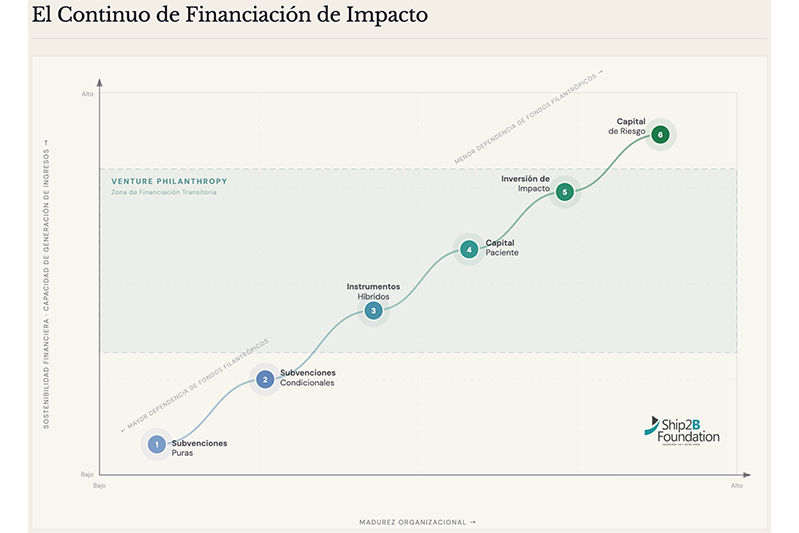
There is a particularly critical area within this continuum: the space that connects philanthropy and investment.
Many organizations find themselves precisely in this position. They have partially validated their model, are generating demonstrable impact, and have growth potential, yet they still need to strengthen internal capabilities, professionalize their management, improve measurement systems, or consolidate their operating model.
These organizations no longer fit entirely within the framework of traditional philanthropy, but they are not yet prepared to meet the demands of investors. It is precisely within this space that we find one of the greatest challenges—and, at the same time, one of the greatest opportunities—for the impact ecosystem.
The Role of Venture Philanthropy
It is within this space of challenge and opportunity that Venture Philanthropy comes into its own.
It should not be understood as a specific financial instrument or as a standalone category within the market. Rather, it is a financing and support approach designed to help high-impact organizations transition from models that depend on philanthropic funding to more sustainable and scalable models.
Venture Philanthropy does not seek to replace either philanthropy or impact investing. Its role is to connect both worlds and facilitate organizations’ successful progression from one stage to the next.
Its approach is built on four fundamental principles:
This last point is particularly important.
Venture Philanthropy is based on a simple premise: for many organizations, the main barrier to growth is not only a lack of financial resources, but also a lack of organizational capabilities.
For this reason, it combines funding with support in areas such as strategy, governance, impact measurement, organizational development, and talent acquisition.
From Mobilizing More Capital to Allocating It Better
If we accept the existence of a financing continuum, we must also change the way we think about capital allocation for impact.
For years, much of the debate has revolved around a seemingly simple question:
Should we donate or invest?
However, this question is based on a flawed assumption. It assumes that the main challenge is choosing a financial instrument, when in reality the challenge is understanding what each organization needs in order to maximize its ability to generate impact.
The real question should be:
What type of capital does this organization need at this stage of its development?
And, perhaps more importantly:
What does it need in addition to capital to turn its potential into tangible results?
Organizations do not evolve in a linear way. Their needs change as they validate their models, strengthen their teams, build capabilities, and seek to scale their impact.
An organization testing a new solution will likely require flexible philanthropic funding. Another that has already demonstrated results may need strategic support and patient capital. A third, with a proven and sustainable model, may be ready to attract impact investment or even venture capital.
The problem arises when we try to apply the same financial solution to fundamentally different realities.
Too often, we measure success by the volume of resources mobilized toward the impact ecosystem. We celebrate the millions committed, the funds launched, or the growth of sustainable investment. All of this is positive, but it leaves one fundamental question unanswered:
Is the right capital reaching the right organizations at the right time?
Because when the type of financing does not match an organization's stage of development, capital becomes less effective.
Sometimes it slows growth by creating dependency.
Sometimes it imposes premature expectations that divert organizations from their mission.
And sometimes it excludes projects with enormous impact potential simply because they do not yet fit within traditional funding categories.
From this perspective, the greatest challenge facing the impact ecosystem is not simply mobilizing more resources.
The real challenge is designing better financing pathways.
Pathways that enable organizations to access the type of capital they need at every stage of their development and facilitate their transition from models heavily dependent on philanthropic resources toward increasingly sustainable and scalable models.
And it is precisely here that Venture Philanthropy demonstrates its true value.
Not as an alternative to philanthropy or impact investing, but as a mechanism capable of connecting both worlds and supporting organizations throughout that journey.
Looking Ahead
The impact ecosystem has made tremendous progress in recent years. Yet we continue to operate with an overly fragmented view of the financing tools available.
The issue is not choosing between philanthropy and investment; it is understanding the space that exists between them.
Because it is precisely within that space that many organizations with transformative potential will determine their future.
And because building stronger bridges between different forms of capital is one of the keys to multiplying social and environmental impact over the coming decade.
At Ship2B Foundation, we work precisely within this intermediary space. We help organizations, foundations, and investors identify the type of capital and support they need to maximize their capacity to generate impact.
Because the goal is to mobilize the right resources, at the right time, and with the right support.
John Mikel Burgaña, Director, Venture Philanthropy
John Mikel Burgaña works at the intersection of social innovation, impact investing, and Venture Philanthropy, promoting support models that combine financing, strategy, and impact measurement to strengthen purpose-driven organizations.
He currently serves as Director of Venture Philanthropy at Ship2B Foundation, where he leads the Venture Philanthropy area, supporting social enterprises, nonprofit organizations, and funders in the design, consolidation, and scaling of solutions aimed at generating social and environmental impact.
To date, he has supported more than 100 social projects in strengthening their business models and scaling their impact-driven solutions. Throughout his career, he has also advised national and international funders in their analysis and decision-making processes, helping connect capital with high-impact-potential initiatives.
Within this framework, he has facilitated the deployment of more than €1 million in Venture Philanthropy funding.
His expertise combines strategy, financing, organizational support, and impact measurement, with the objective of contributing to a more inclusive, sustainable, and systemically transformative economy.

cloud technology axon
Axon Partners Group, Tresmares Capital, Sabadell Venture Capital, Inve...