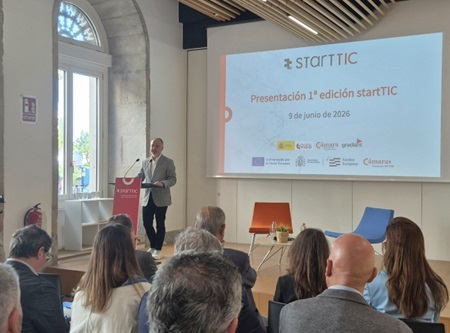
The Vigo Free Trade Zone Auditorium hosted the launch event of startTIC, featuring the presentation of the first edition of its incubation programme aimed at promoting innovative technology projects and supporting their development, validation, and market entry. The event brought together institutional representatives, members of the entrepreneurial ecosystem, companies, startups, and professionals linked to technological innovation.
The High-Technology Incubator is a project led by the Vigo Free Trade Zone Consortium, in partnership with the Chamber of Commerce of Pontevedra, Vigo and Vilagarcía, and Gradiant, under the European initiative “Infrastructure for High-Technology Incubators in Emerging Strategic Sectors.” The project is co-financed at 60% by the European Regional Development Fund (ERDF) under Spain’s 2021–2027 Multi-Regional Operational Programme.
During the event, Rosa Eguizábal, Director of Economic Promotion at the Vigo Free Trade Zone Consortium, presented the objectives and opportunities offered by startTIC, which has been created to strengthen Galicia’s ICT ecosystem, encourage technology transfer, and support entrepreneurs and SMEs developing innovative solutions. This first edition will select 30 projects for an intensive six-month incubation programme, providing participants with personalised mentoring, technological advisory services, training sessions, networking opportunities, and access to advanced infrastructures. Applications will remain open until 6 July through the programme’s website, starttic.com.
The State Delegate for the Vigo Free Trade Zone, David Regades, highlighted the importance of the initiative, stating that “startTIC is a tool to organise, connect, and strengthen the entire ecosystem so that it generates more activity, more companies, and more employment. Vigo and Galicia have an extraordinary foundation to achieve this.” He added that the initiative “is about technology, but it is also about the economy, jobs, talent, collaboration, and the future of the region. It is driven by three partners who share a common belief: technology must serve business growth, knowledge transfer, and the creation of opportunities.”
Regades also stressed that “startTIC forms part of the strategy that the Free Trade Zone has been promoting to strengthen Vigo’s role as a leading technology hub.” He encouraged potential applicants by stating: “If you have a technology project, if you are developing an innovative solution, or if you work in the ICT sector and want to take your development to the next level, this call is for you.”
José García Costas, President of the Chamber of Commerce of Pontevedra, Vigo and Vilagarcía, noted that “this high-technology incubator represents the best launch platform for advancing our ICT sector, as well as other industries where technology can serve as a key cross-cutting driver of growth and competitiveness.” He emphasised that entrepreneurship is increasingly linked to technology sectors and recalled that “digitalisation and technology transfer to SMEs and micro-enterprises are strategic priorities within the Chamber’s roadmap.” This commitment is reflected not only in its participation in startTIC but also in initiatives such as the Digital Hub Net centres in Pontevedra and Vilagarcía.
He explained that “the Chamber’s role within this high-technology incubator will be highly active, focusing on project supervision and mentoring for internationalisation.”
For his part, Gradiant’s General Director, Luis Pérez Freire, stated that “the launch of the first startTIC call is an important step in continuing to consolidate Galicia as a competitive and innovative ICT ecosystem capable of creating and attracting new projects. At Gradiant, we are proud to contribute our extensive experience in technology incubation and transforming knowledge into real-world solutions to help innovative projects grow within the region, attract talent and investment, and contribute to building a benchmark region for ICT entrepreneurship and high-tech company creation.”
The Mayor of Vigo, Abel Caballero, closed the event. He highlighted startTIC as “a key initiative for the entrepreneurial ecosystem and talent attraction,” noting that it will be crucial for the city’s economic development and job creation. He also referred to Vigo’s leadership in the ongoing technological revolution, stating that “new technology-driven startups are the future.”
The event also featured Esteban Vázquez, co-founder and CTO of Alice Biometrics, a Gradiant spin-off, who participated as a success story from Galicia’s technology ecosystem. In a presentation entitled Research, Innovate and Entrepreneur, Vázquez explained that “a deep-tech startup has many distinctive characteristics, but the most important is that before becoming a company, there are many years of research and development. Once you realise that a technology can leave the laboratory and solve a real societal problem, it becomes essential to have business-oriented profiles and a collaborative innovation ecosystem that helps you focus and define the opportunity. That is when you begin transforming knowledge into a product, finding a market, and building a business capable of growing independently.”
startTIC is particularly focused on projects linked to strategic areas such as 5G, cybersecurity, artificial intelligence, defence, advanced communications, and other enabling digital technologies. The incubator is integrated within the VgoTIC Global HUB on López Mora Avenue, the new technology complex promoted by the Vigo Free Trade Zone Consortium. The hub has been conceived as a benchmark space for innovation, entrepreneurship, and collaboration between companies, technology centres, institutions, and entrepreneurial talent.
Information and applications:starttic.com

cloud technology axon
Axon Partners Group, Tresmares Capital, Sabadell Venture Capital, Inve...