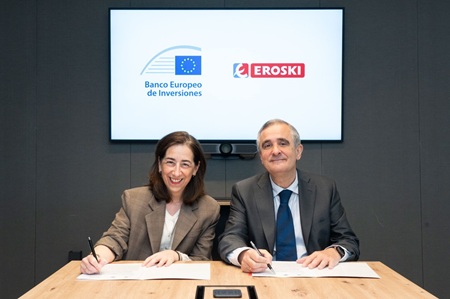
The European Investment Bank (EIB) and Eroski have signed a €40 million framework loan to support the Company in implementing a major investment programme aimed at energy efficiency and digital innovation across its network of stores throughout Spain. The operation will finance projects to reduce energy consumption and greenhouse gas emissions in its stores, platforms, and headquarters, as well as deploy advanced digital technologies that will strengthen the competitiveness of the European retail sector and contribute to job creation during the renovation works.
Investments in energy efficiency will focus on modernising industrial refrigeration systems and heating, ventilation, and air conditioning (HVAC) in approximately 1,500 stores. These measures include transitioning to more sustainable refrigerants and improving energy performance to reduce CO2 emissions. Innovation investments will leverage digital technologies such as artificial intelligence (AI) and data analytics to enhance customer experience, operational efficiency, and cyber resilience.
“The loan signed with Eroski is another example of how the EIB supports the energy transition and digital transformation of a key sector of the economy,” said Pilar Solano, Director of the Corporate Finance Department at the EIB for the EU. “By backing Eroski’s digitalisation and energy efficiency investments in Spain, the EIB is helping reduce dependence on fossil fuels while promoting competitiveness and sustainable growth in the European retail sector.”
“EIB support for this investment programme is part of Eroski’s financing process carried out in November 2025. Its formalisation does not change the terms of this already announced financing process. The EIB’s participation has been developed in parallel over recent months and is consistent with the trust built in Eroski Group’s performance and cooperative model. This backing adds to that of local, national, and international financial institutions, enhancing the institutional credibility of the project and its alignment with European standards in sustainability, innovation, and long-term vision,” said Josu Mugarra Urrutia, CFO of Eroski Group.
“Beyond its fit within the financial framework, this operation directly contributes to our strategic priorities, particularly regarding efficiency and technological innovation. The investments we are driving allow us to optimise our network operations, reduce energy consumption, and simultaneously continue improving our value proposition to customers by adapting more agilely and accurately to their needs,” Mugarra concluded.
The project makes a significant contribution to the EIB Group’s strategic priorities of climate action and digitalisation and technological innovation, as set out in the Group’s Strategic Roadmap for 2024–2027 and the EIB Climate Bank Roadmap Phase 2 (2026–2030). The loan is part of the TechEU initiative, the EIB Group programme aimed at accelerating innovation in the EU by mobilising €250 billion in investments for startups, scale-ups, and innovative companies across Europe by 2027. It also forms part of the EIB’s action plan to support REPowerEU, the programme to strengthen energy security and reduce the EU’s reliance on fossil fuel imports. The operation is backed by InvestEU, the EU programme designed to mobilise over €372 billion in additional investments between 2021 and 2027.
The European Investment Bank (EIB) Group is the financial arm of the European Union, owned by the 27 EU Member States, and is one of the largest multilateral development banks in the world. In 2025, the EIB Group signed €100 billion in new financing and advisory services for over 870 high-impact projects across eight core priorities contributing to the EU’s strategic objectives: climate and environmental action, digitalisation and technological innovation, security and defence, territorial cohesion, agriculture and the bioeconomy, social infrastructure, strong global partnerships, and the Union of Savings and Investments.
Beyond long-term loans for major infrastructure, the EIB Group attracts private investment for high-risk innovative companies and projects, playing an increasingly important role in the European venture debt, private equity, guarantees, and securitisation markets. In Spain, the EIB Group carried out financing and investment operations worth approximately €11 billion, plus an additional €2.9 billion from the Regional Resilience Fund (Next Generation EU loans) in 2025.
The European Investment Fund (EIF), a subsidiary of the EIB Group, specialises in providing guarantees and equity to improve access to finance for small and medium-sized enterprises and startups across Europe. As an anchor investor, the EIF mobilises private investment and strengthens the venture capital ecosystem to support innovative European entrepreneurs through its extensive network of partner banks and investment funds.
In 2023, the EIF, together with six Member States (France, Germany, Italy, Spain, Belgium, and the Netherlands), launched the European Tech Champions initiative, a fund-of-funds designed to scale innovative startups. This initiative has already enabled the creation of 14 European mega venture capital funds and the expansion of 40 companies, including 11 unicorns (entities valued at over €1 billion).
The InvestEU programme provides the EU with long-term financing by mobilising a significant volume of private and public funds to support sustainable recovery. It also attracts private investment to advance the EU’s strategic priorities, such as the European Green Deal and digital transition. InvestEU brings together all the EU financial instruments previously available to support investment in Member States, making investment project financing in Europe simpler, more efficient, and flexible. The programme consists of three components: the InvestEU Fund, the InvestEU Advisory Hub, and the InvestEU Portal.
The InvestEU Fund is implemented through financial partners that invest in projects using the EU budget guarantee of €26.2 billion. The full budget guarantee supports the investment projects of implementing partners, increases their risk-taking capacity, and aims to mobilise at least €372 billion in additional investment.

cloud technology axon

The Fund will invest alongside leading private equity managers in busi...