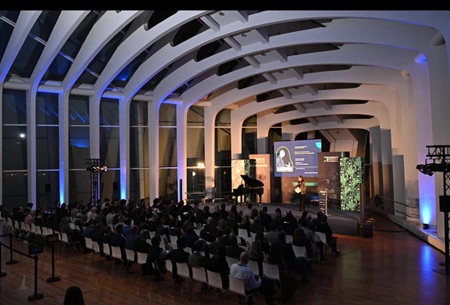
On 26 and 27 November, one of the most anticipated events of the year for the investment ecosystem took place: the BIGBAN Investors Congress. In its eleventh edition, the event—focused especially on the future of investment and technologies such as AI and deeptech—featured the presence and participation of leading investment and entrepreneurship figures including Hansi Hasmann, José Martín Cabiedes, Carolina Rodríguez, Sonia Fernández, François Derbaix, and Paloma Cañete, among other prominent names.
“In this eleventh edition of the BIGBAN Investors Congress, we have consolidated our role as a meeting point for the key players in startup and early-stage investment in Spain. This year we brought together more than 250 investors onsite, as well as over one hundred professionals who followed the panels via livestream. The profile of attendees clearly reflects the maturity of the ecosystem: investors and investment agents with long trajectories and strong expertise, who come to this congress to generate real opportunities for investment and collaboration,” stated Alberto Andujar, Director of BIGBAN Investors Spain.
The congress opened with the Private Investment Night, presented by Alicia Suárez Hulton as Master of Ceremonies, and an inaugural address by Pedro de Álava, President of BIGBAN Investors Spain. He highlighted that “AI accounts for nearly 40% of deal value in Europe, while traditionally strong sectors such as Fintech or Life Sciences show signs of slowing.” He stressed that “in an environment where founders are raising valuations and large funds are imposing their terms, the individual Business Angel loses strength. Believing solely in the isolated ‘opportunity’ is a mistake in today’s context. The market has evolved from opportunistic to specialized and technocratic.”
As leading representatives of private investment in the country, this edition’s main objective was to update the market’s overall outlook through the perspectives of the principal business angels, entrepreneurs, family offices, corporates, and venture capital funds in the ecosystem. The focus was also placed on the technologies and sectors driving dealflow—most notably AI and deeptech.
To provide context, with insights from Jesús Martínez—one of the sector’s top experts and founder of Ecotechers—seed-stage rounds hold significant weight in Spain. This year, 155 transactions above €2 million have been recorded, and more than 70 of them, according to the President of BIGBAN Investors Spain, are related to AI. He also noted that the share of AI in capital deployed remains higher in the U.S., where $8.5 out of every $10 goes to AI, whereas in Spain the ratio is 4 out of 10—an expected difference considering the impact of big tech players such as OpenAI or Anthropic in the U.S. market.
Martínez also highlighted that “major Spanish venture capital firms are well-funded and have strengthened their positions in recent years,” and that there is a growing influx of public investment expected to increase further, with public investors “significantly increasing indirect bets on funds (and startups) through institutions such as Fond-ICO, Global, Next Tech, Enisa, CDTI, or SETT.”
The event featured participation from institutional leaders and key sponsors in the entrepreneurship sector, including Leonor Rodríguez, Head of the Investment and Internationalization Office of the Valencia City Council; Carolina Rodríguez, CEO of ENISA; Enrique Montes, Director-General of IVF; and Felipe Pulido, Regional Director of Corporate Banking at CaixaBank.
Tom Horsey, one of the most relevant figures in the entrepreneurial landscape and First Vice President of BIGBAN Investors Spain, emphasized: “It is a huge success to have so many investors here working together, sharing contacts and knowledge. This is the foundation of BIGBAN: the more we share and connect, the better the ecosystem becomes. This is the vision of the new Board.”
During his speech, Hansi Hansmann (Chairman of The Hans(wo)men Group) issued a call that resonated with the entire room: “Europe desperately needs innovation, and this is why we need all the startups in the world; we already have the money. But this can only work if private capital is incentivized.”
Following the theme of the congress and deepening the analysis of the business angel role, a roundtable was held focusing on How to Go from Hype to Help, exploring the current reality.
One of the points generating the most consensus came from Jordi Rivera, who explained that “more and more funds are moving into pre-seed rounds, which pushes valuations up—and this is something we as business angels must address because we are competing with different conditions and shareholder agreements that change.” François Derbaix (Bewater and Indexa) added another issue: “We tend to think we can help with more things than we actually can. I always expect the founding team to know more about their business than I do. When it comes to investment matters, we may know more about rounds, co-investors, and exits, which the entrepreneur may not have experienced yet. I try not to get involved unless asked, because otherwise you end up being in the way.” Ultimately, Rivera, Derbaix, and Rubén Calvo (SeedRocket) all agreed that one thing a business angel should never do is join the Board of Directors—although they should reserve the right to appoint a board member as minority shareholders. “A startup cannot afford the liability you take on as a board member,” Rivera concluded.
This was perhaps the most intense debate of the congress, featuring José Antonio González (investor and partner at Deloitte), Paloma Cañete (Fides Capital), Paloma Castellano (Wayra), and Aquilino Peña (Kibo Ventures). The diverse perspectives were welcomed. While González expressed a more pessimistic view of Europe and Spain’s place in the global ecosystem, stating, “We have a future, but we are moving too slowly; I cannot give us a passing grade—otherwise, we won’t improve. If we continue like this, Europe will be left behind,” the other panelists were more optimistic, while still critical. Cañete noted, “The bureaucracy and barriers for small companies and foreign investors slow everything down. We won’t be able to create the large companies that exist in the U.S. this way.”
Castellano, however, underlined that “we are stepping up—there is strong momentum from corporations and public institutions to build technological sovereignty.” Peña added, “From a macro perspective, Europe is quite behind because we haven't been able to overcome structural and regulatory limitations… I’m more negative about the past, but positive about the future. And I see Spain above average—we’re in a very good moment. Our job is to think micro: to find 20 great companies in the next five years.”
Peña then concluded—leading directly into the next topic—that “where we are truly struggling is in exits. Of the 25 companies I’ve sold, only one was acquired by a European buyer; the rest were North American, Australian, or Chinese. We lack local corporates that acquire companies.”
Picking up the thread were Diego Recondo (Acurio Venture), Ramón Blanco (Bewater), and Mercé Tell (Encomenda). The key message was clear, summed up by Blanco: “the liquidity problem is huge—enormous and disproportionate. We are in the least liquid period of the last ten years globally.” Recondo illustrated this with a stark example: “If we look at VC funds from 2011–2017, only 40% of them have returned their initial capital to date.”
Panelists discussed various solutions to the lack of liquidity, including secondary funds—able to create liquidity outside public markets—and mono-investment funds, where investors can sell stakes to one another.
With Carlota Mateos (Ancla) and Sonia Fernández (Kibo Ventures), the congress dedicated one of its talks to The Invisible Risk: Burnout. Mateos explained that Ancla was created by entrepreneurs who had largely faced mental-health challenges linked to their professional activity: “72% of high-impact entrepreneurs have experienced mental-health issues such as chronic stress, burnout, anxiety, depression, or panic attacks; yet only 23% seek professional help.” Fatigue, trouble sleeping, and difficulty performing daily activities are clear symptoms of such issues. “82% of entrepreneurs experience them—it could almost be considered a pandemic.”
Ancla’s approach focuses on prevention, preparing entrepreneurs for the scenarios they will face, strengthening resilience, and providing tools to navigate inevitable challenges. Fernández added, “If we as investors don’t care about this personal dimension, who will?” Mateos also pointed out that “90% of entrepreneurs do not see investors as trusted people with whom they can share these issues.”
Led by Javier Ulecia (Bullnet Capital), Rocío Pillado (Adara Ventures), Yolanda Diaz (Idea B3 Hubs), and Fernando Jiménez (Gradiant), this was perhaps the most technology-focused panel, offering a broad view of a future in which AI will have a prominent role but deeptech will also be crucial. Deeptech is driving advances in biotechnology, new materials, energy, and quantum computing, among others, creating opportunities across fields ranging from biotech to defence.

cloud technology axon

The fund’s strategy will focus exclusively on retail assets located ...