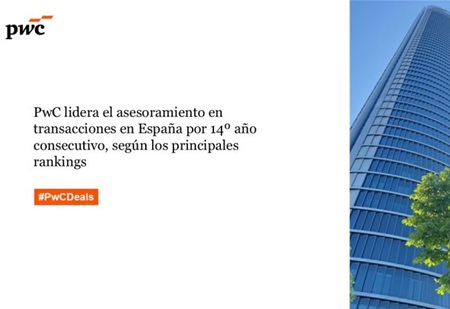
PwC has once again led the financial advisory market for Mergers and Acquisitions (M&A) in Spain in 2025, for the fourteenth consecutive year, by number of transactions. This is confirmed by the leading annual rankings compiled by LSEG (formerly Refinitiv), Mergermarket, Dealogic and Bloomberg.
According to LSEG (formerly Refinitiv), PwC advised on a total of 134 transactions, ranking ahead of EY (76), Deloitte (65), Alantra (29), KPMG (27), Baker Tilly (22), Santander Corporate & Investment Banking (21), Rothschild (20), BDO (20), JP Morgan (18) and Norgestion (18). In the value ranking, PwC remains among the top six advisors, with an aggregate deal value of €12.679 billion.
The Mergermarket ranking also confirms PwC’s leadership, with a total of 117 transactions advised, followed by EY with 66, Deloitte with 57, Alantra with 39, KPMG with 29, JP Morgan and BDO with 24 each, Santander Corporate & Investment Banking with 23, BNP Paribas with 20 and Goldman Sachs with 18.
The Dealogic ranking also lists PwC as the most active financial advisor in the transaction market, having advised on a total of 80 transactions, compared to 38 for EY, 24 for Deloitte, 23 for JP Morgan, 22 for Santander Corporate & Investment Banking, 18 for Alantra, and 17 for BNP Paribas and KPMG.
The Bloomberg ranking also places PwC as the leader with 108 transactions, followed by EY (40), BNP Paribas (19), JP Morgan (17), Alantra (17), Santander Corporate & Investment Banking (16) and Goldman Sachs (15).
PwC has not only led the domestic transaction advisory market, but also the global one, according to data from the main rankings.
The Spanish transaction market in 2025
In 2025, the Spanish transaction market recorded 1,885 deals with an aggregate value of €74.648 billion, according to LSEG. Compared to 2024, the number of deals fell by 6%, while total value increased by 42%, reflecting the weight of larger transactions, especially in the second half of the year. This trend points to a year marked by investor selectivity and a recovery in the latter half, with larger deals boosting total value after a weaker first half.
According to Carlos Fernández Landa, Partner and Head of Deals at PwC Spain, “2025 has made it clear that volatility is no longer a temporary phenomenon, but rather an integral part of the Spanish transaction market, confirming that we are facing a more selective M&A environment. Factors such as geopolitical instability, demographic challenges and technological disruption have made investors more selective and sophisticated.” He adds: “Sectors such as defence, infrastructure, healthcare and the energy transition are leading capital attraction, while digitalisation and artificial intelligence are redefining the strategic agenda of transactions. The middle-market segment remains key, with build-up strategies and secondary transactions at the forefront. The gradual normalisation of interest rates, the still incipient stabilisation of price expectations and greater visibility on earnings have unlocked some processes that had previously been on hold.”
In this context, PwC has advised on numerous transactions across all relevant sectors, working with both corporate groups and private equity investors. Fernández Landa adds that “from PwC’s perspective, the overall balance is positive: more mandates closed, higher pipeline conversion and better-quality opportunities, with more contained execution timelines, albeit with continued discipline on pricing and leverage. In addition, we are seeing more well-structured and focused bilateral processes, where asset quality and the credibility of the value creation plan make the difference. Overall, we see the market regaining a certain level of confidence, while remaining cautious given the macroeconomic backdrop and the possibility of further geopolitical shifts. Examples of relevant transactions advised by PwC include advising Grenergy on the sale of its two largest renewable project portfolios to CVC-DIF and ContourGlobal (KKR); advising Iberdrola on the divestment of its Hungarian business to Premier Energy and on the sale of its gas plants for slurry treatment to Edison Next. PwC has also advised Antolín on the sale of its business in India to Shriam Pistons & Rings Ltd, as well as on the sale of part of its lighting business in Germany and the UK to the Japanese group Oshino Lamps; Trilantic on the sale of a 29.9% stake in Talgo; StepStone on the acquisition of Vitalia Home; Aludec on the sale of its business to CIE Automotive; and Grant Thornton Spain on its integration into the global professional services platform created by New Mountain Capital.”
Outlook for the Spanish M&A market in 2026
Looking ahead to 2026, M&A activity is expected to remain an essential lever to accelerate growth and corporate transformation. Companies that design value-driven M&A strategies and anticipate trends will be better positioned to seize opportunities in a dynamic environment. An increase in transactions is expected in strategic sectors such as defence and dual-use industry, energy transition, technology and data, and healthcare, alongside greater middle-market activity, where more creative deal structures and consolidation processes will be common. Pressure to rotate portfolios, available liquidity and improving financial conditions will act as important catalysts. In addition, technological transformation and digitalisation will continue to be key drivers, with artificial intelligence, cybersecurity and advanced analytics at the centre of corporate decision-making. Sustainability requirements will also gain further importance, consolidating their role as a critical criterion in deal valuation and structuring.
In the words of Carlos Fernández Landa, Partner and Head of Deals at PwC Spain: “In 2026, the key will be to anticipate and move quickly. Companies that know how to combine resilience and ambition, with clear plans to integrate technology, talent and sustainability, will be the ones to lead the next wave of growth. Uncertainty is not going away, but it is becoming the stable framework for decision-making. This will be the year for those who turn complexity into a competitive advantage.”

cloud technology axon
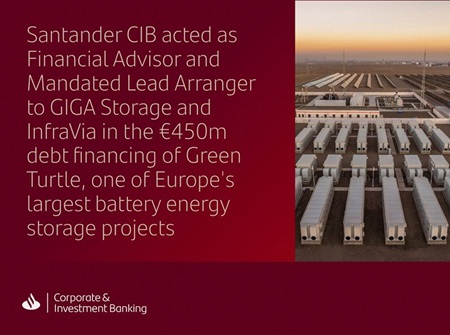
Santander Corporate & Investment Banking has acted as Financial Adviso...